Bidspirit auction | [INCUNABULA] - BONIFACIUS VIII, Pope (Benedetto
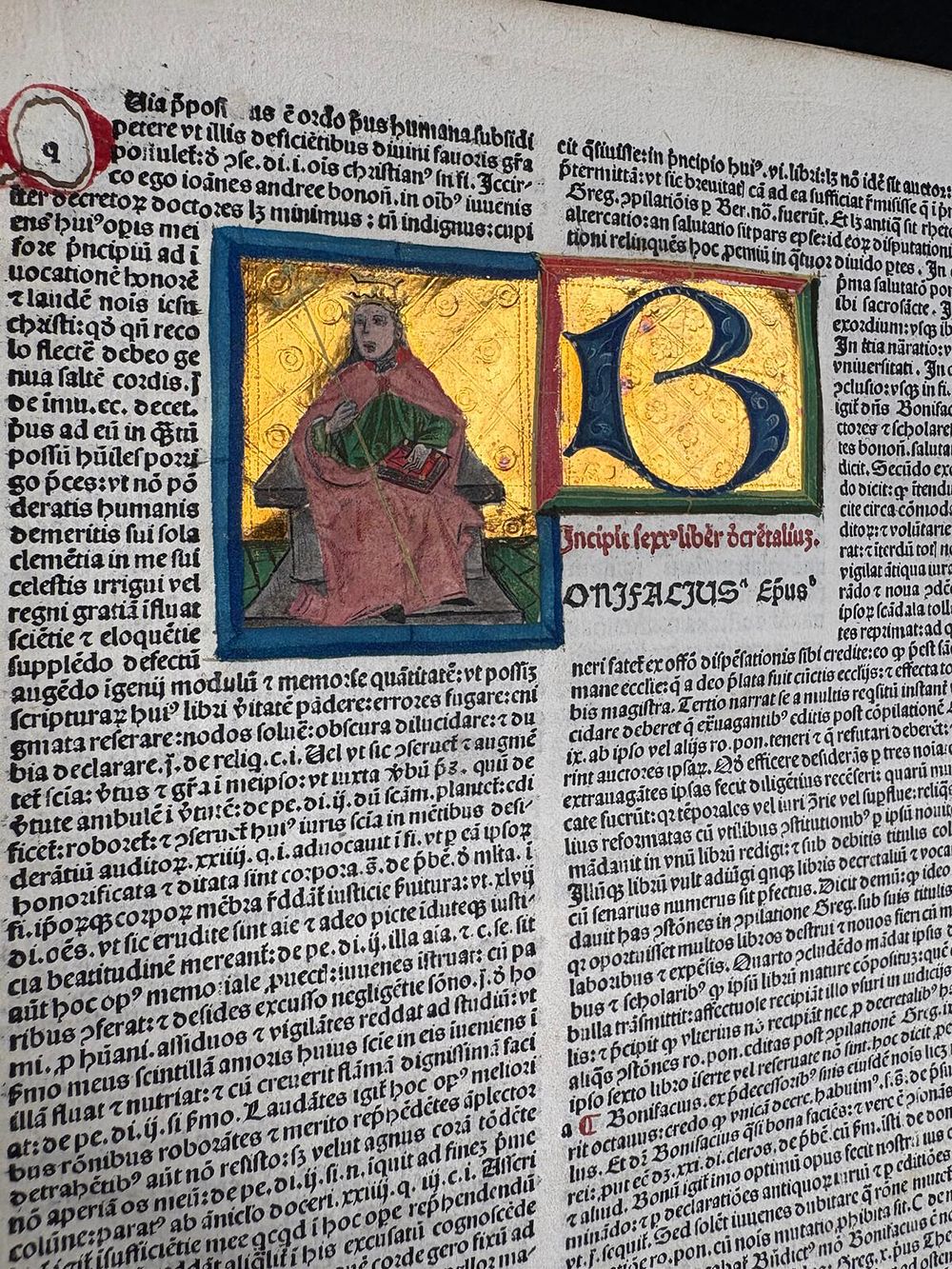
[INCUNABULA] - BONIFACIUS VIII, Pope (Benedetto Gaetano, c.1235–1303) - Liber sextus Decretalium - BONIFACIUS VIII, Pope (Benedetto Gaetano, c.1235–1303). Liber sextus Decretalium. With the commentary of Johannes Andreae. — ANDREAE, Johannes (c.1270–1348). Super arboribus consanguinitatis et affinitatis. Venice: Andreas Torresanus de Asula, Bartholomaeus de Blavis de Alexandria and Mapheus de Paterbonis, 26 September 1482. A SUPERBLY ILLUMINATED VENETIAN INCUNABLE OF ONE OF THE FUNDAMENTAL TEXTS OF MEDIEVAL CANON LAW, DISTINGUISHED BY AN EXCEPTIONAL CONTEMPORARY HISTORIATED INITIAL WITH THE PORTRAIT OF POPE BONIFACE VIII ON A RICHLY WORKED GOLD GROUND. Super-median quarto (243 × 175 mm). 146 leaves. Gothic type, the text and commentary printed in red and black. Magnificent large historiated initial B incorporating a finely painted portrait of Pope Boniface VIII, executed in colours against an embossed gold ground; numerous smaller initials throughout supplied in alternating red and blue, several further enriched with delicate pen-flourishing in red or brown. Modern blue morocco, lightly scuffed. Scattered worming at beginning and end, occasionally touching the text, and some dampstaining; nevertheless a handsome and highly attractive copy, its exceptional illuminated decoration remaining the outstanding feature of the volume. THE ILLUMINATION The artistic importance of the present copy lies above all in its exceptionally accomplished contemporary illumination. The opening of the text is dominated by the great historiated initial B, within which appears the portrait of Pope Boniface VIII, the compiler and promulgator of the Liber Sextus. The miniature is set against a richly embossed gold ground, giving the initial a luminosity and material splendour strikingly reminiscent of the finest late-fifteenth-century manuscript illumination. Far from being merely rubrication added for practical purposes, the initial constitutes a genuine miniature painting conceived to monumentalise the opening of the text. The delicacy of the painted figure, the careful handling of colour and the brilliance and texture of the gold transform the printed page into an object that deliberately recalls the prestige of a luxury manuscript. Its quality is particularly noteworthy in the context of early Venetian printing. During the incunable period, printed books were frequently issued with spaces deliberately left for illumination, allowing individual purchasers to commission decoration according to taste and means. Copies furnished with illumination of this refinement therefore possess an individuality absent from ordinary examples of the edition: no two were necessarily decorated in precisely the same manner. The smaller red and blue initials, together with occasional flourished decoration, continue this interplay between typography and manuscript artistry throughout the volume. The result is an exceptionally attractive example of the transitional culture of the fifteenth-century book, in which the revolutionary technology of printing and the centuries-old art of the illuminator coexist on the same page. THE TEXT Promulgated by Pope Boniface VIII in 1298, the Liber Sextus Decretalium was conceived as the official supplement to the five books of Gregory IX’s Decretales. It gathered and systematised the canon law enacted after Gregory IX and became an integral component of the Corpus iuris canonici, remaining authoritative for centuries. The edition contains the celebrated commentary of Johannes Andreae, one of the foremost canonists of the later Middle Ages, whose gloss became inseparable from the textual transmission of the Liber Sextus. The complex typographical arrangement, with the principal text surrounded by commentary, deliberately perpetuates the visual structure developed in medieval legal manuscripts. This is therefore a particularly revealing object in the history of the book: medieval legal scholarship expressed through the new medium of print, yet still visually enriched by the hand of a highly accomplished illuminator. THE PRINTING The volume was produced by the important Venetian partnership of Andreas Torresanus de Asula, Bartholomaeus de Blavis and Mapheus de Paterbonis. The Gothic types used by Torresanus during this early phase of his career derived from the celebrated Jenson/Colonia printing concern. Torresanus was subsequently to become one of the central figures of Venetian printing: he became the father-in-law and business partner of Aldus Manutius, and later played a major role in the continuation of the Aldine press. PROVENANCE Occasional early manuscript annotations. Inscription: “Ecclesiae decanalis [Utrecht?]”. Acquired from Lathrop C. Harper, Inc., New York, 20 May 1955. The volume was subsequently in the celebrated Collection of Elaine and Alexandre Rosenberg. AN EXCEPTIONALLY ATTRACTIVE ILLUMINATED INCUNABLE,