Bidspirit auction | [INCUNABULA] - PSEUDO-BONAVENTURE [traditionally attributed to
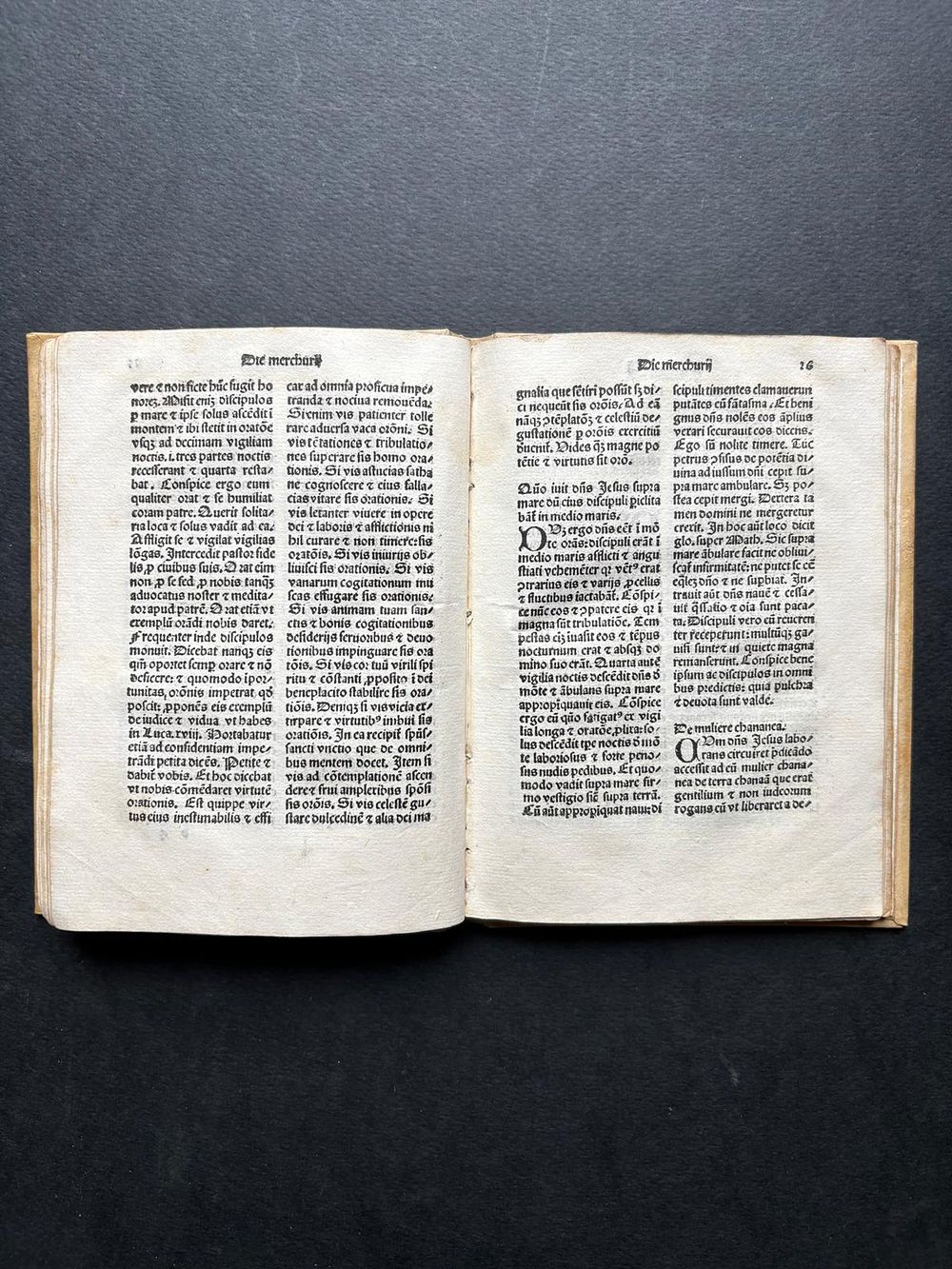
[INCUNABULA] - PSEUDO-BONAVENTURE [traditionally attributed to Saint Bonaventure (1221–1274)] - Meditationes vitae Christi - PSEUDO-BONAVENTURE [traditionally attributed to Saint Bonaventure (1221–1274)]. Meditationes vitae Christi. With: BONAVENTURE, Lignum vitae (extract); and JOHN PECKHAM, Canticum de sanctissimo nomine Jesu Christi. Pavia: [Franciscus Girardengus and Johannes Antonius Birreta, for] Jacobus de Paucis Drapis Burgofrancho, 4 March 1490. 8vo. Gothic type, printed in two columns. The edition collates a–g⁸ h¹⁰, 66 leaves, the first and last blanks; in the present copy the first blank is wanting, the text itself complete. A fresh, wide-margined copy, with the gatherings slightly loose. Twentieth-century full vellum, gilt armorial device to upper cover. AN EXCEPTIONALLY SCARCE PAVIA INCUNABLE OF ONE OF THE MOST INFLUENTIAL DEVOTIONAL TEXTS OF THE LATER MIDDLE AGES — THE CELEBRATED MEDITATIONES VITAE CHRISTI, A WORK OF EXTRAORDINARY IMPORTANCE FOR THE DEVELOPMENT OF AFFECTIVE DEVOTION, FRANCISCAN SPIRITUALITY, LITERATURE AND THE VISUAL IMAGINATION OF THE LIFE AND PASSION OF CHRIST. Long transmitted under the name of Saint Bonaventure, the great Franciscan theologian, cardinal and Doctor of the Church, the Meditationes vitae Christi is now generally catalogued as the work of Pseudo-Bonaventure. Its precise authorship remains one of the most intriguing unresolved questions of medieval devotional literature. The work has frequently been associated with a Franciscan known as Johannes de Caulibus, although modern scholarship has reopened the question of its authorship, date and even the language in which it was originally composed. Whatever its authorship, few devotional books exercised a comparable influence on the religious imagination of late medieval Europe. The Meditationes does not merely recount the Gospel narrative. It invites the reader to enter imaginatively into the life of Christ, reconstructing sacred events in the mind with an extraordinary wealth of intimate, emotional and often vividly visual detail. The reader is encouraged to contemplate Christ, the Virgin and the Apostles almost as if physically present: to observe their gestures, imagine their emotions, share their grief and participate spiritually in the events of Christ’s infancy, ministry and Passion. In this transformation of Scripture into an intensely personal experience lies the work’s exceptional historical importance. The Meditationes became one of the great vehicles of affective spirituality, in which compassion, visualization and emotional identification with the humanity and suffering of Christ assumed a central role in devotional practice. Its success was enormous. The text circulated throughout Europe in hundreds of manuscripts and in numerous Latin and vernacular adaptations, becoming what modern scholarship has described as one of the most influential Franciscan devotional works of the Middle Ages. Its impact extended far beyond monastic reading: it profoundly affected preaching, vernacular religious literature, devotional practice, Passion narratives and the development of European religious drama. Its relationship with the visual arts is especially significant. By encouraging the faithful to construct detailed mental images of episodes from Christ’s life, the Meditationes participated in the same culture of visualization that transformed sacred imagery during the later Middle Ages. Scholars have long examined its relationship with the increasingly intimate and emotionally charged representations of the Nativity, the Virgin and Child, the Crucifixion, the Lamentation and other episodes of the Passion that became characteristic of Trecento and Quattrocento art. The work therefore stands at a remarkable intersection between text, image and devotion: it is not simply a theological or religious treatise, but one of the texts through which the late medieval Christian imagination learned to visualize sacred history. The present edition is an important witness to the transition of this extraordinarily successful medieval text from manuscript culture into print. Printed at Pavia on 4 March 1490, it belongs to the first generation of printed editions of the Meditationes vitae Christi. The edition was produced in the Pavia printing milieu of Franciscus Girardengus and Johannes Antonius Birreta, for Jacobus de Paucis Drapis, called Burgofrancho, whose name appears in the colophon as the financier of the edition. Its compact octavo format and dense Gothic typography preserve something of the character of the small devotional manuscript: this was a book intended not primarily for public liturgical display, but for close and repeated personal reading. The volume has an additional importance that is frequently overlooked in abbreviated descriptions of this edition. The Meditationes are followed by an extract from the Lignum vitae, an authentic work of Saint Bonaventure,