Bidspirit auction | [INCUNABULA] - CLAUDIANUS, Claudius (c.
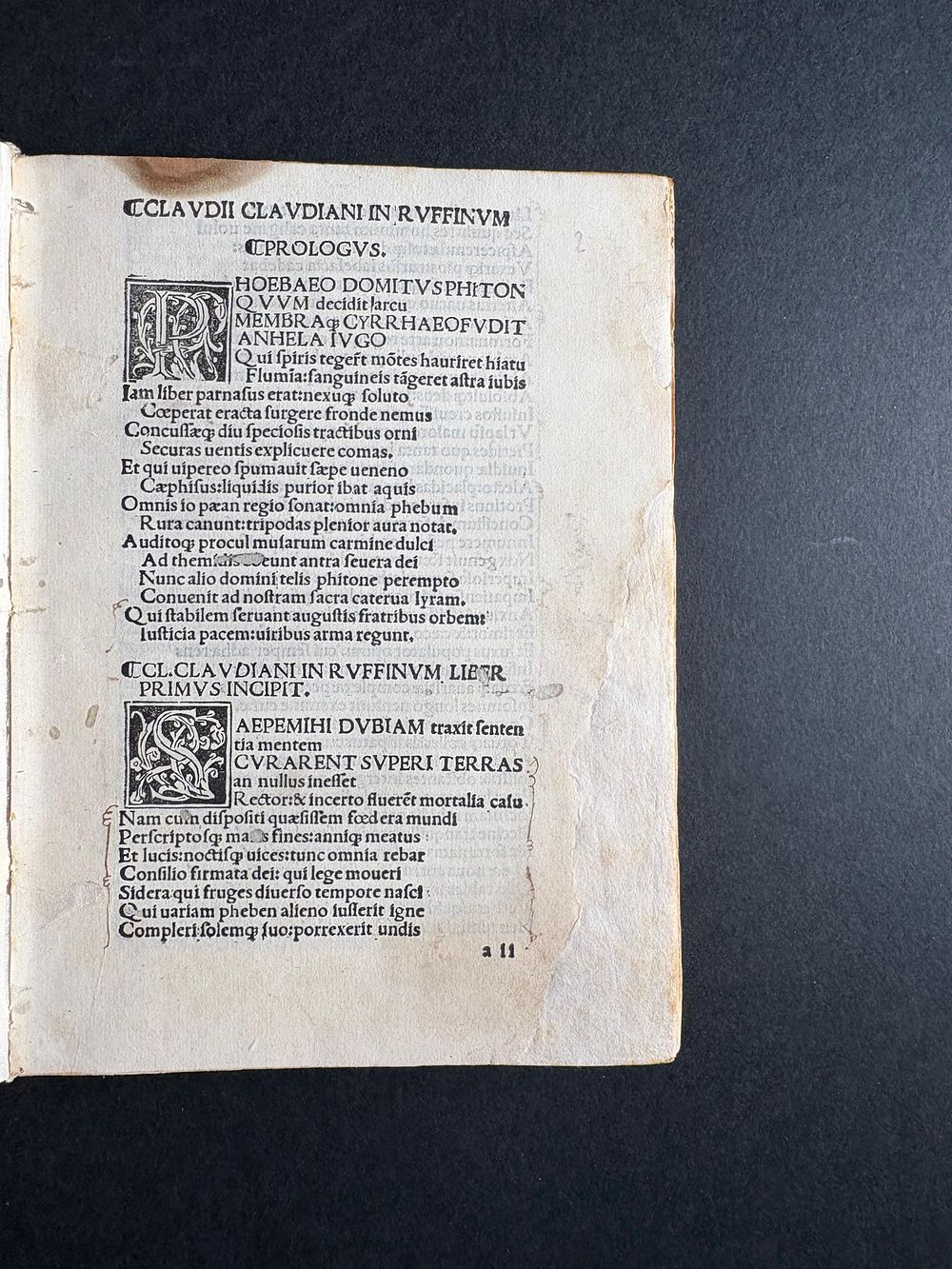
[INCUNABULA] - CLAUDIANUS, Claudius (c. 370–c. 404) - Claudiani Opera - CLAUDIANUS, Claudius (c. 370–c. 404). Opera. Diligenter emendata per Thaddaeum Ugoletum Parmensem. Venice: Johannes Tacuinus de Tridino, 6 June 1495. 4to (195 × 143 mm). [128] leaves. Roman type, 40 lines to a page, with woodcut initials and large woodcut printer’s device at the end. All leaves professionally restored; the final leaves with traces of worming. Disbound from its contemporary limp vellum binding, preserved separately; manuscript title to spine referring to another work. Second edition of the collected works of Claudian, following the first edition of 1493, edited by the Italian humanist Taddeo Ugoleto. An important Venetian incunable of one of the last great poets of classical Latin literature, preserving the works of Claudius Claudianus in the humanist recension of Taddeo Ugoleto. Born probably in Alexandria in the later fourth century, Claudian established himself at the imperial court in the West and became closely associated with the emperor Honorius and, above all, with the powerful general Stilicho. His poetry stands at the very end of the classical Latin tradition and at the threshold of the medieval world. Claudian’s surviving works are remarkable for the breadth of their subject matter. His political poems celebrate imperial victories, consulships and dynastic events, while his invectives against Rufinus and Eutropius combine court propaganda with extraordinary rhetorical force. Alongside these historical works stand mythological and occasional poems, most famously the unfinished De raptu Proserpinae, his celebrated retelling of the abduction of Proserpine by Pluto. The present edition contains the principal works traditionally associated with Claudian, including the panegyrics, In Rufinum, In Eutropium, De bello Gildonico, De bello Gothico, De consulatu Stilichonis, the Epithalamium for Honorius and Maria, the Carmina minora and the De raptu Proserpinae. Claudian’s position in literary history is exceptional. Writing in an age of political crisis and religious transformation, he deliberately adopted the language, metre and mythological vocabulary of the great poets of Augustan Rome. His verse became one of the principal vehicles through which the classical epic and panegyrical tradition survived into late antiquity. The edition was prepared by Taddeo Ugoleto, or Thaddaeus Ugoletus, the distinguished Parma humanist and scholar associated with the court of the Gonzaga and later with the circle of Aldus Manutius. His editorial work on Latin authors belongs to the great humanist effort to recover, correct and stabilize the texts of classical antiquity through the comparison of manuscript sources. Printed by Johannes Tacuinus, one of the important Venetian printers active at the turn of the sixteenth century, the present edition belongs to the formative period in which Venice became the principal European centre for the printing and dissemination of classical texts. The large woodcut device at the end and the clear Roman typography are characteristic of Tacuino’s production and give the volume the restrained elegance of early Venetian humanist printing. Owing to the extensive restoration of all leaves, the worming affecting the final gatherings and the fact that the volume is presently disbound from its contemporary vellum binding, the present example should be regarded as a study copy. Despite its poor state of preservation, it remains textually complete and bibliographically important as one of the earliest printed editions of Claudian. A rare Venetian incunable of one of the last major poets of classical antiquity, notable as the second edition of Claudian’s works and for the influential humanist recension of Taddeo Ugoleto; a study copy, offered primarily for its textual and bibliographical importance. References: ISTC ic00703000; Goff C703; H 5372; IGI 3005; BMC V, 529; GW 7061.