Bidspirit auction | [ALCHEMY, MAGIC & ESOTERICA] -
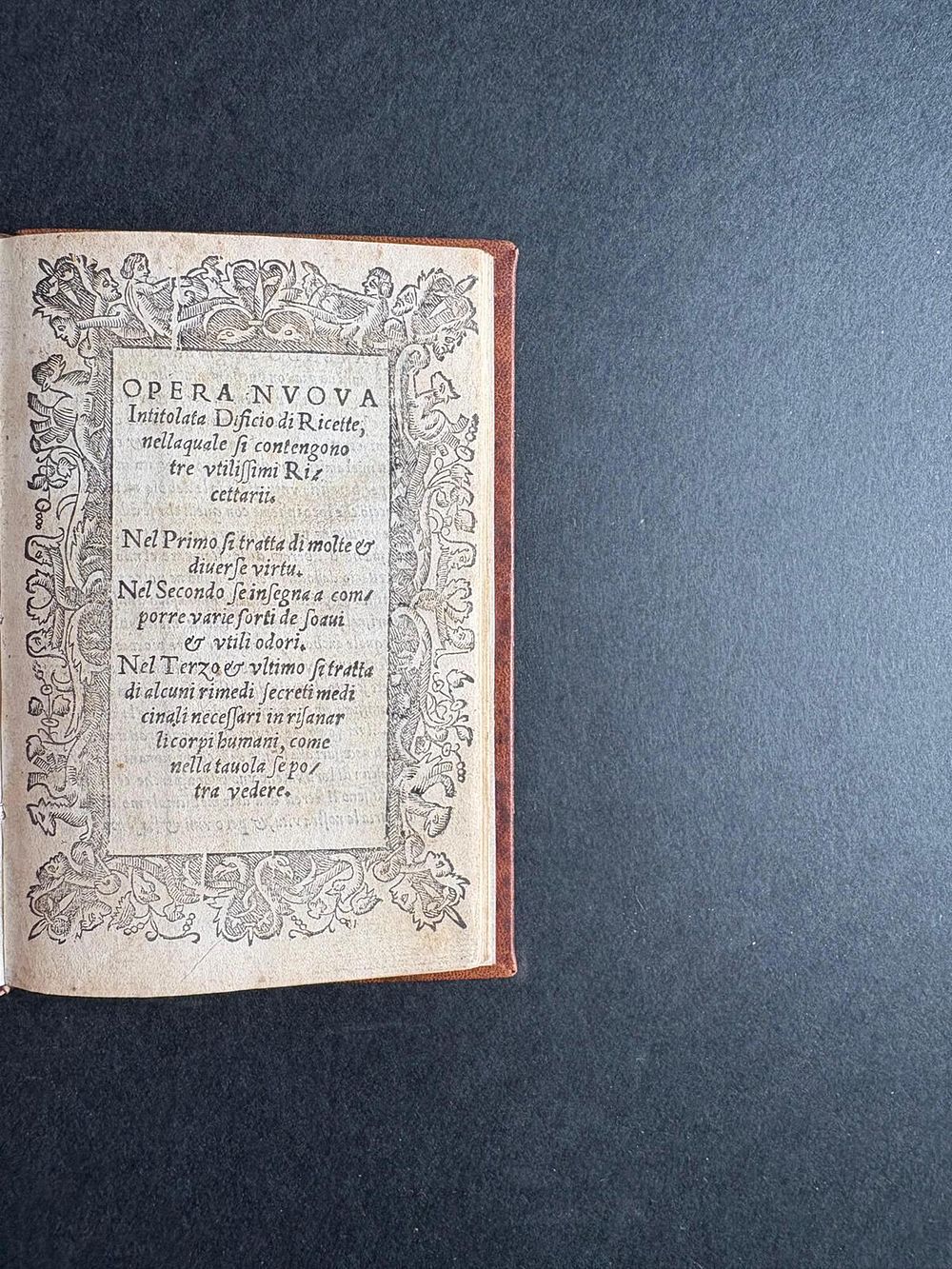
[ALCHEMY, MAGIC & ESOTERICA] - - Opera nuova intitolata Dificio di ricette - Opera nuova intitolata Dificio di ricette, nella quale si contengono tre utilissimi recettarii. Nel primo si tratta di molte & diverse virtù. Nel secondo se insegna a comporre varie sorti de soavi et utili odori. Nel terzo & ultimo si tratta di alcuni rimedi secreti medicinali necessari in risanar li corpi humani. Venice: Francesco Bindoni and Maffeo Pasini, 1533. 8vo (145 × 95 mm). 31, [1] leaves. Title-page within an elaborate figured woodcut border. Some occasional staining; a few skilful restorations to the inner margins of several leaves. Modern leather, title gilt on upper cover. AN EXCEPTIONALLY RARE EARLY EDITION OF ONE OF THE SEMINAL ITALIAN “BOOKS OF SECRETS” OF THE RENAISSANCE — A REMARKABLE VERNACULAR COMPENDIUM OF PRACTICAL KNOWLEDGE, PERFUMERY, COSMETICS AND POPULAR MEDICINE. First published anonymously at Venice in 1525, the Dificio di ricette occupies an important position in the emergence of the printed “book of secrets”, a genre which sought to collect and disseminate practical knowledge traditionally transmitted through workshops, households, apothecaries and manuscript recipe collections. The work proved extraordinarily successful. Its practical and immediately accessible character led to numerous Italian editions and eventually to translations and adaptations in other European languages, notably French and Dutch, making the Dificio an important vehicle for the circulation of practical and medicinal knowledge in early modern Europe. The anonymous compiler presents the book as the fruit of years spent collecting and comparing “ricette esperimentate”— tested recipes and secrets — which friends had persuaded him to publish for the benefit of others interested in such knowledge. The work is divided into three distinct recipe books. The first is an extraordinary miscellany of practical secrets concerning the body and everyday life. It includes preparations for the teeth and breath, treatments for the hair and beard, depilatories, cosmetics intended to beautify the face, preparations for preserving or modifying physical appearance, and numerous other household and artisanal recipes. The second is devoted principally to the art of perfumes and sweet-smelling preparations, giving instructions for the manufacture and composition of scented substances and other preparations associated with personal refinement and domestic use. The third turns explicitly to secret medicinal remedies intended for the preservation and restoration of human health, bringing the volume particularly close to contemporary popular medicine and the practical world of the apothecary. Among its most striking recipes are a “Remedio a sospetto di peste”, intended for use when plague was feared, and the extraordinary “Remedio ad aiutar uno infermo abandonato da li medici” — a remedy for assisting a sick person who had effectively been abandoned by his physicians. Other recipes concern digestive complaints, bodily odours, fertility, diseases and methods intended to protect the body against corrupted air. The recipes reveal a world in which medicine, cosmetics, perfumery, household practice and empirical natural knowledge were not yet rigidly separated. Ingredients and procedures move freely between therapeutic, aesthetic and practical applications, providing a particularly vivid picture of everyday Renaissance attitudes towards the body, health and the manipulation of natural substances. The Dificio di ricette has repeatedly been identified by modern scholarship as one of the earliest and most influential examples of the vernacular literature of secrets. Its importance lies precisely in the transfer of recipes and technical knowledge from relatively restricted manuscript and professional traditions into the inexpensive printed book, making such information available to a substantially wider readership. Some scholars have proposed an attribution to Eustachio Celebrino, the prolific Venetian engraver and author of several practical manuals of the same period, although the work remains conventionally catalogued as anonymous. The popularity of the text contrasts sharply with the rarity of the earliest editions today. These small practical books were heavily used and consequently had a low survival rate. The present Venetian edition of 1533, printed by Francesco Bindoni and Maffeo Pasini only eight years after the first edition, is therefore an exceptionally desirable witness to the earliest dissemination of the work. A RARE SURVIVAL FROM THE FIRST DECADE OF ONE OF THE MOST INFLUENTIAL ITALIAN BOOKS OF SECRETS: A FASCINATING COMPENDIUM OF RENAISSANCE MEDICINE, PERFUMERY, COSMETICS AND PRACTICAL KNOWLEDGE. References: cf. Sander, Le livre à figures italien, nos. 6480–6484; BnF, Dificio di ricette; William Eamon, Science and the Secrets of Nature: Books of Secrets in Medieval and Early Modern Culture.