Bidspirit auction | [ALCHEMY, MAGIC & ESOTERICA] -
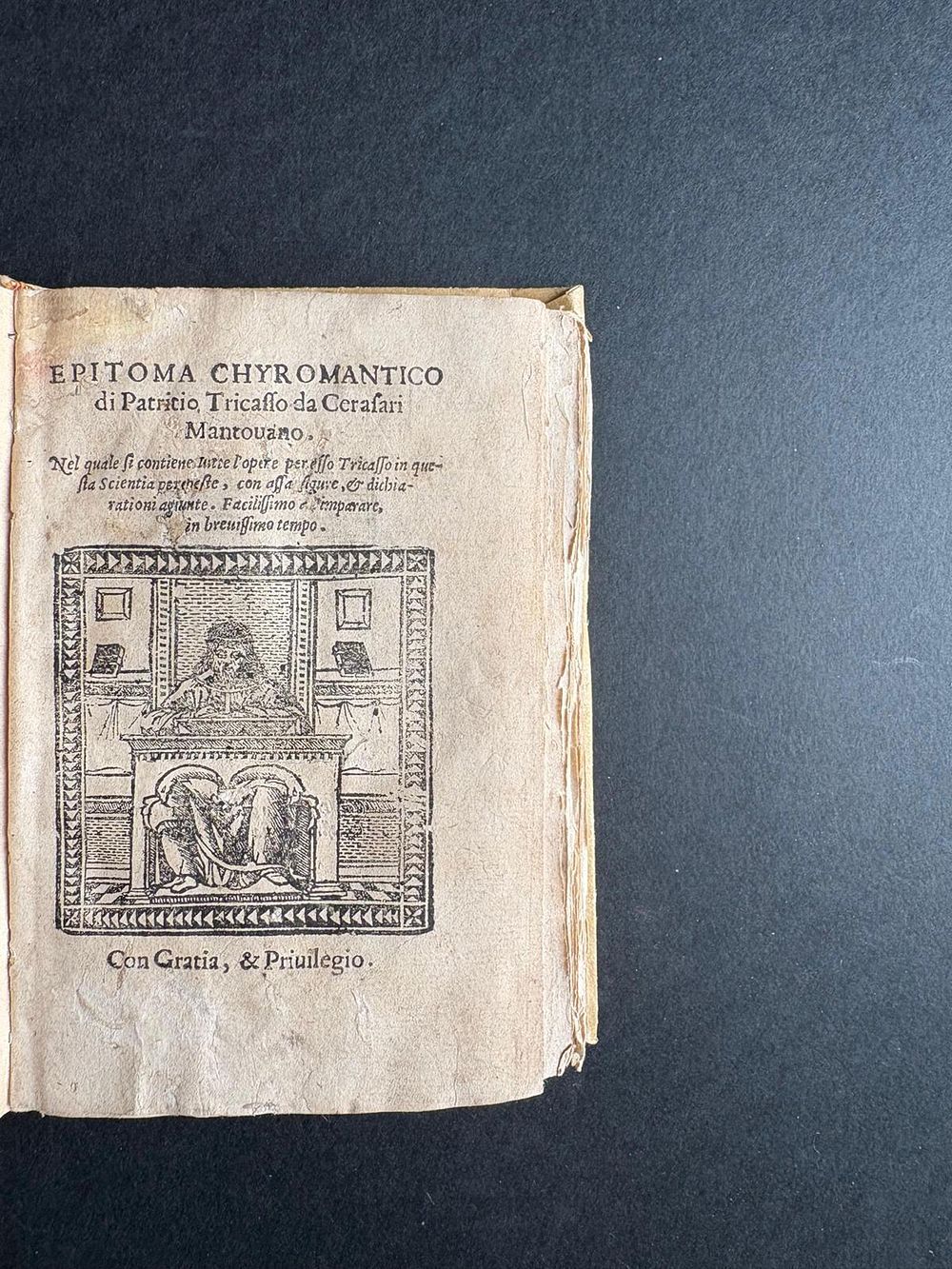
[ALCHEMY, MAGIC & ESOTERICA] - TRICASSO, Patritio [Paride Ceresara] (1466–1532) - Epitoma chyromantico - TRICASSO, Patritio [Paride Ceresara] (1466–1532) Epitoma chyromantico di Patritio Tricasso da Cerasari Mantouano. Nel quale si contiene tutte l’opere per esso Tricasso in questa scientia composte, con assai figure, & dichiarationi agiunte. Facilissimo ad imparare, & in brevissimo tempo. Venice: Agostino Bindoni, 1538. 8vo. 344 pp. Two large woodcut illustrations on the recto and verso of the title-page, printer’s device at end and 78 woodcut diagrams of hands, principally full-page, illustrating the lines, mounts and signs employed in chiromantic interpretation. Eighteenth-century vellum, manuscript title to spine. Entirely untrimmed, preserving its broad deckle-edged margins.Some light restoration, principally confined to the blank margins of pp. 1–15 and 341–344; otherwise a good, genuine and attractive copy. A RARE AND PROFUSELY ILLUSTRATED RENAISSANCE TREATISE ON PALMISTRY, PRESENTED HERE IN AN UNUSUALLY DESIRABLE UNTRIMMED COPY WITH ALL 78 WOODCUT DIAGRAMS OF THE HUMAN HAND. Patritio Tricasso — the pseudonym of the Mantuan humanist Paride Ceresara — was one of the most prominent Italian practitioners and theorists of chiromancy during the early sixteenth century. Educated in the humanistic environment of the northern Italian courts, Ceresara achieved particular fame through astrology and palmistry, disciplines which in Renaissance intellectual culture occupied an ambiguous territory between natural philosophy, physiognomy and divination. The Epitoma chyromantico represents his most systematic attempt to organise the art of reading the hand into a coherent body of knowledge. Tricasso himself describes it as the culmination of his previous writings, assembling and clarifying material previously dispersed through his earlier works. At the foundation of his system lies the conviction that the lines and signs of the human hand constitute visible indications from which temperament, character and future events might be inferred. Tricasso defines chiromancy as an art of prediction based upon the careful examination of those signs and insists upon a disciplined method rather than the superficial judgements of popular fortune-tellers. The work proceeds through an extraordinarily detailed analysis of the hand: the principal and secondary lines, their length and direction, interruptions, forks and intersections, the mounts associated with individual fingers, and the geometrical figures produced by combinations of these signs. Astrology is fundamental to this system. Different regions and mounts of the hand are associated with planetary influences, and Tricasso repeatedly interprets physical signs according to the traditional correspondence between the microcosm of the human body and the celestial macrocosm. The outstanding feature of the book is its remarkable visual apparatus. The colophon explicitly states that 29 additional figures had been added, bringing the total to 78, and the volume contains an extensive sequence of woodcut hands in which individual lines and configurations are isolated and labelled for the reader. These illustrations transform what might otherwise be an abstract divinatory system into a practical visual manual. The reader could compare an actual hand directly with the engraved examples, making the Epitoma one of the most extensively illustrated early printed manuals of palmistry. Tricasso’s approach is also noteworthy for his repeated insistence upon observation and method. Treccani records his claim that the practitioner should not judge precipitately but should instead examine every sign carefully and test conclusions through experience and natural reasoning. Although his conclusions belong to a divinatory worldview, this attempt at systematic classification places the work within the broader Renaissance ambition to decipher the human body as a legible manifestation of hidden natural forces. The Epitoma occupies an important position in the history of physiognomy, divination and Renaissance occult philosophy, and its profusion of woodcut hands makes it one of the most immediately recognisable books on chiromancy of the sixteenth century. The present copy is particularly appealing for being preserved entirely untrimmed, retaining its broad natural margins and deckle edges — an uncommon survival in a small-format Renaissance book that was normally subjected to repeated rebinding and trimming. The limited restorations are principally confined to the blank margins and do not detract significantly from its remarkably genuine character. A PARTICULARLY ATTRACTIVE, UNTRIMMED COPY OF ONE OF THE GREAT ILLUSTRATED BOOKS OF RENAISSANCE CHIROMANCY, PRESERVING THE COMPLETE SERIES OF 78 WOODCUT HANDS AND ITS WIDE DECKLE-EDGED MARGINS.