Bidspirit auction | [ALCHEMY, MAGIC & ESOTERICA] -
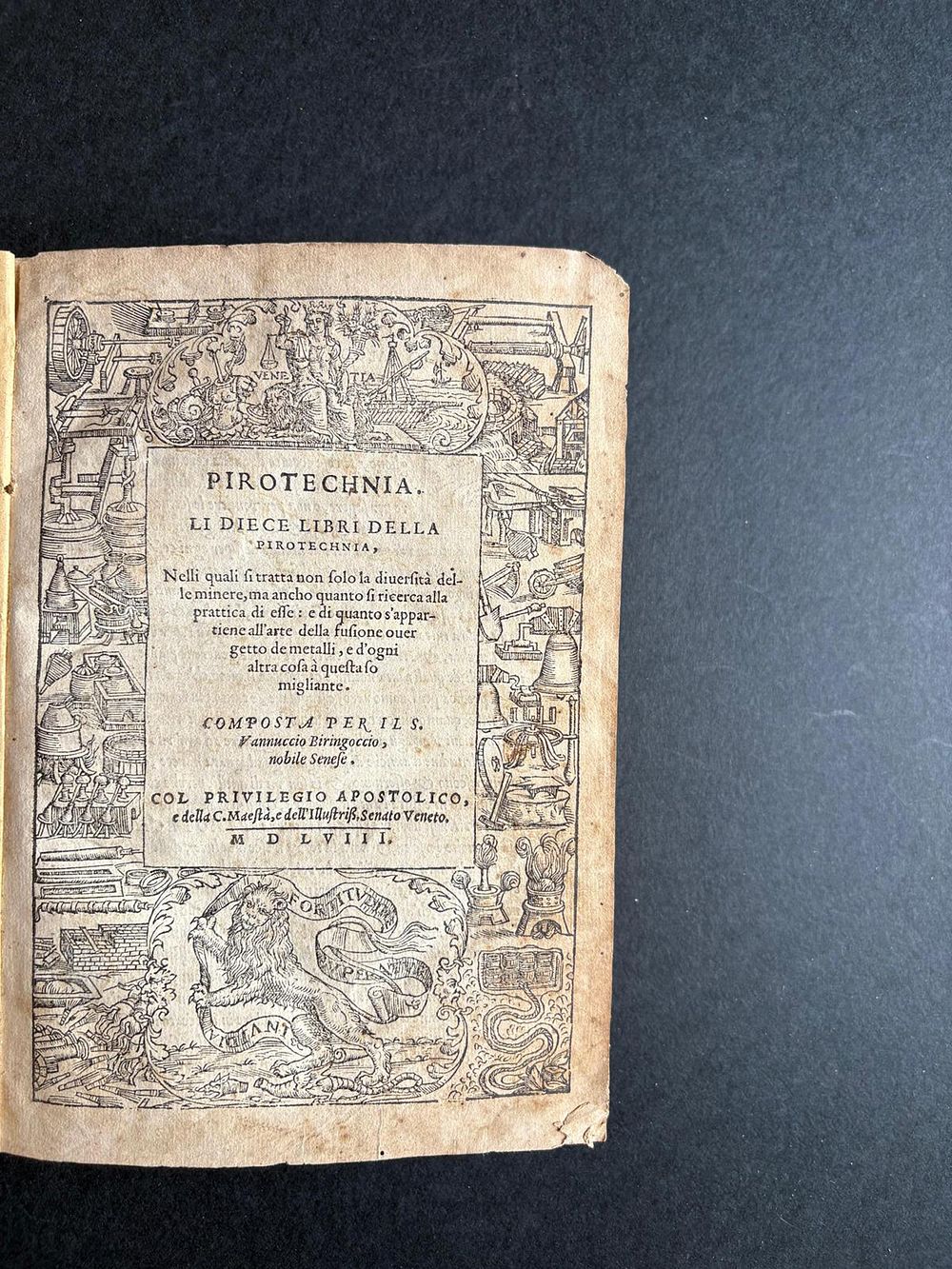
[ALCHEMY, MAGIC & ESOTERICA] - BIRINGUCCIO, Vannoccio (1480–1539) - De la pirotechnia (La Pirotechnia) - BIRINGUCCIO, Vannoccio (1480–1539) Pirotechnia. Li diece libri della Pirotechnia, composta per il S. Vannuccio Biringoccio, nelli quali si tratta non solo di diversità delle minere, ma ancho quanto si ricerca alla prattica di esse: e di quanto s’appartiene all’arte della fusione over getto de metalli, e d’ogni altra cosa à questa somigliante. Venice: [Curzio Troiano Navò], 1558; colophon: Comin da Trino di Monferrato, 1559. 4to. [8], 168 leaves. Title within an elaborate woodcut architectural border, printer’s devices and numerous woodcut illustrations throughout the text, depicting mines, furnaces, smelting and casting operations, machinery, moulds and other technical processes. Twentieth-century boards. Private collection stamps. The final leaf with an old restoration affecting a small portion of the blank margin. Some browning, otherwise a fresh, genuine and well-preserved copy. THIRD EDITION OF ONE OF THE GREAT TECHNICAL BOOKS OF THE RENAISSANCE AND THE EARLIEST COMPREHENSIVE PRINTED TREATISE ON METALLURGY, MINING AND THE TECHNOLOGY OF FIRE. First published posthumously at Venice in 1540, Vannoccio Biringuccio’s Pirotechnia represents one of the fundamental monuments in the history of technology. Based to a remarkable degree upon the author’s own practical experience of mines, foundries, mints, furnaces and workshops, it offered an unprecedented systematic account of the extraction, testing, refining, alloying and casting of metals. Biringuccio was not primarily a university scholar but a practising technician, metallurgist and foundryman. His book consequently differs markedly from much contemporary natural philosophy: throughout the Pirotechnia, direct observation and workshop experience repeatedly take precedence over inherited authority. The ten books cover an extraordinary range of technical subjects. Biringuccio discusses ores and mines; mineral substances; assaying and smelting; the separation and refining of gold and silver; metallic alloys; the casting of cannon, bells and statues; small-scale artistic casting; mints and coinage; glassmaking, pottery and lime; gunpowder, mines, projectiles and fireworks. Treccani describes the work as embracing virtually the entire practical metallurgy and pyrotechnology of its age. The sections on metal casting are of exceptional historical importance. Biringuccio describes the construction of furnaces and moulds, the preparation and behaviour of alloys, and the procedures required for the casting of artillery, bells and monumental sculpture. His account preserves invaluable evidence concerning workshop methods which were normally transmitted orally among craftsmen rather than recorded in print. The book is equally important for the history of mining and mineralogy. Biringuccio considers the occurrence of metallic ores, their recognition and extraction, methods of assaying their contents, and the processes by which metals could be separated from impurities and from one another. Of particular interest is his complex attitude towards alchemy. Biringuccio was openly sceptical of claims that base metals could genuinely be transmuted into gold, but he nevertheless recognised that practising alchemists had developed valuable laboratory techniques and substances. Modern scholarship has emphasised precisely this tension: he rejected the grand claims of metallic transmutation while respecting the practical achievements of the “operating philosophers” who had contributed to the development of glass, alloys, gunpowder and other manufactured substances. The celebrated woodcut illustrations are integral to the work. They show furnaces, bellows, moulds, casting pits, mining equipment, artillery and numerous other devices, creating one of the richest visual records of sixteenth-century industrial and artisanal technology. The importance of the Pirotechnia becomes even clearer when placed beside Georgius Agricola’s De re metallica, which appeared only in 1556. Whereas Agricola wrote in learned Latin, Biringuccio composed his work in the vernacular and drew extensively upon his own working experience. The book therefore gives an unusually direct voice to the technological culture of the Renaissance workshop. The present edition is the third Italian edition, with the date 1558 on the title-page and 1559 in the colophon, following the first edition of 1540 and the second of 1550. Treccani specifically identifies this issue as the edition printed by Comin da Trino, while EDIT16 records it under CNCE 6158. Despite some browning, the present copy remains fresh and genuine, with only a small old marginal repair to the final leaf and the text and illustrations well preserved. AN ATTRACTIVE COPY OF ONE OF THE FOUNDATIONAL BOOKS IN THE HISTORY OF METALLURGY AND TECHNOLOGY — A RICHLY ILLUSTRATED RENAISSANCE ENCYCLOPAEDIA OF MINING, METALWORKING, FOUNDRY PRACTICE,