Bidspirit auction | [ALCHEMY, MAGIC & ESOTERICA] -
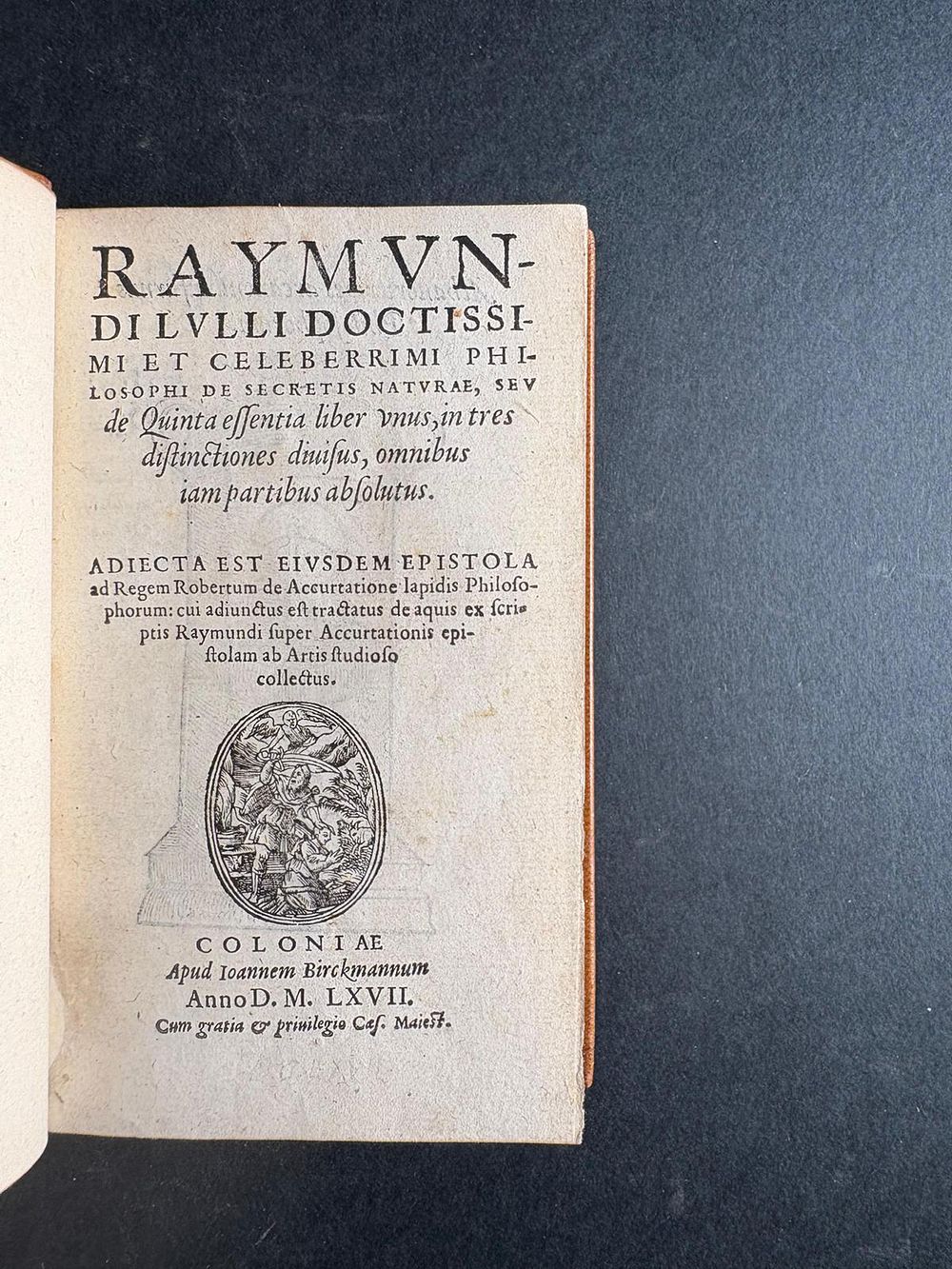
[ALCHEMY, MAGIC & ESOTERICA] - PSEUDO-LLULL [traditionally attributed to Ramon Llull (c. 1232–1316) - De secretis naturae seu De quinta essentia - PSEUDO-LLULL [traditionally attributed to Ramon Llull (c. 1232–1316)]. Raymundi Lulli doctissimi et celeberrimi philosophi De secretis naturae, seu De quinta essentia liber unus, in tres distinctiones divisus, omnibus iam partibus absolutus. Adiecta est eiusdem Epistola ad Regem Robertum de accurtatione lapidis philosophorum; cui adiunctus est Tractatus de aquis... Cologne: Johann Birckmann, 1567. 8vo. [8], 376 pp. Printer’s device on title; woodcut alchemical illustration on verso of title depicting the philosophical furnace or athanor, with further woodcut diagrams and initials. An exceptionally fresh and beautifully preserved copy, bound in full Marocco by Emilio Brugalla, signed and dated 1951. An important sixteenth-century edition of one of the central texts of the pseudo-Lullian alchemical corpus, devoted to the quintessence, the transmutation of matter and the philosopher’s stone. Long attributed to the Catalan philosopher and mystic Ramon Llull, the De secretis naturae seu de quinta essentia is now recognized as a major work of the medieval pseudo-Lullian alchemical tradition, probably composed in the second half of the fourteenth century. It played a fundamental role in establishing the enduring Renaissance image of “Llull the alchemist.” At the centre of the work is the concept of the quinta essentia, the incorruptible “fifth essence” believed to transcend the four terrestrial elements. Building upon the alchemical and medical tradition associated with John of Rupescissa, the author develops the quintessence into a comprehensive theory of purification and transformation, extending from medicine to the perfection and transmutation of metals. The work is accompanied by the celebrated Epistola ad Regem Robertum de accurtatione lapidis philosophorum, concerning the abbreviation or acceleration of the process for producing the philosopher’s stone, together with the Tractatus de aquis, devoted to the alchemical “waters” and solvents central to laboratory practice. Of particular visual interest is the woodcut representation of the athanor, the philosophical furnace used to maintain the continuous and controlled heat considered essential to alchemical transformation. Such images were not merely decorative but formed part of the practical and symbolic language of Renaissance alchemy. The De secretis naturae occupies an important position in the transmission of alchemical thought from the Middle Ages into the Renaissance. Through works such as this, the name of Ramon Llull became associated with an extensive corpus of writings on the philosopher’s stone, distillation, metallic transmutation and the hidden powers of nature. The pseudo-Lullian tradition was read by major figures of Renaissance natural philosophy, including John Dee, and remained influential well into the seventeenth century. The Cologne edition of 1567, printed by Johann Birckmann, belongs to the period of intense renewed interest in alchemical literature and preserves one of the most influential texts in the development of the Lullian alchemical legend. The exceptional condition of the present copy is further enhanced by its elegant full Marocco leather binding by Emilio Brugalla (1901–1987), signed and dated 1951. Brugalla, regarded as one of the outstanding European art bookbinders of the twentieth century, was celebrated for the refinement and technical precision of his bindings for important early books. A fine and highly attractive copy of a key text in the history of Western alchemy, combining the medieval search for the quintessence and the philosopher’s stone with the Renaissance legend of Ramon Llull as a master of the alchemical art.