Bidspirit auction | [ALCHEMY, MAGIC & ESOTERICA] -
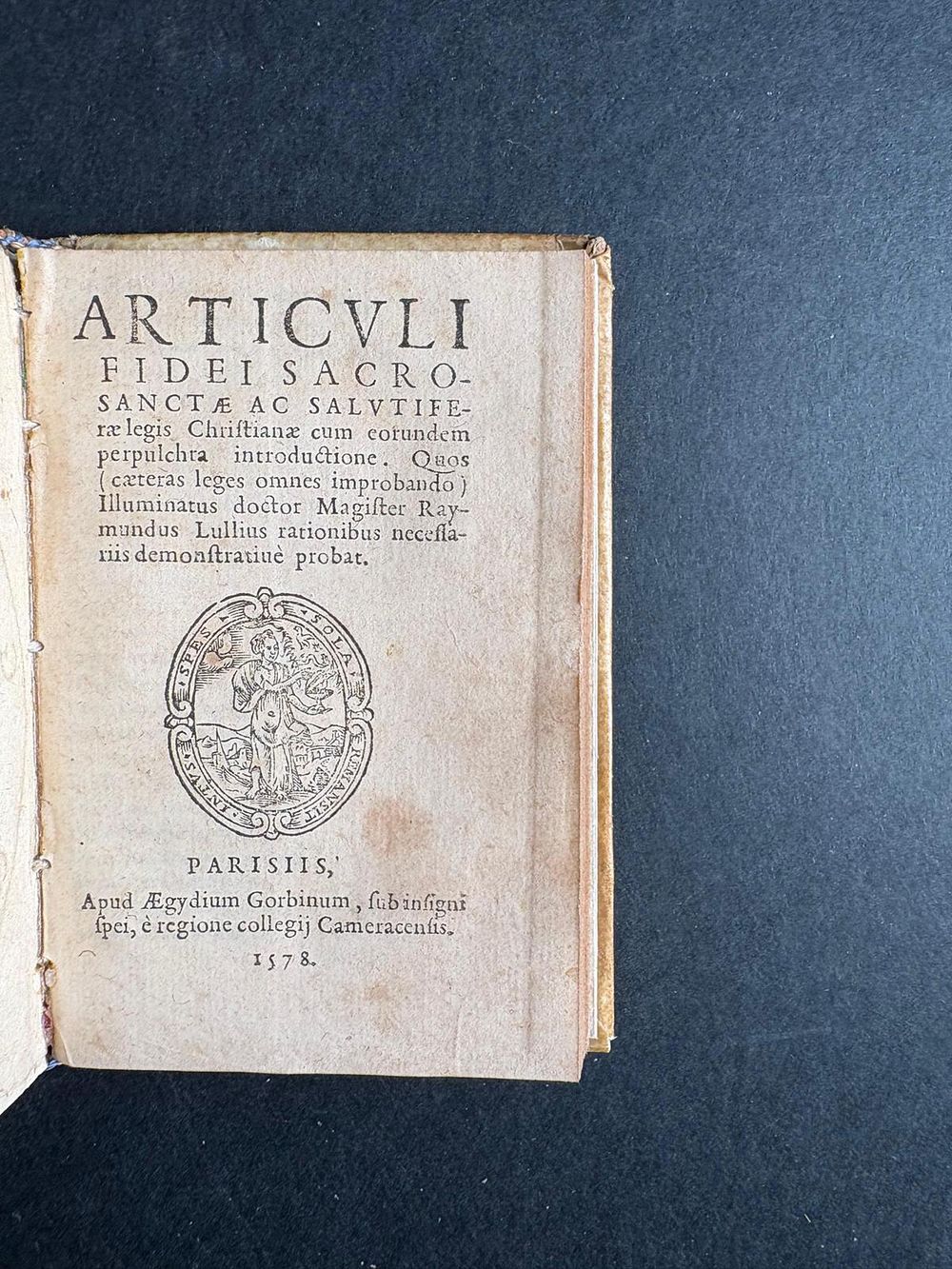
[ALCHEMY, MAGIC & ESOTERICA] - LLULL, Ramon (c. 1232–1316) - Sammelband of three Lullian works (Ars brevis; De auditu Kabbalistico; Articuli fidei) - LLULL, Ramon (c. 1232–1316) — PSEUDO-LLULL [MAINARDI, Pietro]. A REMARKABLE CONTEMPORARY SAMMELBAND OF THREE LULLIAN WORKS PRINTED IN PARIS BY GILLES GOURBIN IN 1578, INCLUDING THE CELEBRATED ARS BREVIS AND THE RARE DE AUDITU KABBALISTICO, WITH THEIR COMBINATORIAL DIAGRAMS AND VOLVELLES. 1. PSEUDO-LLULL [MAINARDI, Pietro]. Opusculum Raymundinum de auditu Kabbalistico sive ad omnes scientias introductorium. Paris: Gilles Gourbin (Aegidius Gorbinus), 1578. With the celebrated diagrammatic apparatus, including five plates, one incorporating a movable volvelle, and two figures in the text. 2. LLULL, Ramon. Ars brevis illuminati doctoris magistri Raymundi Lull. Quae est ad omnes scientias pauco & brevi tempore assequendas introductorium & brevis via... Paris: Gilles Gourbin, 1578. With the characteristic Lullian combinatorial diagrams and volvelles. Complete apart from one movable element of one volvelle, otherwise exceptionally well preserved. 3. LLULL, Ramon. Articuli fidei sacrosanctae ac salutiferae legis Christianae cum eorundem perpulchra introductione. Quos ... Illuminatus doctor Magister Raymundus Lullius rationibus necessariis demonstrative probat. Paris: Gilles Gourbin, 1578. Three works in one volume, 16mo. Contemporary full vellum, preserving the three works together in their original sixteenth-century binding. An exceptionally fresh and attractive copy, complete in text and illustrations apart from the single movable element noted above. A HIGHLY UNUSUAL SIXTEENTH-CENTURY LULLIAN SAMMELBAND, BRINGING TOGETHER THREE OF THE MOST IMPORTANT TEXTS THROUGH WHICH THE “ART” OF RAMON LLULL — ITS COMBINATORIAL LOGIC, UNIVERSAL ASPIRATIONS AND RENAISSANCE ASSOCIATION WITH CABALA — WAS TRANSMITTED TO EARLY MODERN EUROPE. Few medieval thinkers enjoyed an intellectual afterlife as extraordinary as Ramon Llull. Philosopher, theologian, missionary and mystic, Llull devised what he called his Art: an ambitious universal method designed to organize the principles of knowledge and to discover and demonstrate truth through the systematic combination of fundamental concepts. At the heart of this method were the celebrated Lullian figures — circles, letters, tables and rotating discs — by which concepts could be placed into changing relationships with one another. The physical volvelles preserved in early printed editions are therefore not merely illustrations: they are working instruments of thought, material embodiments of Llull's attempt to make reasoning operational through a system of permutations and combinations. The present volume is particularly compelling because it unites, in a single contemporary binding, three Paris editions issued by Gilles Gourbin in the same year, 1578, representing three complementary aspects of the Lullian tradition: the universal Art itself, its application to Christian theology, and its remarkable Renaissance transformation into a supposedly “cabalistic” method of knowledge. THE ARS BREVIS: A MACHINE FOR UNIVERSAL KNOWLEDGE The intellectual centre of the volume is Llull's Ars brevis, composed in 1308 as a concise exposition of the mature form of his Ars generalis ultima. Its ambition was extraordinary: to establish a method applicable across the sciences, through which fundamental principles could be combined according to a formal system in order to generate questions, propositions and demonstrations. The diagrams and rotating wheels are integral to that project. Letters correspond to fundamental attributes and relations; by rotating and recombining them, the user explores different logical relationships. The book consequently occupies a remarkable place in the history of attempts to formalize and mechanize intellectual operations. The Ars brevis became one of Llull's most influential works during the Renaissance and early modern period. His Art was intensively studied, transformed and commented upon by subsequent thinkers. Giordano Bruno was among its most brilliant Renaissance interpreters, adapting Lullian combinatorial procedures to his own systems of memory and knowledge. More than a century later, Gottfried Wilhelm Leibniz, in his Dissertatio de arte combinatoria of 1666, explicitly engaged with the Lullian tradition in developing his own vision of a universal combinatorial method. Modern historians of logic and mathematics consequently regard Llull's Art as an extraordinary early episode in the long history of formal and combinatorial approaches to knowledge. The surviving volvelles in the present volume give physical form to this history. One movable component of a volvelle in the Ars brevis is lacking; the remainder of the work and its diagrammatic apparatus is preserved. THE DE AUDITU KABBALISTICO: LLULL, CABALA AND THE RENAISSANCE SEARCH FOR A UNIVERSAL METHOD The first work in the volume,