Bidspirit auction | [ALCHEMY, MAGIC & ESOTERICA] -
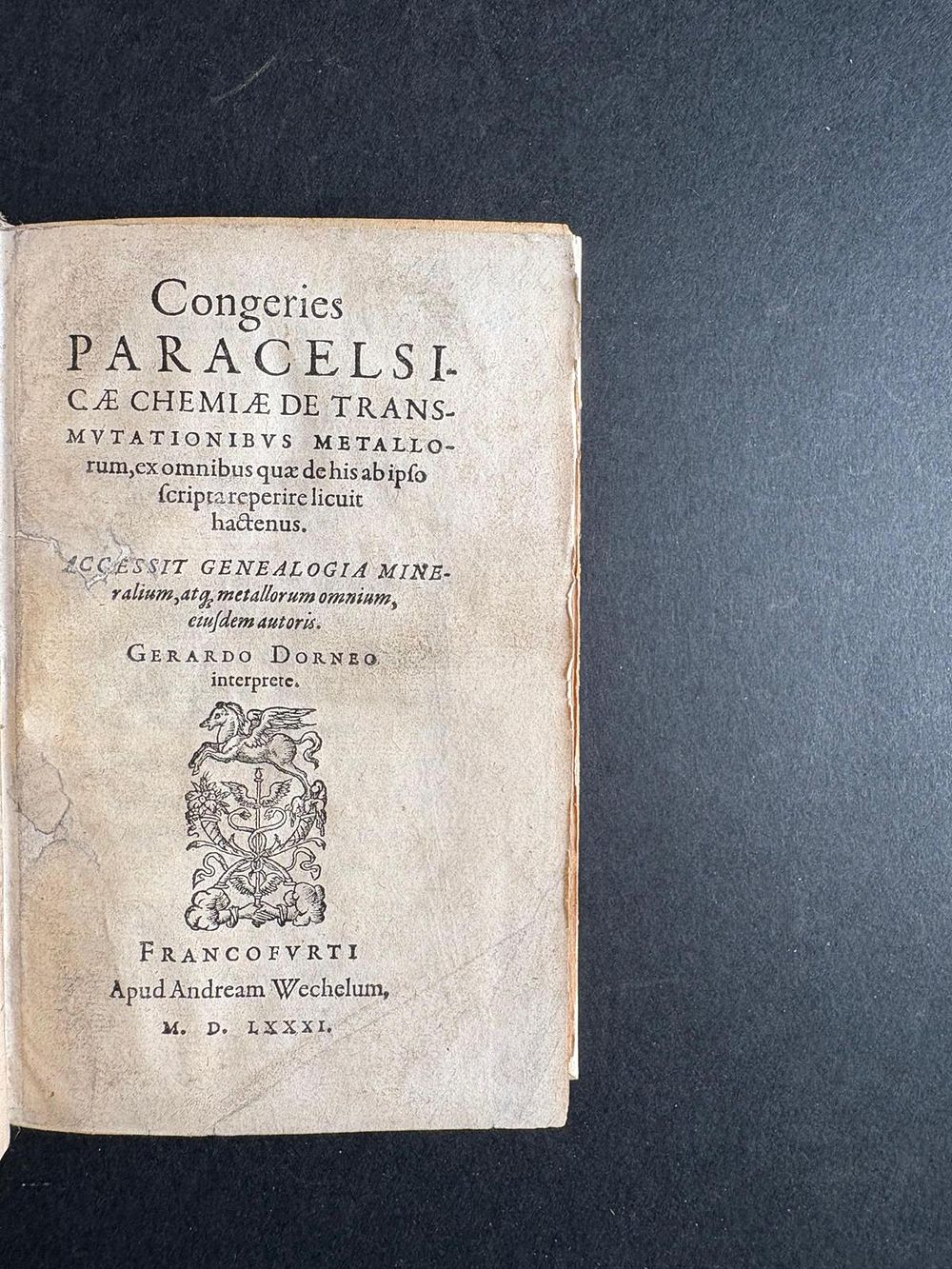
[ALCHEMY, MAGIC & ESOTERICA] - PARACELSUS [Theophrastus Bombastus von Hohenheim] (1493/94–1541) - Congeries Paracelsicae chemiae de transmutationibus metallorum - PARACELSUS [Theophrastus Bombastus von Hohenheim] (1493/94–1541) Congeries Paracelsicae chemiae de transmutationibus metallorum, ex omnibus quae de his ab ipso scripta reperire licuit hactenus. Accessit genealogia mineralium, atque metallorum omnium, eiusdem autoris. Gerardo Dorneo interprete. Frankfurt am Main: Andreas Wechel, 1581. 8vo. 277, [1] pp. Printer’s device on title. Small skilful restoration to the title-page. Early twentieth-century half vellum over marbled paper boards. FIRST EDITION OF GERHARD DORN’S IMPORTANT COLLECTION OF PARACELSUS’S WRITINGS ON THE TRANSMUTATION, GENERATION AND NATURE OF METALS AND MINERALS — A MAJOR SIXTEENTH-CENTURY TEXT OF PARACELSIAN ALCHEMY AND EARLY CHEMICAL THOUGHT. Published four decades after Paracelsus’s death, the Congeries Paracelsicae chemiae brings together his writings concerning one of the central problems of Renaissance alchemy: the possibility of the transformation and transmutation of metals. The collection was prepared and translated into Latin by Gerhard Dorn, one of the most important sixteenth-century interpreters and disseminators of Paracelsian thought. Dorn played a crucial role in making the writings of Paracelsus accessible to the international learned world, translating, editing and systematising texts which had originally circulated largely in German and often in complex manuscript or early printed traditions. As the title itself announces, the Congeries was conceived as a gathering of everything then available from Paracelsus concerning the transmutation of metals. The volume therefore concentrates upon subjects lying at the heart of Paracelsian natural philosophy: the origin and maturation of metals within the earth, mercury, sulphur and salt, metallic tinctures, the purification and transformation of matter, and the possibility of reproducing or accelerating natural processes by chemical art. Added to the principal collection is the important Genealogia mineralium atque metallorum omnium, devoted to the generation and relationships of minerals and metals. Here metallic substances are treated not as inert bodies but as products of dynamic natural processes taking place within the earth — an idea fundamental to Paracelsian cosmology and to the developing chemical conception of matter. For Paracelsus, alchemy was considerably more than the pursuit of artificial gold. It constituted a practical method for understanding, separating, purifying and transforming natural substances, with applications extending from metallurgy to pharmacy and medicine. The Congeries is consequently an important document of the period in which traditional alchemical theories of transmutation were being incorporated into a broader programme of chemical philosophy and experimental manipulation of matter. The terminology of the work — repeatedly concerned with aurum, argentum, mercurius, sulphur, sal, tinctura, vitriolumand the operations of fire — vividly reflects the laboratory culture from which early modern chemistry was to emerge. Dorn’s edition is particularly significant in the history of Paracelsianism. By translating and organising Paracelsus’s often difficult writings into Latin, he helped transform the controversial Swiss physician from a German-language medical reformer into a figure of European intellectual importance. The influence of this particular collection endured well beyond the sixteenth century. Portions of the Congeries were translated into English in 1657 under the title Paracelsus of the Chymical Transmutation of Metals and Minerals, testimony to the continued importance of the work in seventeenth-century alchemical and chemical literature. A SCARCE AND IMPORTANT EARLY PARACELSIAN PRINTING, DEVOTED SPECIFICALLY TO THE TRANSMUTATION AND GENERATION OF METALS, AND ONE OF THE MOST CONCENTRATED SIXTEENTH-CENTURY STATEMENTS OF PARACELSUS’S ALCHEMICAL AND METALLURGICAL DOCTRINES. References: Sudhoff 186; VD16 P 435; USTC 624733; Wellcome Collection.