Bidspirit auction | [ALCHEMY, MAGIC & ESOTERICA] -
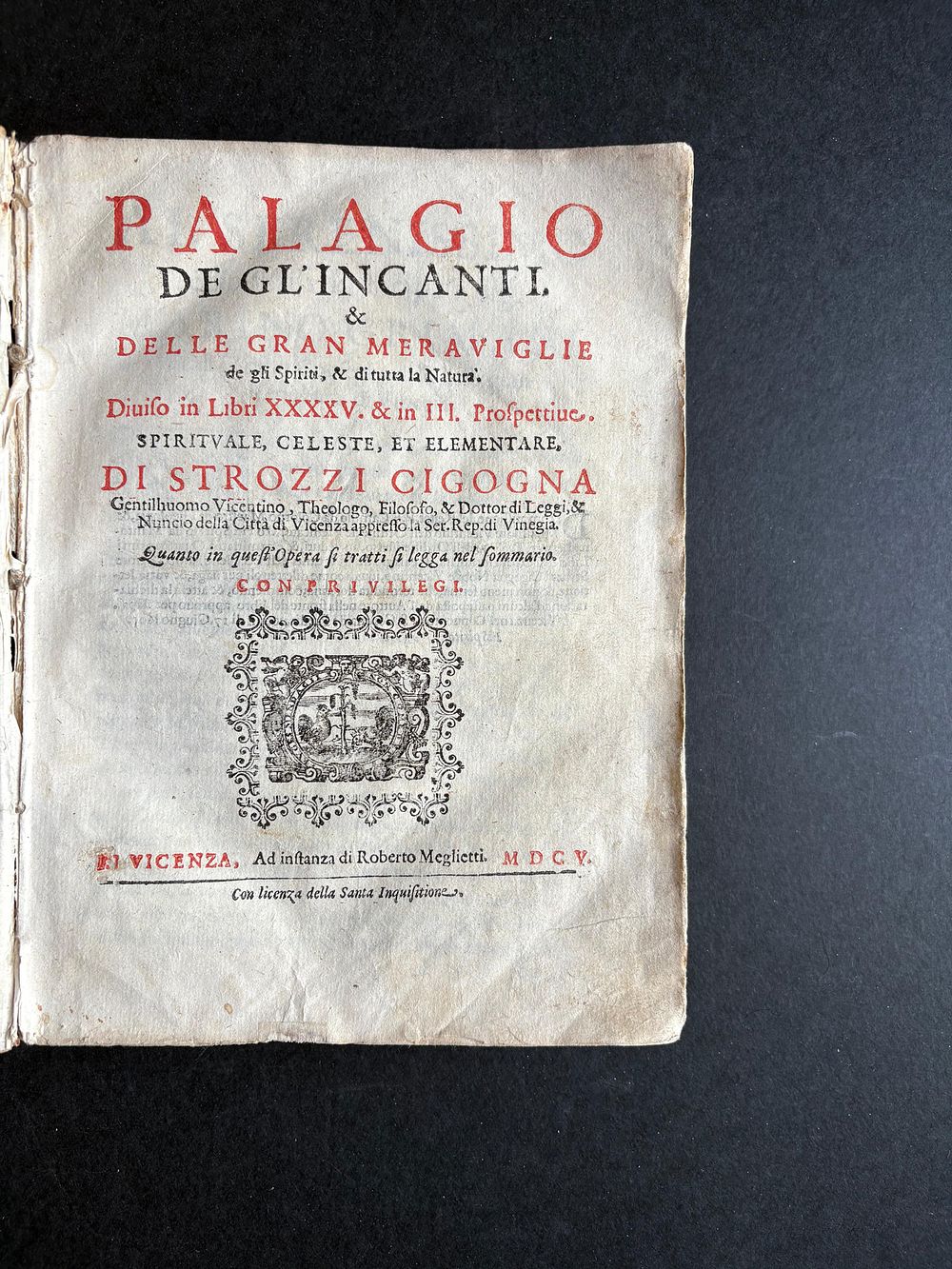
[ALCHEMY, MAGIC & ESOTERICA] - CICOGNA, Strozzi. - Palagio de gl'incanti - CICOGNA, Strozzi. Del Palagio de gl’Incanti, & delle gran meraviglie de gli Spiriti, & di tutta la natura loro. Diviso in libri XXXXV. & in III. Prospettive. Spirituale, Celeste, et Elementare. Vicenza, 1605. FIRST EDITION. AN EXCEPTIONALLY RARE AND REMARKABLY FINE COPY OF ONE OF THE MOST FASCINATING ITALIAN BOOKS ON DEMONOLOGY, MAGIC AND THE SUPERNATURAL, PRESERVING THE EXTREMELY RARE PORTRAIT OF THE AUTHOR, VERY FREQUENTLY ABSENT FROM SURVIVING COPIES. 4to. [32], 423, [1] pp. Title printed in red and black with woodcut device, woodcut initials, head- and tail-pieces, and the very rare portrait of Strozzi Cicogna. Contemporary limp vellum, manuscript title to spine. A magnificent, crisp and exceptionally fresh copy, preserved in its original binding and particularly remarkable for the presence of the author’s portrait. First edition, published at Vicenza in 1605, in the year in which the work first appeared in a number of closely contemporary issues. Cicogna’s Palagio de gl’Incanti is one of the most extraordinary encyclopaedic treatments of the supernatural produced in early seventeenth-century Italy: an immense and highly curious compendium devoted to spirits, demons, angels, apparitions, witchcraft, magic, incubi and succubi, familiar spirits, transformations, enchantments, diabolical phenomena and the hidden forces of nature. Cicogna conceives the universe as an immense “Palace of Enchantments”, divided into three great perspectives — Spiritual, Celestial and Elemental — through which he attempts to order the whole invisible and supernatural world. The result is an extraordinary synthesis of theology, scholastic philosophy, classical learning, demonology, folklore and occult tradition, drawing upon ancient philosophers, theologians and contemporary accounts of marvels and supernatural events. Among its most striking passages are discussions of the nature and intelligence of demons; incubi and succubi and their supposed intercourse with human beings; spirits capable of transporting bodies from one place to another; Genii, Lares and household gods; Sylvans, Fauns, Foletti and familiar spirits; nocturnal gatherings of magicians; magical transformations of the human body; enchantments, apparitions and diabolical illusions; and even the supposed ability of spirits to prolong life, rejuvenate the aged or restore the dead to life. Far from being merely a collection of popular superstition, the Palagio represents an ambitious attempt to reconcile the extraordinary and apparently inexplicable phenomena inherited from classical and Renaissance culture with Christian cosmology and contemporary natural philosophy. It consequently occupies a particularly fascinating position at the intersection of demonology, witchcraft, occult philosophy, folklore and the history of ideas. The work immediately attracted considerable attention and circulated in several editions issued in 1605. Its treatment of magic, spirits and supernatural phenomena ultimately proved sufficiently problematic for ecclesiastical authorities that the book was placed on the Index of Prohibited Books in 1623. Cicogna’s reputation rests above all upon the Palagio de gl’Incanti, his most celebrated and enduring work. Its extraordinary range of subjects and abundance of accounts concerning demons and spirits have made it an important source for the study of early-modern beliefs in witchcraft and the supernatural. Copies of the original 1605 Vicenza edition are notably scarce on the market. Copies retaining the author’s portrait are considerably more elusive, the portrait being very frequently absent. The present copy, exceptionally fresh, in its contemporary limp vellum and complete with this important and rarely preserved illustration, is therefore a particularly desirable example of this celebrated work of early Italian demonology and occult literature. A superb copy of an exceptionally rare and highly evocative book.