Bidspirit auction | [ALCHEMY, MAGIC & ESOTERICA] -
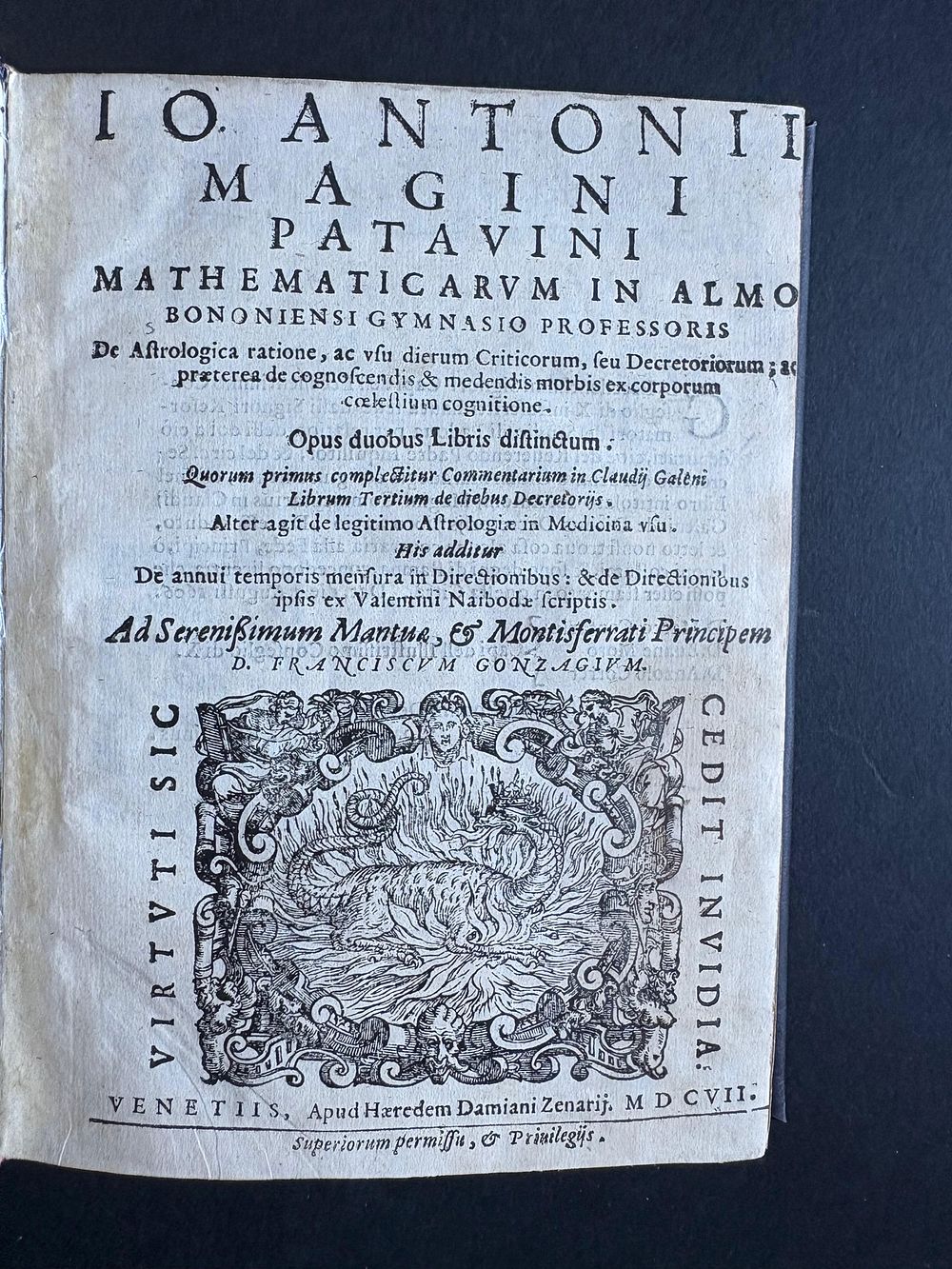
[ALCHEMY, MAGIC & ESOTERICA] - MAGINI, Giovanni Antonio (1555–1617) - De astrologica ratione ac usu dierum criticorum - ***Note: This lot is located in Italy and requires an Italian export licence. We will manage the full application process for you. An additional fee of £50 applies.*** MAGINI, Giovanni Antonio (1555–1617). De astrologica ratione, ac usu dierum criticorum, seu decretoriorum; ac praeterea de cognoscendis et medendis morbis ex corporum coelestium cognitione. Venice: Heirs of Damiano Zanari [Bartolomeo Rodella], 1607. 4to (197 × 140 mm). [10], 120 [i.e. 118] leaves. Elaborate woodcut printer’s device on title, woodcut headpieces and initials, and numerous astrological diagrams and horoscope figures throughout. Modern black binding with gilt decoration inspired by the astrological illustrations, gilt title to spine. Some browning; title lightly cropped; small paper flaw at 2A3, not affecting text; light waterstaining to the lower corner of the final leaves. First edition. An important and extensively illustrated treatise on medical astrology by Giovanni Antonio Magini, mathematician, astronomer and celebrated cartographer, and professor of mathematics at the University of Bologna. Published at Venice in 1607, De astrologica ratione is one of the most significant early seventeenth-century attempts to define and defend the legitimate role of astrology in medicine. Magini sought to distinguish a learned, mathematically grounded medical astrology from the forms of fatalistic and superstitious prediction that he regarded as incompatible with Christian doctrine and human free will. The work is divided into two principal books. The first provides a detailed commentary on the third book of Galen’s De diebus decretoriis, concerning the “critical days” upon which the course and outcome of an illness were believed to depend. The second develops Magini’s argument for the legitimate application of celestial observation to diagnosis and prognosis, placing astrology within the established medical tradition of Hippocrates and Galen. The volume concludes with material derived from the writings of the German mathematician and astrologer Valentin Naibod on astronomical directions, together with a remarkable series of thirty medical horoscopes. Several of these case studies draw upon earlier authorities including Thomas Bodier, Girolamo Cardano and Girolamo Rossi, illustrating in graphic form the supposed relationship between planetary configurations, the onset of disease, critical moments in its development and the eventual recovery or death of the patient. These numerous horoscope diagrams give the book particular visual and documentary importance. They transform abstract astrological theory into a collection of practical medical cases and provide a vivid record of the close relationship that still existed between astronomy, astrology and medicine at the beginning of the seventeenth century. Magini was one of the leading mathematical figures of his generation. Professor at Bologna, correspondent of astronomers and mathematicians including Tycho Brahe, Kepler and Galileo, and author of important astronomical, geographical and cartographical works, he occupied a central position in the scientific culture of late Renaissance Italy. De astrologica ratione is therefore more than an astrological manual: it is an important document of a period in which the boundaries between celestial science and medical practice were still being actively negotiated, and in which scholars attempted to reconcile inherited classical doctrines with mathematics, observation and the theological limits imposed upon astrological prediction. A rare and attractive first edition, richly illustrated with astrological and medical diagrams, of one of the principal Renaissance works devoted to the relationship between celestial phenomena, disease and medical prognosis.