Bidspirit auction | [ALCHEMY, MAGIC & ESOTERICA] -
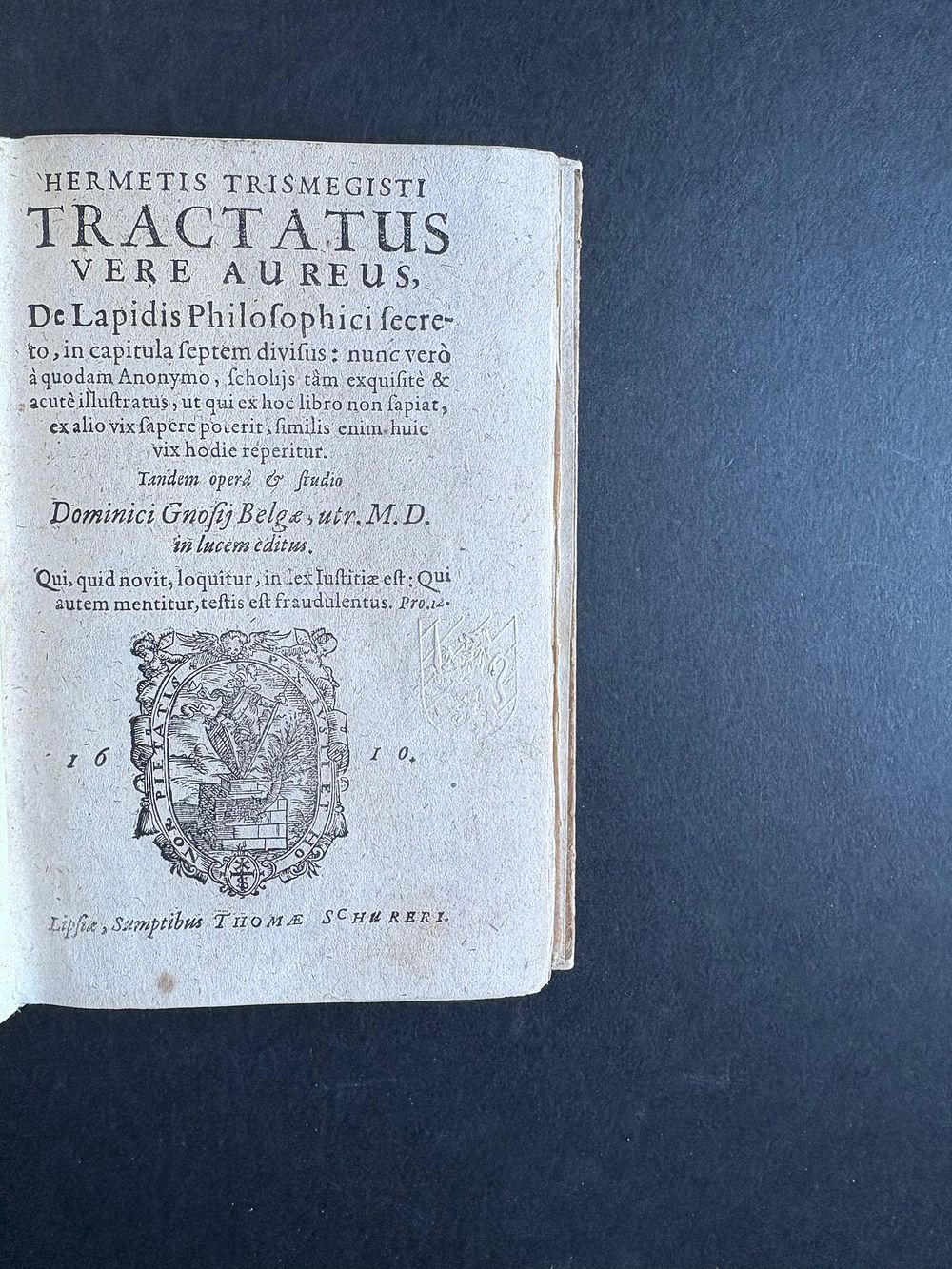
[ALCHEMY, MAGIC & ESOTERICA] - HERMES TRISMEGISTUS [pseud.] – GNOSIUS, Dominicus, editor and commentator - Tractatus vere aureus de lapidis philosophici secreto - HERMES TRISMEGISTUS [pseud.] – GNOSIUS, Dominicus, editor and commentator Tractatus vere aureus, de Lapidis Philosophici secreto, in capitula septem divisus: nunc vero a quodam Anonymo, scholiis tam exquisite & acute illustratus, ut qui ex hoc libro non sapiat, ex alio vix sapere poterit, similis enim huic vix hodie reperitur. Tandem opera & studio Dominici Gnosii Belgae in lucem editus. Leipzig: sumptibus Thomae Schureri; Valentinus Am Ende imprimebat, 1610. 8vo. [8] leaves, 276 [recte 277] pp., [1] leaf. Printer’s device on title and at end, with several diagrams and alchemical figures in the text. Contemporary pasteboard binding, manuscript title to spine. Contemporary or early marginal annotations on several pages. Uniformly browned, as frequently encountered in copies of this edition owing to the quality of the paper, but not excessively so; overall a fresh, genuine and attractive copy. THE IMPORTANT 1610 EDITION OF ONE OF THE CLASSIC TEXTS OF WESTERN ALCHEMY, DEVOTED ENTIRELY TO THE SECRET OF THE PHILOSOPHERS’ STONE AND ACCOMPANIED BY THE EXTENSIVE SCHOLIA OF DOMINICUS GNOSIUS. Traditionally attributed to Hermes Trismegistus, the legendary sage regarded throughout the Renaissance as the primordial source of Hermetic wisdom, the Tractatus aureus is one of the most celebrated pseudepigraphal texts in the literature of alchemy. The work is expressly devoted to the secret of the Philosophers’ Stone — De Lapidis Philosophici secreto — and is divided into seven chapters in which the generation, preparation and perfection of the philosophical matter are described through the deliberately obscure and symbolic language characteristic of the alchemical tradition. Its central themes are those of the Great Work: the union and separation of contrary principles, the purification and transformation of matter, the operations of fire, the relationship between sulphur and mercury, the conjunction of masculine and feminine principles and the progressive attainment of metallic perfection. The text presents alchemy not merely as a recipe for the manufacture of artificial gold but as a philosophy of nature founded upon the belief that metals possess an inherent capacity for growth and perfection. The alchemist’s task was to discover the hidden processes employed by Nature and, through art, reproduce or accelerate them within the laboratory. Of particular importance in the present edition are the extensive scholia or commentaries associated with Dominicus Gnosius, which seek to penetrate the deliberately enigmatic language of the original text and explain its symbols in terms of contemporary Hermetic and alchemical doctrine. Gnosius’s commentary repeatedly develops the characteristic language of coniunctio, the reconciliation of opposites that lies at the centre of the alchemical process. Masculine and feminine, fixed and volatile, sun and moon, sulphur and mercury are presented as complementary aspects of a single matter whose reunion leads ultimately to the Philosopher’s Stone. The work is illustrated with a number of diagrams and symbolic figures, reinforcing the close relationship between textual obscurity and visual symbolism which characterised the transmission of alchemical knowledge. Although traditionally attributed to Hermes Trismegistus, the Tractatus aureus does not form part of the philosophical Corpus Hermeticum. Its authorship and precise origins remain uncertain, and it belongs instead to the later alchemical tradition which placed numerous works under the prestigious authority of Hermes. The text had appeared earlier in the sixteenth century, including in the Ars Chemica of 1566. Older bibliographies sometimes cite a supposed Leipzig edition of 1600, but modern bibliographical research has rejected the existence of that edition. The present Leipzig 1610 printing therefore occupies a particularly important position in the independent transmission and interpretation of the text, notably through the commentary of Gnosius. The Tractatus aureus retained a considerable reputation among later Hermetic and alchemical writers and continued to be reprinted and discussed for centuries, becoming one of the standard texts associated with the mystery of the Lapis Philosophorum. The early marginal annotations in the present copy are particularly appropriate in a work of this nature, providing evidence of an early reader actively engaging with and attempting to interpret the deliberately cryptic alchemical text. A VERY ATTRACTIVE, GENUINE COPY IN ITS CONTEMPORARY PASTEBOARD BINDING OF AN IMPORTANT AND SCARCE EARLY-SEVENTEENTH-CENTURY EDITION OF ONE OF THE CLASSIC TEXTS ON THE PHILOSOPHERS’ STONE, ENRICHED BY EARLY MARGINALIA. References: VD17 23:295550X; Ferguson I, 390; Brüning 975; Ferchl 231; Caillet 5103; Wellcome Collection.