Bidspirit auction | [ALCHEMY, MAGIC & ESOTERICA] -
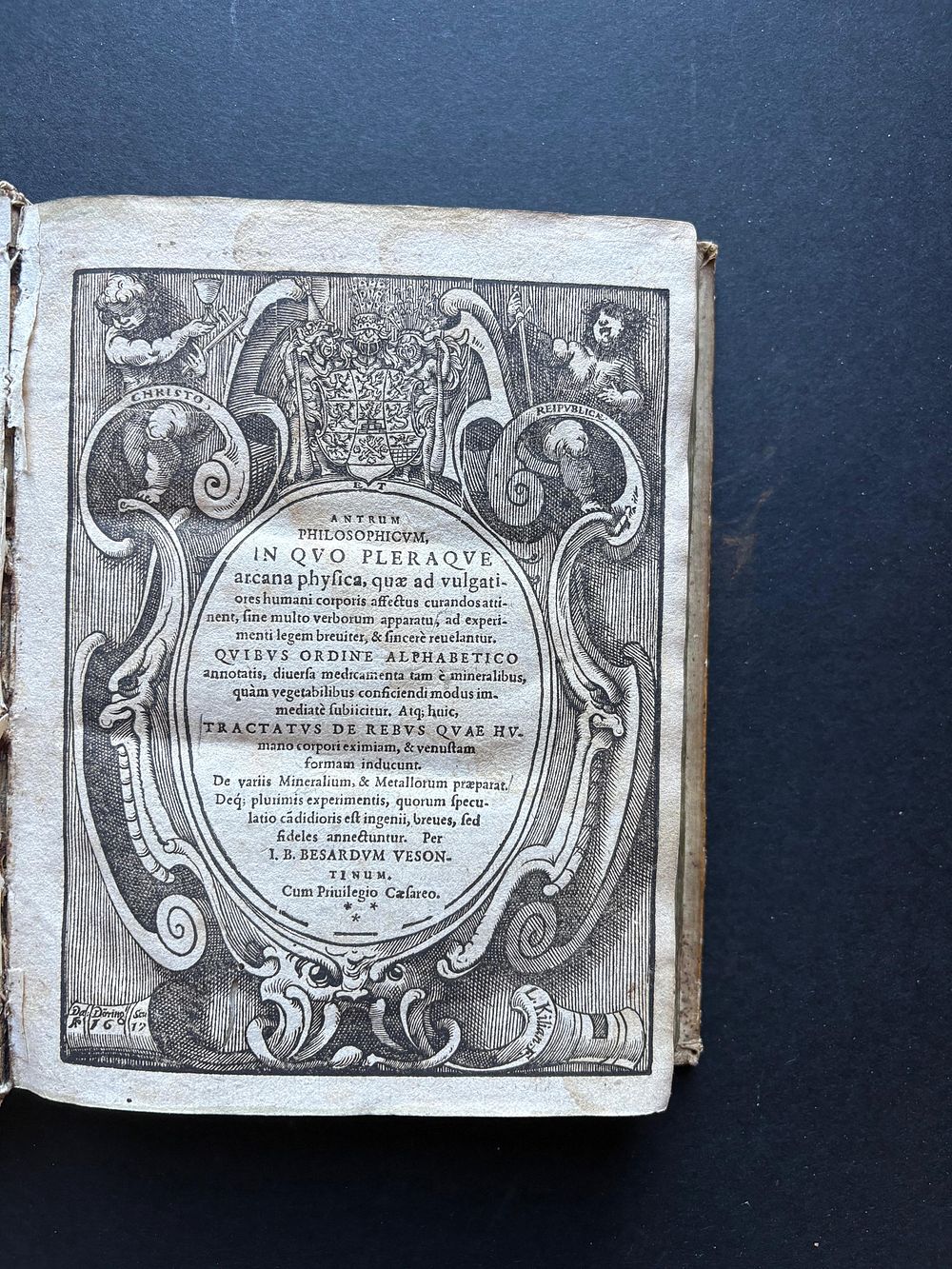
[ALCHEMY, MAGIC & ESOTERICA] - BÉSARD, Jean-Baptiste (c. 1567–c. 1625) - Antrum philosophicum - BÉSARD, Jean-Baptiste (c. 1567–c. 1625) Antrum philosophicum, in quo pleraque arcana physica, quae ad vulgatiores humani corporis affectus curandos attinent, sine multo verborum apparatu, ad experimenti legem breviter, & sincere revelantur; quibus ordine alphabetico annotatis, diversa medicamenta tam e mineralibus, quam vegetabilibus conficiendi modus immediate subiicitur; atque huic tractatus de rebus quae humano corpori eximiam, & venustam formam inducunt, de variis mineralium, & metallorum praeparatione, deque plurimis experimentis... annectuntur. Augsburg: David Franck, for the author, 1617. 4to. [24], 248 pp. Elaborate woodcut title-border by D. Döring after Lucas Kilian, and one woodcut in the text depicting a chemical furnace. Contemporary blind-tooled pigskin over raised bands. First leaves with some waterstaining and a small wormtrack; occasional minor foxing. Overall a handsome and well-preserved copy. Provenance: Stefane Roth, bookplate, not further identified; Dr. Anton Roth (1909–1997), physician and noted German bibliophile of Vierkirchen near Dachau, bookplate. FIRST AND ONLY EDITION. A VERY RARE AND REMARKABLE EARLY-SEVENTEENTH-CENTURY COMPENDIUM OF MEDICINE, PHARMACY, COSMETICS, ASTROLOGY AND ALCHEMY, WITH IMPORTANT SECTIONS ON METALS AND THEIR CHEMICAL PREPARATION. The Antrum philosophicum is one of the most unusual works of Jean-Baptiste Bésard, the extraordinarily versatile physician, jurist, scholar and celebrated lutenist who is today better known for his influential musical publications. In this work Bésard turned instead to medicine and natural philosophy, assembling a practical encyclopaedia of remedies, pharmaceutical preparations, cosmetic procedures and chemical experiments. The principal medical section is arranged largely according to ailments and presents remedies for a wide variety of conditions. Bésard stresses practical experience over excessive theoretical discussion, promising remedies tested ad experimenti legem and describing preparations derived from both the vegetable and mineral kingdoms. The recipes provide a vivid picture of early seventeenth-century therapeutic practice. They include syrups, pills, electuaries, ointments, distilled preparations and numerous compound remedies, combining traditional Galenic materia medica with substances and procedures increasingly associated with chemical medicine. The scope of the book, however, extends considerably beyond conventional medicine. A substantial section is devoted to substances and procedures intended to give the human body beauty and an attractive appearance, making the work an important document in the history of Renaissance and early Baroque cosmetics. Bésard discusses preparations concerned with bodily appearance and personal care within a medical and astrological framework in which the success of certain procedures could depend upon favourable celestial influences. Particularly significant are the chapters devoted to minerals, metals and alchemical practice. Bésard treats the preparation and manipulation of metallic and mineral substances and discusses operations belonging to the laboratory tradition from which early modern chemistry was developing. The woodcut representation of a furnace provides a rare visual accompaniment to this practical chemical material. The book thus stands at a fascinating transitional point between traditional medicine, Paracelsian chemical practice and experimental pharmacy. Remedies derived from plants coexist with mineral medicines, cosmetic secrets and procedures for the treatment and transformation of metals, illustrating the porous boundaries between medicine, pharmacy and alchemy in the early seventeenth century. Bésard himself was an unusually polymathic figure. Trained in law and active also as a physician, he achieved lasting fame as a virtuoso lutenist and compiler of the monumental Thesaurus harmonicus (1603), one of the most important collections of lute music of the period. In the same year as the Antrum philosophicum, 1617, he also published his Novus partus and the influential lute treatise Isagoge in artem testudinariam. The present volume therefore reveals a strikingly different aspect of one of the most cultivated and versatile intellectual figures of his generation. The provenance is of particular bibliographical interest. Dr. Anton Roth (1909–1997), a country physician at Vierkirchen near Dachau, was also a serious German bibliophile and collector of early books and manuscripts. His library was sufficiently distinguished for Rudolf Adolph to devote a separate study to it in 1969, Dr. med. Anton Roth und seine Bücher. Together with his wife, Dr. Lotte Roth-Wölfle, Roth also assembled an important collection of medieval and early-modern devotional manuscripts. The second Roth bookplate may suggest an earlier or related ownership,