Bidspirit auction | [ALCHEMY, MAGIC & ESOTERICA] -
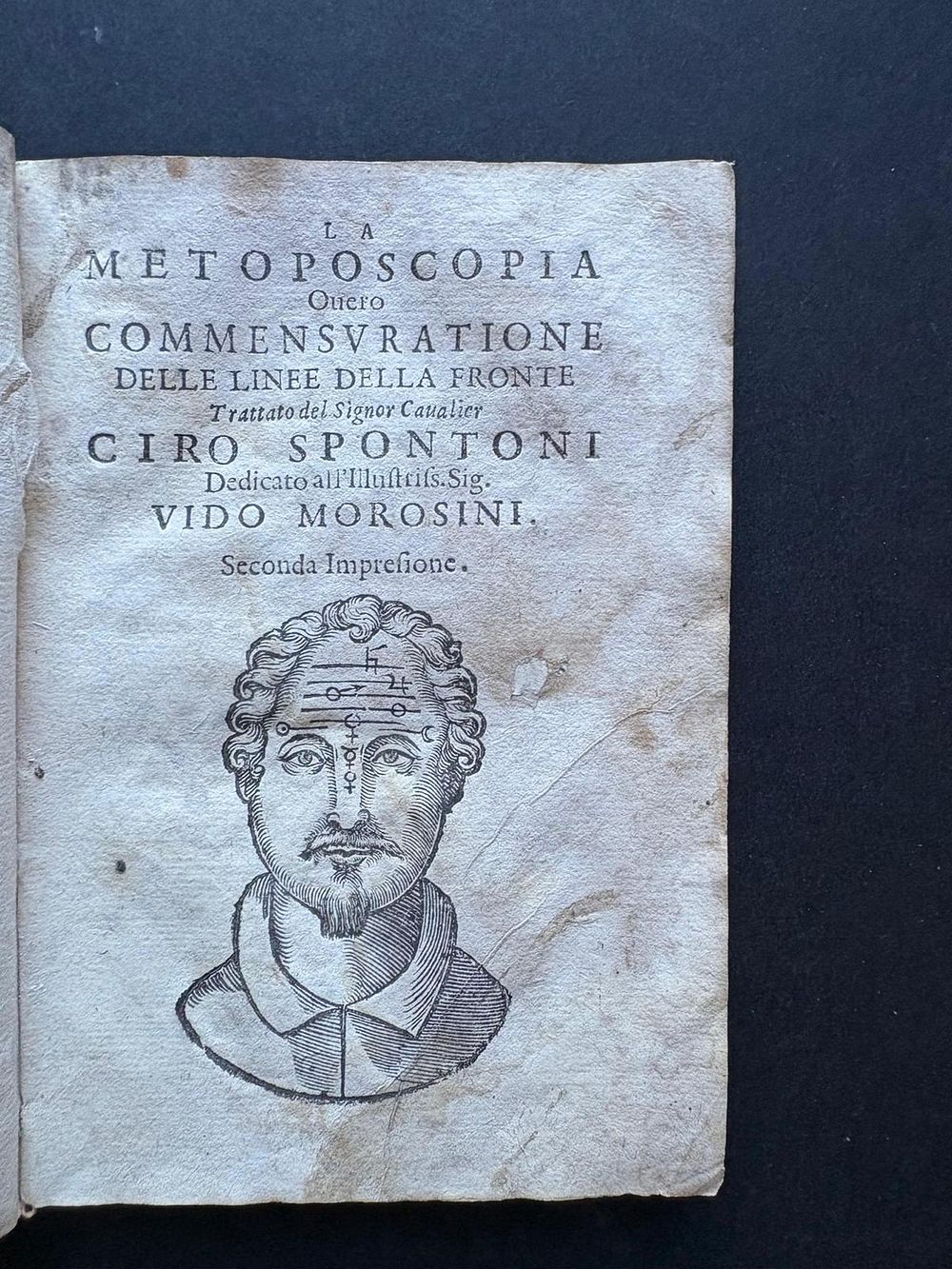
[ALCHEMY, MAGIC & ESOTERICA] - SPONTONI, Ciro (c. 1552–c. 1610) - La Metoposcopia overo commensuratione delle linee della fronte - SPONTONI, Ciro (c. 1552–c. 1610) La Metoposcopia overo commensuratione delle linee della fronte. Trattato del signor cavalier Ciro Spontoni. Venice: Evangelista Deuchino, 1629. 8vo (152 mm). 104, [8] pp., the final blank leaf preserved and bearing manuscript notes by an early owner. Numerous woodcut illustrations in the text, including a woodcut diagram on the title-page; printer’s device at colophon. Contemporary limp vellum. SECOND EDITION (“SECONDA IMPRESSIONE”) OF THIS RARE AND CURIOUS SEVENTEENTH-CENTURY TREATISE ON METOPOSCOPY — THE ART OF INTERPRETING CHARACTER, TEMPERAMENT AND DESTINY FROM THE LINES OF THE HUMAN FOREHEAD. First published at Venice in 1626, Spontone’s Metoposcopia belongs to the remarkable early modern tradition in which physiognomy, astrology and divination converged in an attempt to read the invisible qualities of an individual from the visible signs of the body. Unlike general physiognomy, which sought meaning in the overall appearance of the face and body, metoposcopy concentrated specifically upon the forehead. Spontone argues that the lines and configurations found there differ from person to person and can therefore reveal not only qualities of character and temperament but also aspects of past and present life and even events yet to come. The work attempts to transform this divinatory practice into a systematic visual discipline. Its numerous woodcut diagrams illustrate different configurations of forehead lines, enabling the reader to compare the subject before him with the patterns described in the text. Spontone associates the lines and regions of the forehead with astrological influences, reflecting a period in which celestial correspondences remained deeply embedded in theories of medicine, temperament and the human body. The position, direction and intersection of the lines were interpreted as signs from which longevity, disposition, fortune and other characteristics might supposedly be inferred. The treatise thus occupies an intriguing position between physiognomy, judicial astrology and occult divination, and offers a particularly vivid example of the early seventeenth-century desire to construct systems capable of translating bodily appearance into knowledge of the hidden individual. Spontone’s method is especially striking for the confidence with which the forehead is presented as an autonomous field of interpretation. The visible lines of the skin become, in effect, a diagram to be deciphered — a physical surface upon which internal character and celestial influence were believed to leave their marks. The Metoposcopia appeared only after Spontone’s death and was prepared for publication by Giovanni Battista Spontone. The first edition was issued in Venice in 1626; the present second impression of 1629 followed only three years later. Subsequent editions testify to the continuing fascination exercised by the subject during the seventeenth century. The survival of the final blank leaf, here bearing manuscript annotations by an early owner, is particularly appealing in a small practical book of this kind and provides evidence of its early readership and use. A COMPLETE COPY IN CONTEMPORARY LIMP VELLUM OF A RARE AND HIGHLY VISUAL SEVENTEENTH-CENTURY WORK ON THE OCCULT READING OF THE HUMAN FOREHEAD, PRESERVING THE FINAL BLANK WITH EARLY MANUSCRIPT NOTES. References: Michel & Michel, VII, p. 148; Thorndike, A History of Magic and Experimental Science, VI, p. 506; cf. Cicognara 2471.