Bidspirit auction | [ALCHEMY, MAGIC & ESOTERICA] -
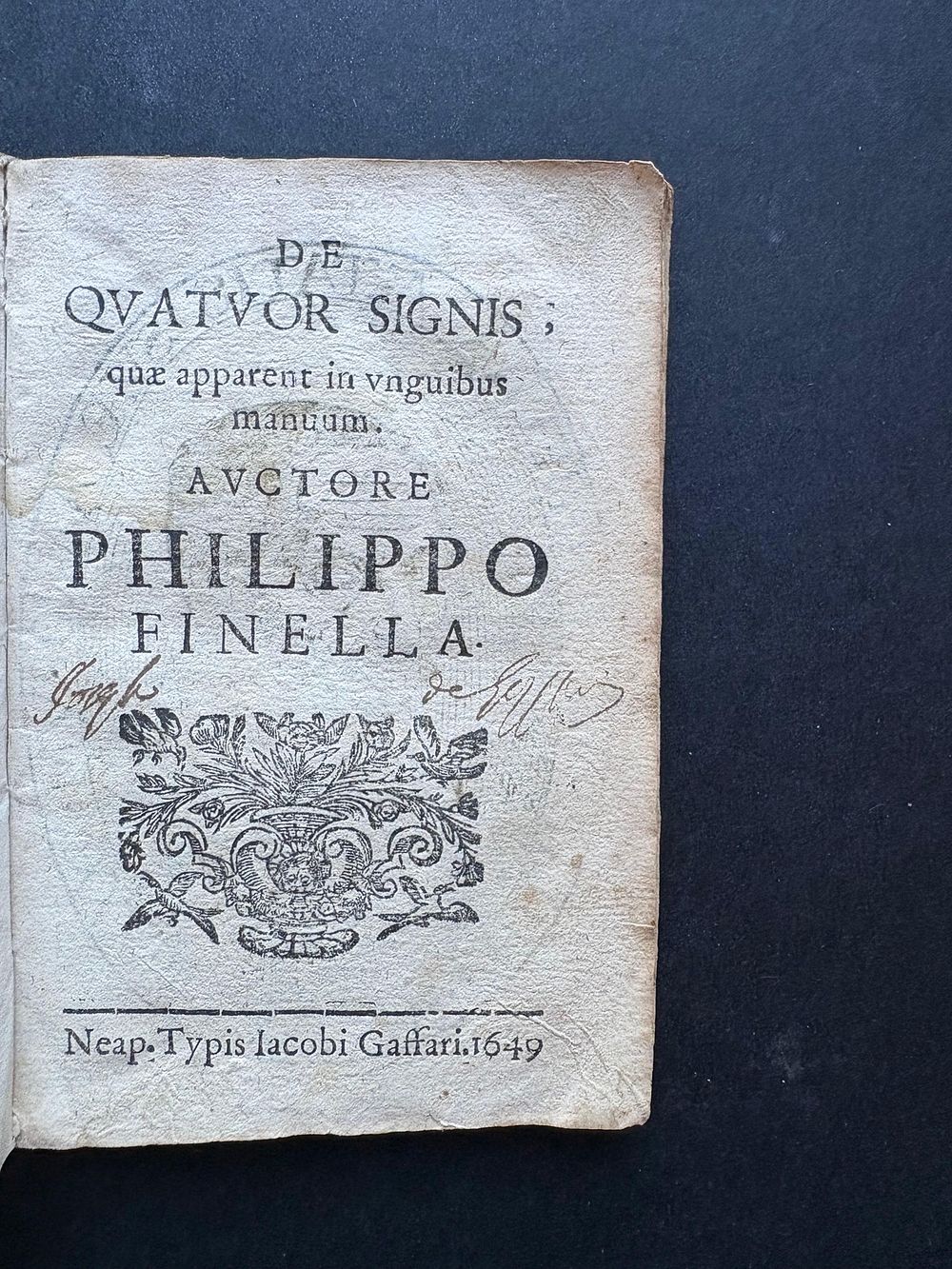
[ALCHEMY, MAGIC & ESOTERICA] - FINELLA, Filippo (1584–1650) - De quatuor signis quae apparent in unguibus manuum - FINELLA, Filippo (1584–1650) De quatuor signis, quae apparent in unguibus manuum. Naples: Giacomo Gaffari, 1649. 8vo (150 × 100 mm). 68, [3] pp. Woodcut ornament on title, woodcut portrait of the author on A1v, woodcut illustrations and initials. Some browning, light waterstaining to the first gathering and a few minor stains. Contemporary vellum, lightly rubbed, with some chipping and a few tiny wormholes to rear cover. Provenance: contemporary inscription on front endpaper, “Hos libros habui Roma apud madragolina [?] anno 1651”; another contemporary ownership inscription, largely illegible; possibly Joseph de Rossi, contemporary ownership inscription on title. FIRST EDITION. AN EXTREMELY RARE SEVENTEENTH-CENTURY TREATISE ON PHYSIOGNOMY, ASTROLOGY AND THE DIVINATORY INTERPRETATION OF THE HUMAN NAILS. One of the most curious works of Filippo Finella, the Neapolitan writer and practitioner of physiognomy whose publications occupy the borderland between early modern medicine, astrology, divination and the study of the human body. Published in Naples in 1649, De quatuor signis develops a subject which Finella had touched upon in his earlier writings on natural physiognomy. In twenty-one chapters he examines the different signs and colours appearing on the fingernails — principally white, black, red and ash-grey — and interprets them according to their position, bodily significance and supposed astrological influence. The colours are further related to the traditional four humours of the human body and to the dominant planets. Each finger is considered according to its planetary correspondence: the thumb with Venus, the index finger with Jupiter, the middle finger with Saturn, the ring finger with the Sun and the little finger with Mercury. Through this elaborate system, apparently insignificant marks on the nails become signs from which character, temperament and future circumstances might be inferred. The treatise belongs to the extraordinary tradition of seventeenth-century physiognomy and astrological medicine, in which the visible features of the body were regarded as outward manifestations of hidden physical, moral and celestial forces. Finella's approach reflects the intellectual environment of Baroque Naples and the continuing influence of the physiognomic tradition associated above all with Giambattista della Porta. Finella produced an extensive series of works on natural physiognomy, moles, the lines of the forehead, astrology and related divinatory sciences. His writings enjoyed sufficient circulation to be found in major European collections, although individual editions are today often of considerable rarity. The present work is recorded, for example, in the Wellcome Collection in only small-format copies, where it is catalogued as a 68-page illustrated treatise specifically concerning fingernails and physiognomy. The woodcut portrait is of particular interest within Finella's corpus: portraits appearing in his works provide an important source for establishing his birth date of 1584. The accompanying woodcut illustrations translate his physiognomic and astrological system into a practical visual language appropriate to the compact manual format. The contemporary vellum binding and early ownership inscriptions — including one explicitly dated Rome, 1651, only two years after publication — add considerable interest to the present copy. A REMARKABLY RARE FIRST EDITION OF ONE OF THE MOST UNUSUAL BOOKS OF SEVENTEENTH-CENTURY PHYSIOGNOMY: AN ILLUSTRATED MANUAL DEVOTED ENTIRELY TO READING HUMAN CHARACTER, TEMPERAMENT AND CELESTIAL INFLUENCE THROUGH THE SIGNS VISIBLE ON THE FINGERNAILS. References: Thorndike VIII, p. 460; Dizionario Biografico degli Italiani, XLVIII, s.v. “Filippo Finella”; Wellcome Collection; NUC Pre-1956, 172, p. 518.