Bidspirit auction | [ALCHEMY, MAGIC & ESOTERICA] -
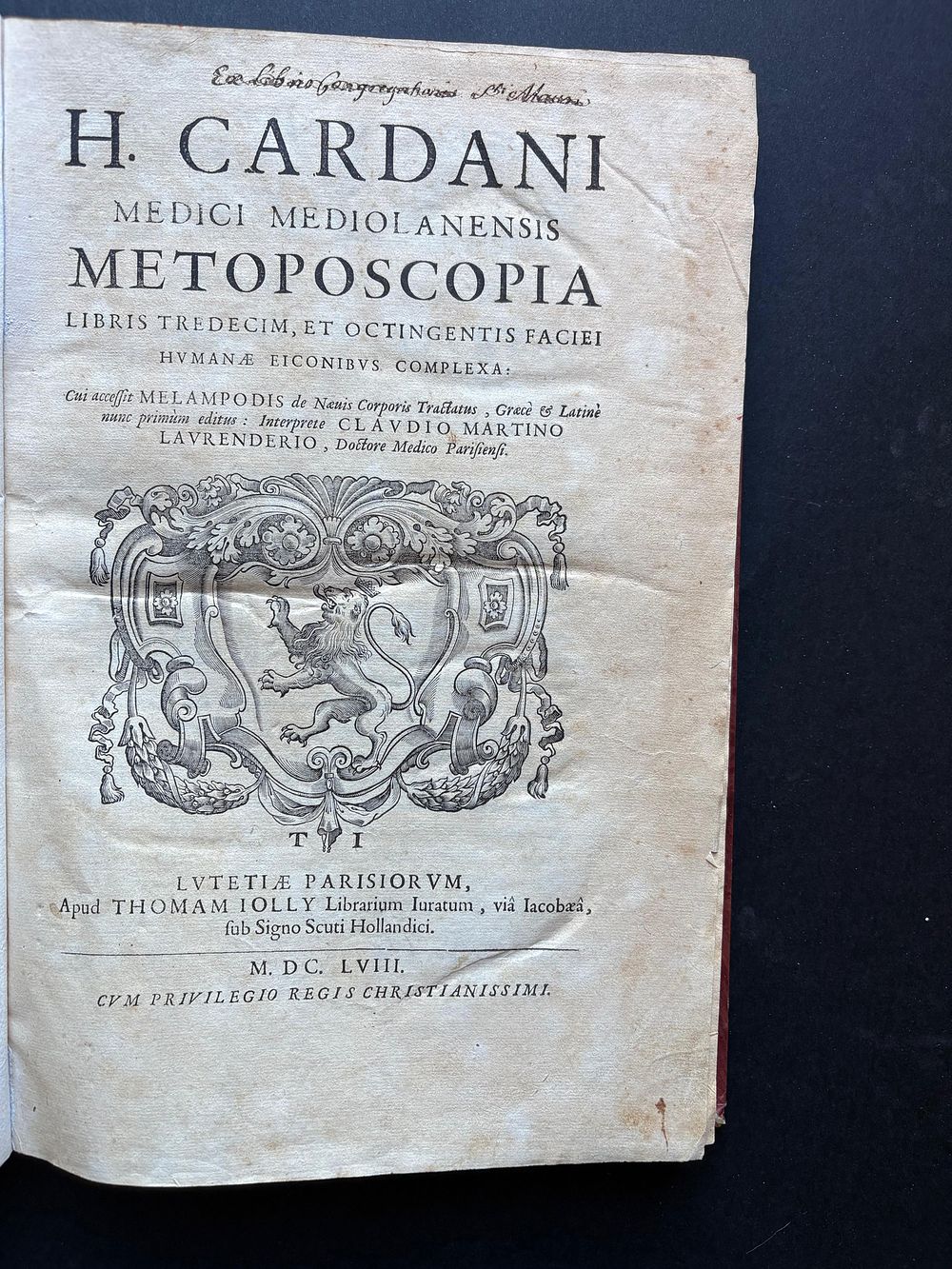
[ALCHEMY, MAGIC & ESOTERICA] - CARDANO, Girolamo (1501–1576) - Metoposcopia libris tredecim - CARDANO, Girolamo (1501–1576). Metoposcopia, libris tredecim, et octingentis faciei humanae eiconibus complexa. Cui accessit Melampodis De naevis corporis tractatus, Graece et Latine nunc primum editus, interprete Claudio Martino Laurenderio. Paris: Thomas Jolly, 1658. Folio. [8], VIII, 225, [3] pp. Printer’s device on title, ornamental initials and approximately 800 remarkable woodcut representations of the human face, three full-page. Nineteenth-century vellum, spine with six raised bands and lettering-piece. Complete. First posthumous edition, published in the same year as the French translation. An extraordinary and profusely illustrated work by Girolamo Cardano, one of the most celebrated physicians, mathematicians and natural philosophers of the Renaissance, devoted to metoposcopy: the interpretation of character, temperament and destiny through the configuration of the forehead and its lines. Written during Cardano’s lifetime but never published by him, the Metoposcopia finally appeared at Paris in 1658, more than eighty years after his death. Its thirteen books constitute one of the most elaborate attempts ever made to create a systematic language of the human face. Cardano regarded the forehead as a kind of celestial map. Its principal lines were associated with the seven traditional planets — Saturn, Jupiter, Mars, the Sun, Venus, Mercury and the Moon — and their position, direction, intersection and combination were interpreted according to astrological principles. The extraordinary series of approximately 800 woodcut faces gives visual form to this system. Minute variations in the lines of the forehead are classified and interpreted as indications of temperament, intelligence, fortune, danger, illness, social condition and even circumstances surrounding an individual’s death. The work consequently occupies a fascinating position at the intersection of physiognomy, medicine and astrology. Rather than treating the face merely as an expression of physical temperament, Cardano attempted to connect the visible human body with the larger celestial order, making facial appearance a reflection of the same planetary forces that formed the basis of the horoscope. Cardano was among the most remarkable polymaths of the sixteenth century. A distinguished physician and professor of medicine at Pavia and Bologna, he was equally celebrated for his contributions to algebra, probability, natural philosophy and astrology. His belief in the intimate correspondence between the macrocosm and the individual human being permeates much of his work and finds one of its most visually striking expressions in the Metoposcopia. The volume concludes with the De naevis corporis attributed to the ancient author Melampus, here published in Greek with a Latin translation by Claude Martin de Laurendière. The treatise interprets moles and other bodily marks as signs of character and future events, providing an appropriate classical complement to Cardano’s examination of the forehead. The simultaneous appearance of the Latin and French editions in Paris in 1658 testifies to the continuing fascination exerted by Cardano’s thought almost a century after the intellectual world in which the work had been conceived. A remarkable first edition of one of the most spectacular illustrated works on Renaissance physiognomy and astrology, distinguished by its extraordinary sequence of some 800 human faces and by Cardano’s ambitious attempt to transform the forehead into a map of planetary influence, human character and destiny.