Bidspirit auction | [ALCHEMY, MAGIC & ESOTERICA] -
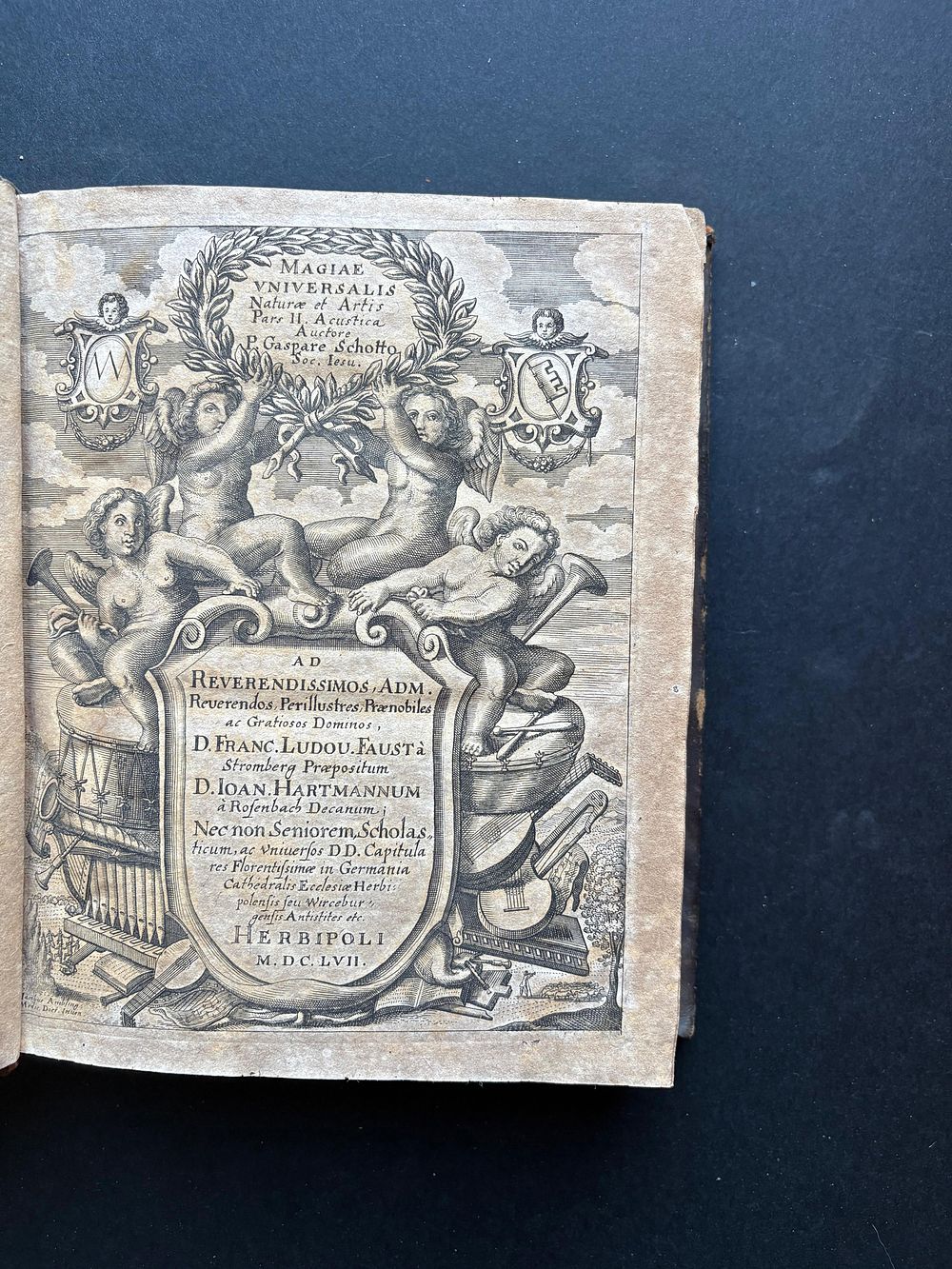
[ALCHEMY, MAGIC & ESOTERICA] - SCHOTT, Gaspar (1608–1666) - Magia universalis naturae et artis - SCHOTT, Gaspar (1608–1666). Magia Universalis Naturae et Artis, sive Recondita Naturalium & Artificialium rerum Scientia... Opus Quadripartitum. Pars I. Optica. II. Acoustica. III. Mathematica. IV. Physica. Bamberg, Johann Martin Schönwetter, 1677. RARE AND COMPLETE SET OF ONE OF THE GREAT ILLUSTRATED ENCYCLOPAEDIAS OF SEVENTEENTH-CENTURY SCIENCE AND NATURAL MAGIC. 4 volumes, 4to. Complete with the four allegorical engraved frontispieces and all 90 copper-engraved plates, in addition to numerous illustrations and diagrams in the text. Vol. I, Optica: 538 pp., engraved allegorical frontispiece and 25 engraved plates. Vol. II, Acoustica: 432 pp., engraved allegorical frontispiece and 31 engraved plates. Vol. III, Thaumaturgus Mathematicus: 732 pp., engraved allegorical frontispiece and 21 engraved plates. Vol. IV, Thaumaturgus Physicus: 670 pp., engraved allegorical frontispiece and 13 engraved plates. Uniform contemporary full calf, spines richly decorated in gilt, red morocco lettering-pieces with titles in gilt. A remarkably attractive and entirely genuine seventeenth-century set preserved in its original bindings. Small restoration to the blank margin of p. 129 in the fourth volume. Some leaves browned, occasionally more noticeably, owing to the quality of the paper, a characteristic frequently encountered in copies of this edition. Otherwise a very good and appealing copy. Gaspar Schott's monumental Magia Universalis is one of the most ambitious attempts of the Baroque age to encompass the hidden workings of nature, mathematics and experimental science within a single richly illustrated encyclopaedia. Written at the fascinating intellectual frontier where Renaissance magia naturalis meets the new experimental science of the seventeenth century, the work brings together optics, acoustics, music, mechanics, mathematics, magnetism, cryptography, pyrotechnics, medicine, physiognomy and a remarkable variety of scientific curiosities and mechanical inventions. Schott had studied under Athanasius Kircher and later worked closely with him in Rome. From 1652 to 1655 the two Jesuit polymaths renewed an intense scientific collaboration, and Schott became one of the principal disseminators of Kircher's experiments, inventions and encyclopaedic scientific culture throughout Europe. The first part, Magia Optica, investigates light, colour, vision, lenses, mirrors, perspective, optical illusion and projection. Among its most celebrated subjects are anamorphosis, the camera obscura and ingenious optical devices, placing the work within the early history of projected images and optical experimentation. The second part, Magia Acoustica, constitutes an extraordinary seventeenth-century survey of sound. Schott discusses the propagation of sound, echoes, the human voice, musical theory, musical instruments, acoustic effects and mechanical devices. Particularly fascinating are his accounts of musical and acoustic marvels, including the celebrated treatment of tarantism and the supposed curative power of music against the bite of the tarantula. The third part, Thaumaturgus Mathematicus, explores the apparently miraculous effects obtainable through mathematics and mechanics, describing and illustrating a multitude of machines, instruments and physical experiments. The fourth and final part, Thaumaturgus Physicus, ventures still further into the seventeenth-century world of scientific curiositas. Its eight books encompass cryptography and secret writing, pyrotechnics, magnetism, sympathy and antipathy, medicine, divination, physiognomy and chiromancy, Schott repeatedly seeking natural or physical explanations for phenomena which to the uninitiated might appear magical. Throughout the four volumes, the extraordinary engraved apparatus transforms the work into a visual repertory of Baroque scientific imagination: optical experiments, mirrors and lenses, acoustic phenomena, musical instruments, mechanical contrivances, mathematical devices and demonstrations of the hidden forces of nature. Complete sets of the four parts are particularly desirable, the individual volumes having frequently been separated on account of their distinct scientific subjects. The present copy is especially appealing for retaining all four parts together in uniform contemporary full calf and for being complete with all four engraved frontispieces and the entire suite of 90 engraved plates. A FINE, COMPLETE AND HIGHLY ATTRACTIVE COPY OF SCHOTT'S MASTERPIECE: A LANDMARK OF SEVENTEENTH-CENTURY SCIENTIFIC CURIOSITY AND ONE OF THE MOST SPECTACULAR ILLUSTRATED WORKS TO EMERGE FROM THE INTELLECTUAL WORLD OF ATHANASIUS KIRCHER.