Bidspirit auction | [ALCHEMY, MAGIC & ESOTERICA] -
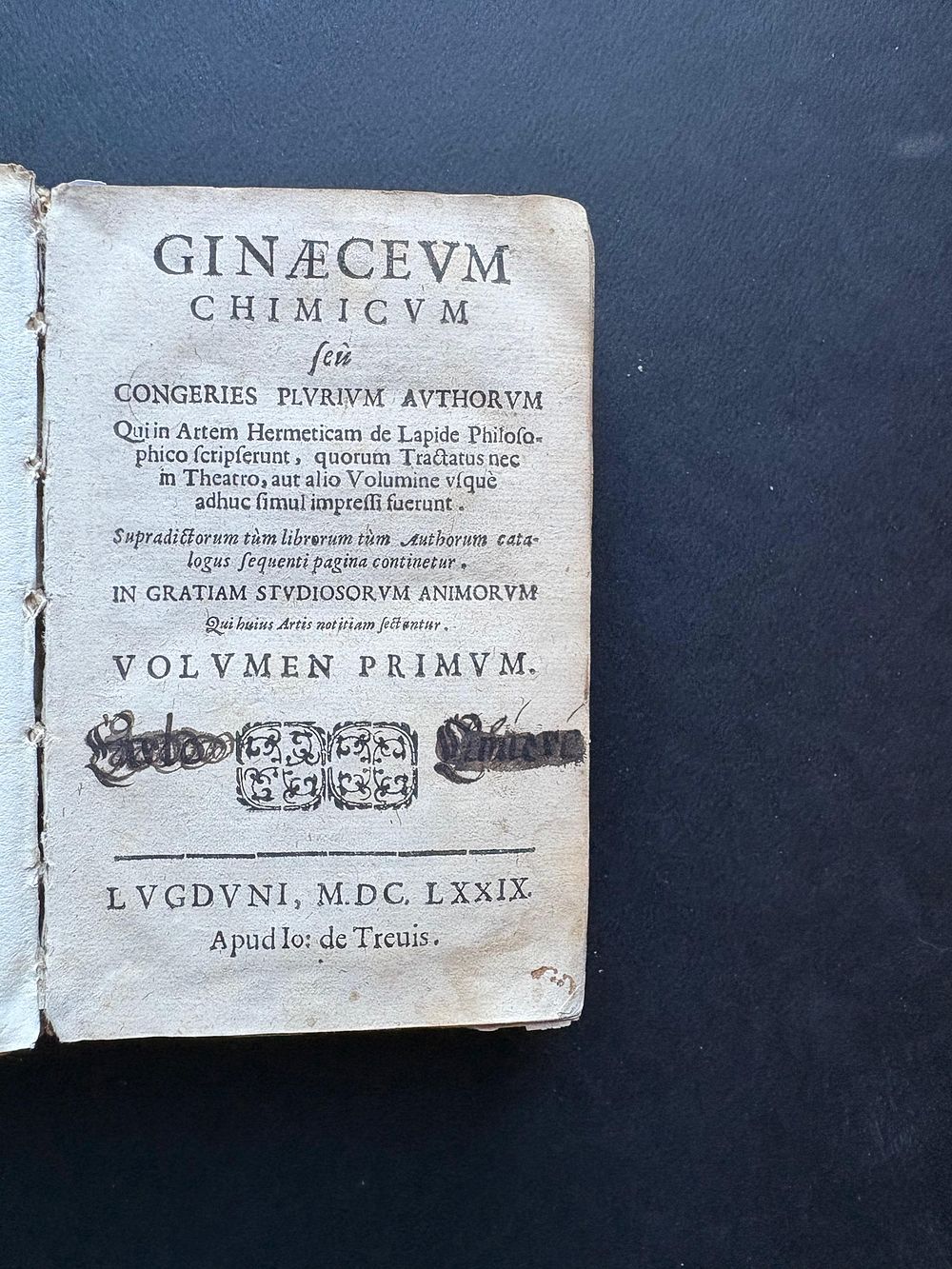
[ALCHEMY, MAGIC & ESOTERICA] - - Ginaeceum chimicum - Ginaeceum Chimicum, seu Congeries plurium authorum qui in Artem Hermeticam de Lapide Philosophico scripserunt, quorum tractatus nec in Theatro, aut alio volumine usque adhuc simul impressi fuerunt. Volumen primum. Lyon: apud Io. de Trevis, 1679. 8vo. [2], 727 pp. Contemporary vellum, manuscript title to spine. Contemporary ownership inscription on the title-page deliberately erased, otherwise preserving traces of its early provenance. Provenance: Dr M. Bourrée, Châtillon-sur-Seine, nineteenth-century engraved bookplate, probably identifiable with Dr Léon Bourrée, physician at Châtillon-sur-Seine and a documented collector and antiquarian; later with the bookseller Émile Nourry, Paris, his bookseller’s label on the front pastedown. FIRST EDITION OF AN EXCEPTIONALLY RARE AND IMPORTANT SEVENTEENTH-CENTURY ANTHOLOGY OF ALCHEMICAL AND HERMETIC TEXTS, BRINGING TOGETHER TWENTY-ONE TREATISES ON THE PHILOSOPHERS’ STONE, THE GENERATION AND TRANSMUTATION OF METALS, MERCURY, SULPHUR AND THE THEORY AND PRACTICE OF THE GREAT WORK. The Ginaeceum Chimicum occupies a distinctive place among the great alchemical compilations of the seventeenth century. Like the Theatrum Chemicum and the Musaeum Hermeticum, it attempted to preserve and assemble within a single volume a substantial body of writings belonging to the medieval and early modern tradition of the Ars Hermetica. The title itself describes the book as a Congeries plurium authorum — a gathering of numerous authors who had written on the Hermetic art and the Philosophers’ Stone — and expressly emphasises that the texts had not previously been printed together in this form. The collection encompasses some of the central authorities of Western alchemy, including writings attributed to Geber, together with works connected with Avicenna, John Dastin, John Belye, Giovanni Bracesco, Georg Horn and other medieval and early modern adepts. The subjects range from the nature and generation of metals to mercury and sulphur, tinctures, metallic transformation, the preparation of the philosophical matter and the production of the Lapis Philosophorum. Among its most important components is the celebrated Summa perfectionis attributed to Geber, one of the foundational texts of Latin medieval alchemy. The volume also transmits the Liber investigationis, writings on minerals associated with Avicenna, and a substantial sequence of later texts devoted to the practical and theoretical problems of metallic transmutation. Of exceptional importance are the contributions associated with the Italian Hermetic philosopher and poet Francesco Maria Santinelli (1627–1697). The Ginaeceum contains the first printed appearances of the Minera Philosophorum, the Radius ab Umbra and the related Dialogus, initially published anonymously here and reissued the following year in the Androgenes Hermeticus. These texts belong to the same intellectual environment as Santinelli’s celebrated Lux Obnubilata, one of the most influential Italian alchemical works of the later seventeenth century. The Minera Philosophorum and Radius ab Umbra address one of the central mysteries of Hermetic philosophy: the identification of the prima materia, the hidden substance from which the Philosophers’ Stone is to be generated. Through the traditional language of sulphur and mercury, male and female, fixed and volatile, dissolution and coagulation, the works present the Great Work as both a transformation of matter and an investigation into the hidden operations of Nature. The extraordinary breadth of the Ginaeceum makes it an important witness to the continuity of the alchemical tradition at precisely the period when experimental chemistry was beginning to emerge as an independent discipline. Medieval authorities such as Geber and Avicenna appear beside seventeenth-century authors, illustrating the persistence and reinterpretation of traditional alchemical concepts in the age of Boyle and early modern experimental science. Although the title designates the book “Volumen primum, ” no continuation appears to have been published, leaving this substantial volume as the complete surviving form of the project. The present copy is particularly attractive for its contemporary vellum binding with manuscript spine title and for its notable French provenance. The nineteenth-century bookplate of M. Bourrée, docteur-médecin à Châtillon-sur-Seine, can probably be identified with Dr Léon Bourrée, a physician at Châtillon-sur-Seine whose collecting activities are independently documented. Contemporary archaeological records refer explicitly to antiquities preserved in the cabinet du Docteur Bourrée, confirming his activity as a collector. Of further interest is the bookseller’s label of Émile Nourry (1870–1935), the important Parisian antiquarian bookseller, publisher and scholar better known under the pseudonym Pierre Saintyves.