Bidspirit auction | [ALCHEMY, MAGIC & ESOTERICA] -
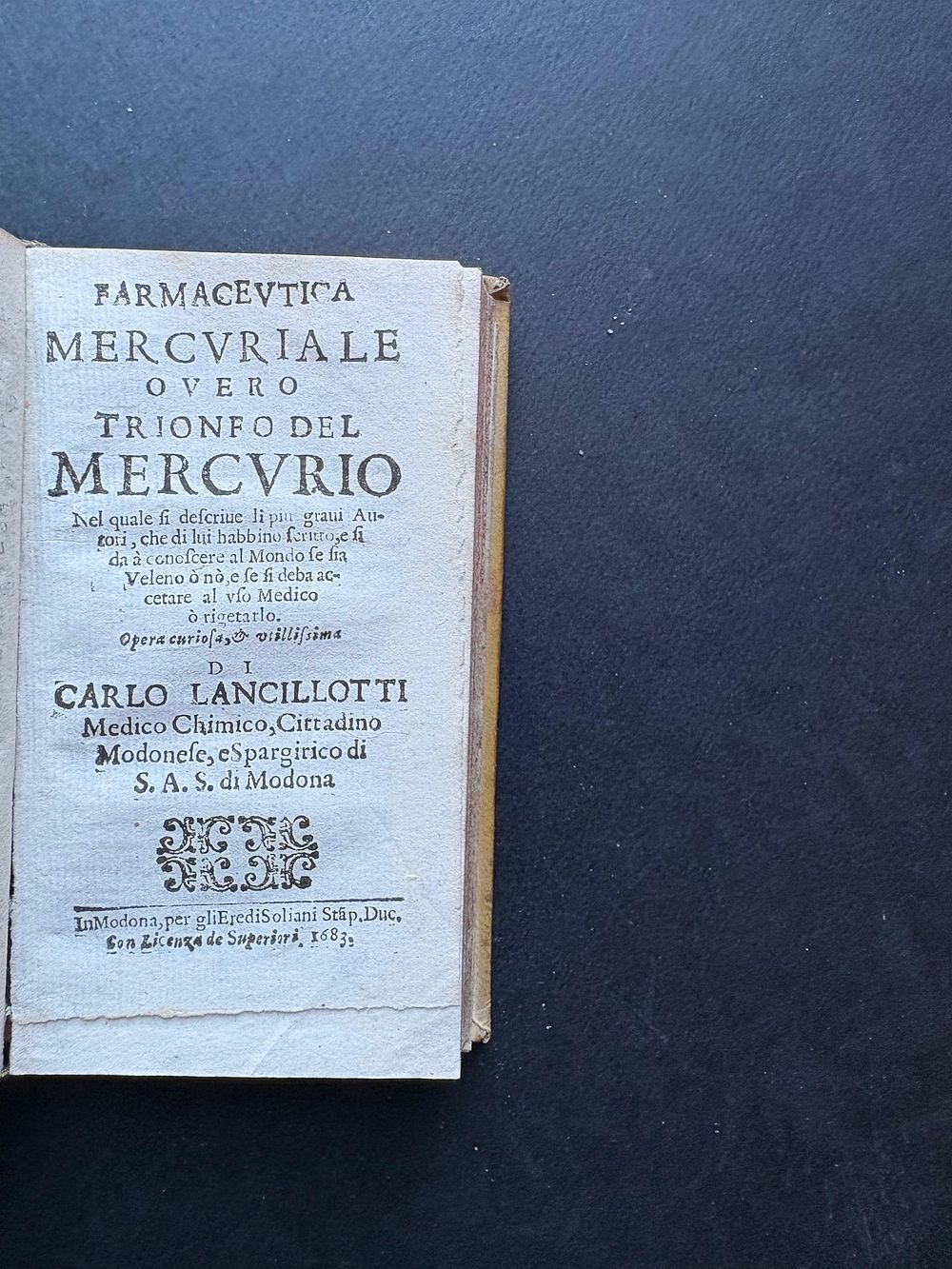
[ALCHEMY, MAGIC & ESOTERICA] - LANCILLOTTI, Carlo - Farmaceutica antimoniale / Farmaceutica mercuriale - LANCILLOTTI, Carlo Farmaceutica antimoniale, overo Trionfo dell’antimonio – Farmaceutica mercuriale, overo Trionfo del mercurio. Modena: heirs of Soliani, 1683. 2 works in one volume, 12mo (140 × 75 mm). Farmaceutica antimoniale: 35, [1 blank], 287 pp. Farmaceutica mercuriale: [2], 8, [2 blank], 208 pp. Together illustrated with an allegorical frontispiece and 5 plates, comprising 2 folding engraved plates and 3 full-page woodcuts depicting chemical apparatus and processes. Contemporary stiff vellum, manuscript titles to spine, sprinkled edges. RARE FIRST EDITIONS OF TWO REMARKABLE SEVENTEENTH-CENTURY ITALIAN TREATISES ON IATROCHEMISTRY AND CHEMICAL PHARMACY, DEVOTED TO THE MEDICINAL USE OF ANTIMONY AND MERCURY. Carlo Lancillotti, a Modenese physician and chemist active in the tradition of seventeenth-century spagyric medicine, here examines two of the most powerful, controversial and symbolically charged substances employed by early modern chemical physicians: antimony and mercury. The Farmaceutica antimoniale, significantly subtitled Trionfo dell’antimonio, is an extended defence of the medical virtues of antimony against physicians who sought to exclude it from therapeutic practice. Lancillotti argues that the dangers traditionally associated with the mineral arose not from antimony itself but from inadequate knowledge of its chemical preparation, and describes methods intended to transform it into effective medicinal compounds. The work belongs to the long controversy surrounding antimonial remedies, which had divided European physicians since the sixteenth century. In opposition to strictly Galenic pharmacology, chemical physicians maintained that mineral substances could be rendered therapeutically useful through appropriate processes of purification, separation and transformation. Its companion, the Farmaceutica mercuriale, overo Trionfo del mercurio, applies a comparable argument to mercury, asking explicitly whether it should be considered a poison or admitted into medical practice. Lancillotti marshals the authority of earlier Greek, Arabic and Renaissance physicians in support of its medicinal employment, considering both raw mercury and the numerous compounds and preparations derived from it. Mercury had by this period acquired particular importance in European medicine as one of the principal treatments for syphilis, while remaining highly controversial because of its evident toxicity. Lancillotti's treatise therefore provides a revealing document of the seventeenth-century attempt to reconcile empirical therapeutic practice with the developing techniques of chemical pharmacy. Throughout both works, traditional medical authorities coexist with the vocabulary, apparatus and experimental procedures of the chemical laboratory. The result is an important testimony to the gradual transformation of pharmacy during the seventeenth century, when distillation, calcination, sublimation and related techniques increasingly entered medical practice alongside the older Galenic materia medica. The illustrations reinforce this practical character. The folding engravings and full-page woodcuts depict furnaces, vessels, distillation apparatus and other equipment used in the preparation of chemical medicines, making the volume particularly significant as a visual record of seventeenth-century pharmaceutical practice. Lancillotti's writings circulated beyond Italy and form part of the European dissemination of practical chemical knowledge during the later seventeenth century. His works were known in Dutch and German translations and were subsequently cited in historical bibliographies of chemistry. Condition: misbound: the title-pages of the two works have been interchanged, while the allegorical frontispiece has been bound at the end of the volume. The folding plates with small tears and marginal losses; the full-page woodcuts somewhat closely trimmed, with minor loss to the printed area at the margins. Some occasional minor defects, but preserving the complete illustrated apparatus of the two works in a contemporary vellum binding. A RARE SURVIVAL OF TWO COMPLEMENTARY TREATISES AT THE INTERSECTION OF MEDICINE, PHARMACY AND EARLY CHEMISTRY, OFFERING AN UNUSUALLY DIRECT ACCOUNT OF THE SEVENTEENTH-CENTURY MEDICAL DEBATE SURROUNDING ANTIMONY AND MERCURY. References: Ferguson, Bibliotheca Chemica, II, p. 6; Tiraboschi, III, p. 70.