Bidspirit auction | [ALCHEMY, MAGIC & ESOTERICA] -
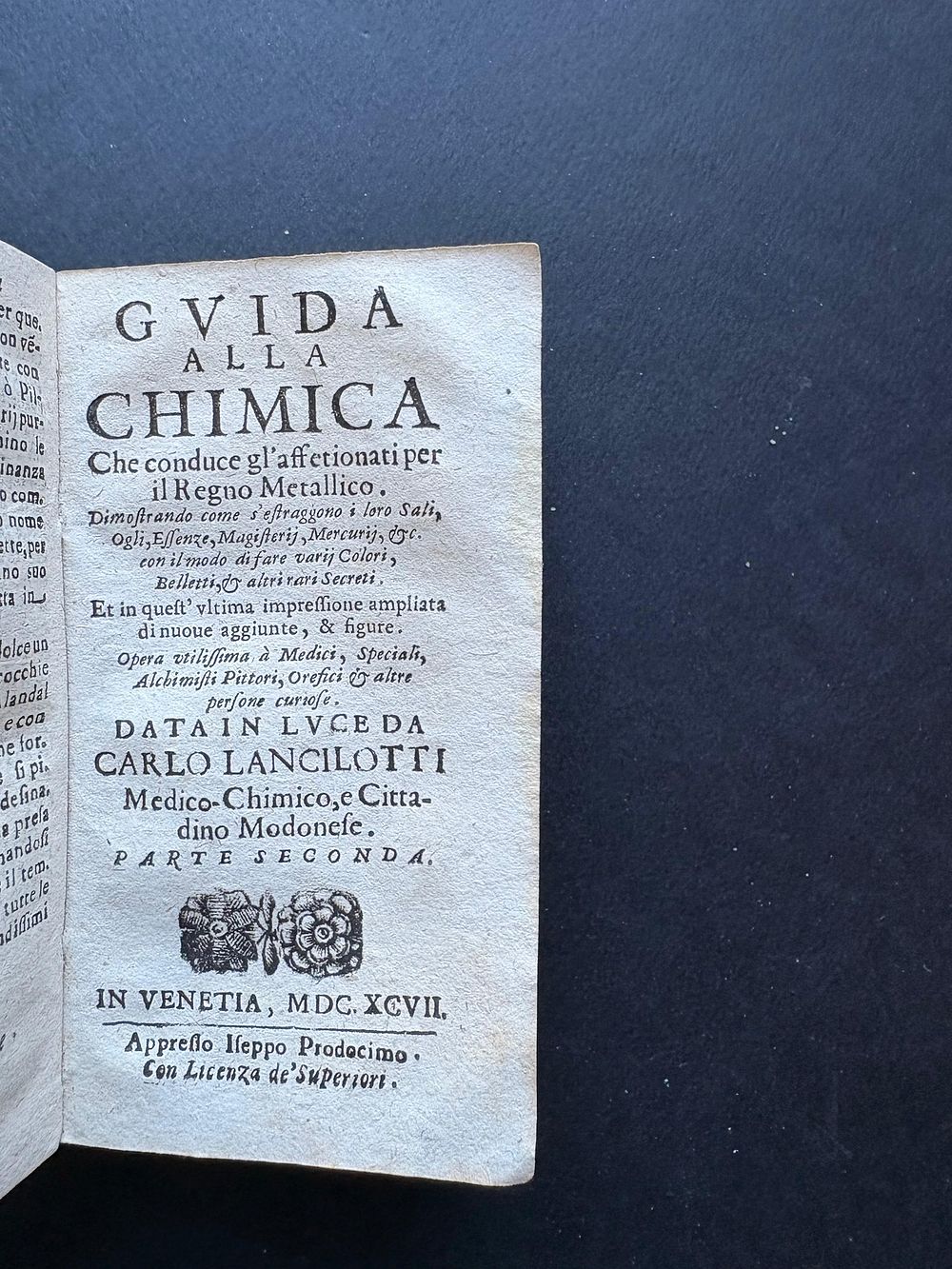
[ALCHEMY, MAGIC & ESOTERICA] - LANCILLOTTI, Carlo - Guida alla chimica - LANCILLOTTI, Carlo Guida alla chimica che per suo mezzo conduce gl’affetionati alle operationi sopra ogni corpo misto animale, minerale, o vegetabile. Dichiarando come s’estraggono i loro sali, ogli, essenze, magisterij, mercurij, &c. con il modo di fare varij colori, belletti, & altri rari secreti. Et in quest’ultima impressione ampliata di nuove aggiunte, & figure. Venice: Iseppo Prodocimo, 1697. 3 parts in one volume, 16mo. (24), 188; (12), 126; (16), 226 pp. 10 full-page woodcut plates, depicting furnaces, alembics, vessels and other chemical apparatus, complete as called for by the table at the end of the volume. Contemporary boards. A COMPLETE COPY OF THE ENLARGED SEVENTEENTH-CENTURY EDITION OF ONE OF THE PRINCIPAL ITALIAN PRACTICAL MANUALS OF CHEMISTRY AND SPAGYRIC MEDICINE, PRESERVING THE FULL SERIES OF TEN WOODCUT PLATES. First published at Modena in 1672, Lancillotti’s Guida alla chimica enjoyed considerable success and appeared in several subsequent editions. The present Venetian edition of 1697 is explicitly described on the title-page as enlarged with new additions and illustrations. Lancillotti conceived the Guida as a practical introduction to chemical operations applicable to substances belonging to the animal, mineral and vegetable kingdoms. The work provides an unusually broad survey of the techniques, materials and apparatus employed in late seventeenth-century chemistry, pharmacy and spagyric medicine. The first part introduces the fundamental operations of the chemical laboratory and the management of fire, discussing processes including corrosion, precipitation, calcination, sublimation, distillation, putrefaction, circulation and coagulation. Considerable attention is devoted to the preparation of waters, oils, tinctures, essences, extracts, spirits and salts. The second part is principally devoted to the mineral kingdom, with particular attention to metals, mercury and their chemical treatment, purification and pharmaceutical applications. The third part considerably broadens the scope of the manual, treating the human body, diseases and pharmaceutical remedies, together with medicinal substances derived from animals, birds, fish and insects. Of particular interest is the series of ten full-page woodcut plates, showing furnaces, alembics, retorts, receivers and other equipment required for the operations described in the text. The illustrations provide a vivid visual record of the material culture of the seventeenth-century chemical laboratory and reinforce the essentially practical character of Lancillotti’s manual. The Guida alla chimica belongs to a crucial period in the development of European chemistry, when techniques inherited from alchemy and Paracelsian spagyria were increasingly incorporated into medicine, pharmacy and experimental practice. Lancillotti’s work is especially valuable for the directness with which it records laboratory procedures, apparatus and recipes intended for actual use. COMPLETE IN ALL THREE PARTS AND WITH ALL TEN WOODCUT PLATES, AS CALLED FOR BY THE TABLE AT THE END OF THE VOLUME. A WELL-PRESERVED AND APPEALING COPY OF AN UNCOMMON ITALIAN WORK AT THE INTERSECTION OF EARLY CHEMISTRY, ALCHEMY, PHARMACY AND MEDICINE.