Bidspirit auction | [ALCHEMY, MAGIC & ESOTERICA] -
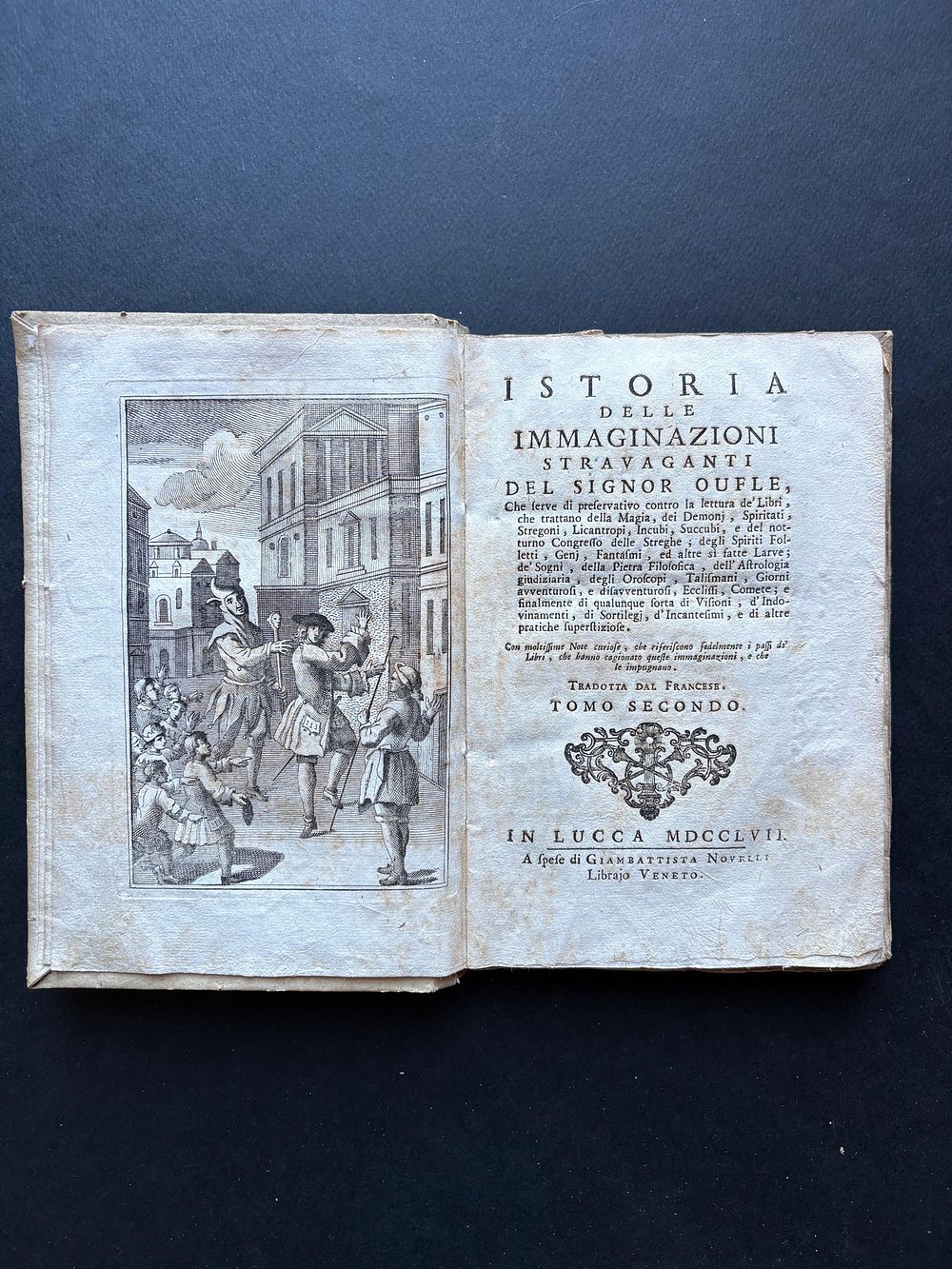
[ALCHEMY, MAGIC & ESOTERICA] - BORDELON, Laurent (1653–1730) - Istoria delle immaginazioni stravaganti del Signor Oufle - BORDELON, Laurent (1653–1730). Istoria delle immaginazioni stravaganti del Signor Oufle, che serve di preservativo contro la lettura de’ libri che trattano della magia, de’ demoni, spiritati, stregoni, licantropi, incubi, succubi e del notturno congresso delle streghe; degli spiriti folletti, geni, fantasmi ed altre sì fatte larve; de’ sogni, della pietra filosofica, dell’astrologia giudiziaria, degli oroscopi, talismani, giorni avventurosi e disavventurosi, eclissi, comete; e finalmente di qualunque sorta di visioni, d’indovinamenti, di sortilegi, d’incantesimi e di altre pratiche superstiziose. Tradotta dal francese. Tome I: 1754. Tome II: Lucca, Giambattista Novelli, 1757. 2 volumes, 8vo. With engraved frontispiece. Complete. A particularly fresh and well-preserved copy, each volume retaining its contemporary interim paper-board binding. An unusual mixed-date set of the Italian translation of Laurent Bordelon’s celebrated Histoire des imaginations extravagantes de Monsieur Oufle, one of the most curious and entertaining early Enlightenment attacks on magic, witchcraft, astrology and popular superstition. First published in French in 1710, Bordelon’s work takes the form of a satirical narrative centred upon Monsieur Oufle, a compulsive reader whose mind has been overwhelmed by books on the occult. Like a supernatural counterpart to Don Quixote, Oufle no longer distinguishes between the imaginary world created by his reading and ordinary reality. Convinced of the existence of werewolves, demons, witches, ghosts and magical transformations, he repeatedly interprets everyday events according to the fantastic literature that fills his library. At one moment he believes himself transformed into a werewolf; elsewhere he fears demonic apparitions, witchcraft, astrological influences and supernatural signs. The comic adventures, however, conceal a serious intellectual purpose. Bordelon intended the book as a “preservative” against credulity. Magic, demonology, judicial astrology, alchemy, talismans, dreams, divination, apparitions, incubi and succubi, the witches’ Sabbath, lycanthropy, eclipses and comets are systematically examined and subjected to rational criticism. The work is consequently much more than a satirical novel. Its extensive notes cite and discuss a remarkable range of earlier books on magic, witchcraft, demonology and occult philosophy. Bordelon thus constructs, almost inadvertently, a substantial repertory of the literature of the supernatural while simultaneously attempting to discredit it. This paradox accounts for much of the book’s enduring fascination: a work written against occult beliefs became, through the breadth of the material it records, an important source for the history of European magic and superstition. Modern scholarship has emphasized the close relationship between Monsieur Oufle and Cervantes’ Don Quixote. Both protagonists are victims of indiscriminate reading: Don Quixote interprets reality through chivalric romance, while Oufle sees the world through demonological, astrological and magical literature. In Bordelon’s hands, the Cervantine model becomes a vehicle for Enlightenment criticism of superstition and irrational belief. The Italian translation is itself significant evidence of the continuing European circulation of the work during the eighteenth century, when debates surrounding magic, witchcraft and supernatural phenomena increasingly confronted the emerging culture of rational and empirical explanation. Of particular appeal in the present copy is the survival of both volumes in their contemporary interim bindings. Such cartonato d’attesa bindings were often intended as temporary protection before a book received a more elaborate covering and consequently survive less frequently than finished bindings. Here they preserve the volumes in an unusually direct and authentic eighteenth-century state. The present set is also bibliographically intriguing: the first volume bears the date 1754, while the second is dated 1757. Standard bibliographical records normally identify the Italian Novelli edition from 1757 onwards; the mixed dating of the present set therefore deserves particular notice. A fine, complete and exceptionally fresh copy of this fascinating Enlightenment critique of occultism and superstition, preserved in its contemporary interim bindings and combining literary satire with one of the period’s richest surveys of magic, witchcraft, demonology, astrology and supernatural belief.