Bidspirit auction | [ALCHEMY, MAGIC & ESOTERICA] -
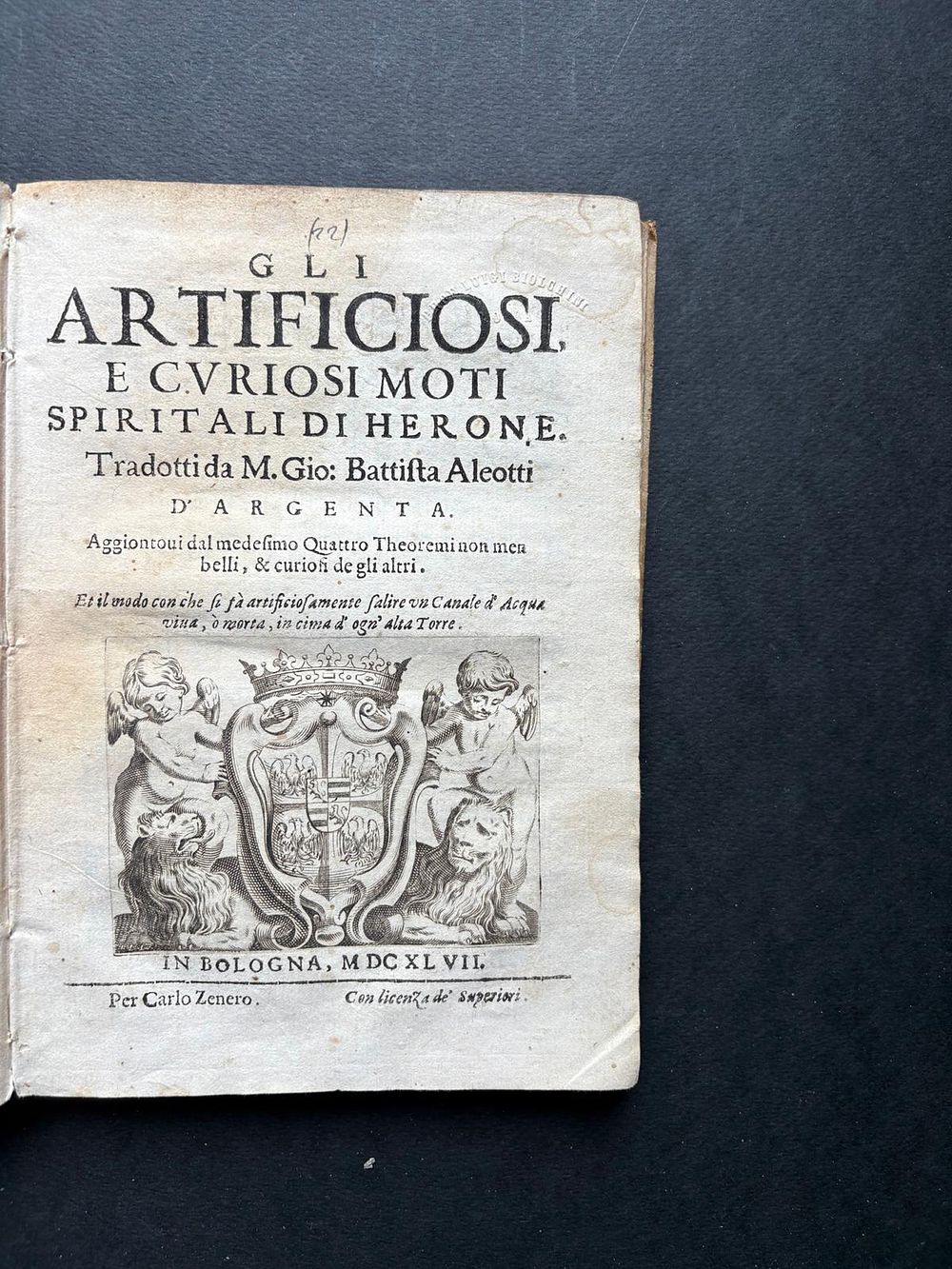
[ALCHEMY, MAGIC & ESOTERICA] - HERO OF ALEXANDRIA. - Gli artificiosi e curiosi moti spiritali di Herone - HERO OF ALEXANDRIA. Gli artificiosi, e curiosi moti spiritali di Herone. Tradotti da M. Gio. Battista Aleotti d’Argenta. Aggiontoui dal medesimo quattro theoremi non men belli, & curiosi de gli altri. Et il modo con che si fà artificiosamente salire un canale d’acqua viva, ò morta, in cima d’ogn’alta torre. Bologna: Carlo Zenero, 1647. 4to. [8], 103, [9] pp. Engraved arms of the dedicatee Scipione Gonzaga on the title-page; numerous woodcut diagrams and illustrations throughout. Complete with all illustrations. Vellum binding. Occasional light staining, otherwise a very good copy. Second edition of Giovanni Battista Aleotti’s important Italian translation of Hero of Alexandria’s Pneumatics, first published at Ferrara in 1589, and one of the most engaging illustrated books devoted to ancient mechanical and hydraulic technology. Hero of Alexandria, active in the first century AD, was one of the most remarkable engineers and experimental writers of antiquity. His Pneumatics describes ingenious devices operating through air pressure, water, steam, siphons and concealed mechanical forces: fountains, vessels, hydraulic mechanisms, sounding devices, automata and machines designed to produce apparently marvellous effects. The work stands at the fascinating intersection of ancient science, engineering and spectacle. Among the devices described are mechanisms capable of imitating birdsong, automatically dispensing liquids, making statues sound trumpets, operating organs through moving air, producing fountains and transforming changes in air or water pressure into mechanical movement. The Italian translation was made by Giovanni Battista Aleotti (1546–1636), architect, engineer and hydraulic specialist, one of the most distinguished technical figures of late Renaissance Italy and later architect of the celebrated Teatro Farnese at Parma. Aleotti did considerably more than translate Hero: he supplemented the ancient text with four original theorems and with a method for raising water to the summit of a high tower, giving the book an additional significance within the history of early modern hydraulics and applied mechanics. These Quattro theoremi, occupying the final section of the volume and provided with their own title-page, were considered sufficiently important to be reprinted later in the great seventeenth-century collection Veterum mathematicorum opera. The numerous woodcuts are essential to the character of the work, translating Hero’s often ingenious mechanical principles into immediately understandable visual form. They document a world in which scientific experimentation, hydraulic engineering and mechanical entertainment were still closely connected, and illustrate the direct transmission of Hellenistic technology into the practical culture of Renaissance and Baroque Europe. The 1647 Bologna edition is the second edition of Aleotti’s translation and preserves both Hero’s ancient mechanical inventions and Aleotti’s important Renaissance additions. A complete and attractive copy of a celebrated illustrated work on early mechanics, pneumatics, hydraulics and automata, combining the technological imagination of ancient Alexandria with the engineering culture of Renaissance Italy.