Bidspirit auction | [ASTRONOMY, MATHEMATICS & PHYSICS] -
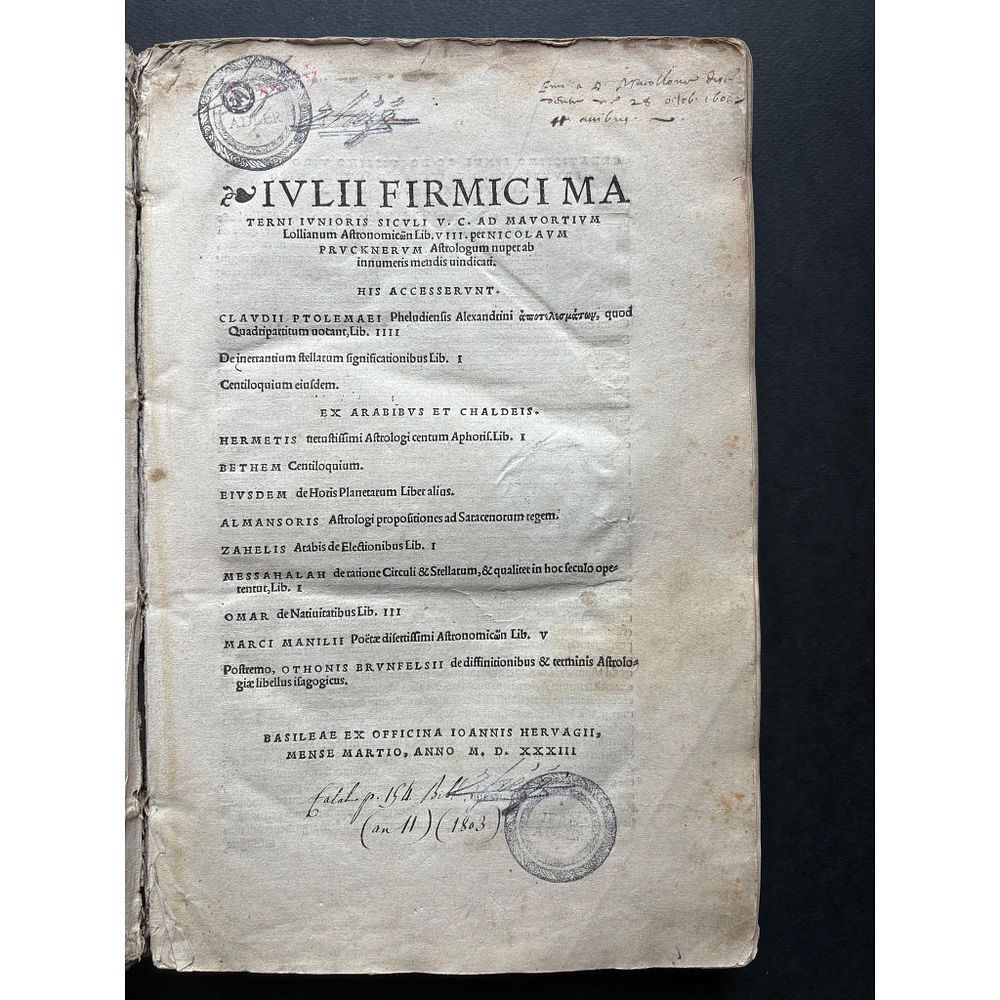
[ASTRONOMY, MATHEMATICS & PHYSICS] - PTOLEMAEUS, Claudius (c. 100–c. 170) - Phaenomena stellarum MXXII fixarum - PTOLEMAEUS, Claudius (c. 100–c. 170). Phaenomena, stellarum MXXII. fixarum ad hanc aetatem reducta, atque seorsum in studiosorum gratiam. Nunc primum edita, interprete Georgio Trapezuntio. Adiecta est Isagoge Ioannis Noviomagi ad stellarum inerrantium longitudines ac latitudines, cui etiam accessere Imagines sphaerae barbaricae duodequinquaginta Alberti Dureri. Cologne (Coloniae Agrippinae), 1537. Folio (310 × 205 mm). 52 pp. Woodcut astronomical illustrations. Title-page with woodcut celestial imagery after Albrecht Dürer. Early ownership stamp of Jean Adler. Some marginal dampstaining and foxing. BOUND WITH: FIRMICUS MATERNUS, Julius. Iulii Firmici Materni Iunioris Siculi V.C. ad Mavortium Lollianum Astronomicon libri VIII, per Nicolaum Prucknerum astrologum nuper ab innumeris mendis vindicati. His accesserunt Claudii Ptolemaei ... Quadripartitum ... De inerrantium stellarum significationibus ... Centiloquium... Basel: Johann Herwagen, March 1533. Folio. [16], 244 pp. Numerous woodcut astronomical and astrological diagrams and illustrations in the text. Early ownership stamps, including that of Jean Adler, with further marks of provenance and occasional early marginal annotations. Some marginal worming. Two works bound together in contemporary limp vellum, manuscript title to spine; binding worn and locally repaired, inner hinges partly split, ties lacking. Early inscription on front flyleaf. An appealing, wide-margined copy preserved in its first binding. AN IMPORTANT RENAISSANCE ASTRONOMICAL SAMMELBAND, UNITING THE FIRST SEPARATE EDITION OF PTOLEMY’S CATALOGUE OF 1,022 FIXED STARS WITH ONE OF THE MOST SUBSTANTIAL SIXTEENTH-CENTURY PRINTED CORPORA OF CLASSICAL AND ARABIC ASTROLOGY. The Cologne Phaenomena of 1537 is a particularly significant and visually compelling publication in the transmission of Ptolemaic astronomy during the Renaissance. It contains the stellar catalogue forming Books VII and VIII of Ptolemy’s Almagest, here issued separately for the first time in the Latin translation of the great fifteenth-century humanist George of Trebizond. Ptolemy’s catalogue of 1,022 fixed stars, arranged according to the traditional constellations, remained one of the fundamental records of the ancient sky. Compiled in the second century AD, it transmitted to Renaissance Europe a systematic description of the heavens which, directly or through Arabic astronomical traditions, continued to provide the conceptual and observational framework for European astronomy until the great new stellar catalogues of the sixteenth and seventeenth centuries. For the present edition the Cologne scholar Johannes Noviomagus (Johannes Bronkhorst) supplied an Isagogeexplaining the determination of the longitudes and latitudes of the fixed stars and brought the coordinates forward to his own period, thereby transforming the ancient catalogue into a practical Renaissance astronomical document. Of exceptional interest is the edition’s association with Albrecht Dürer. The title explicitly announces the Imagines sphaerae barbaricae duodequinquaginta Alberti Dureri, referring to the forty-eight classical constellations and to the celebrated celestial imagery derived from Dürer’s great star maps of 1515. Produced in collaboration with the mathematician and cartographer Johannes Stabius and the astronomer Conrad Heinfogel, Dürer’s northern and southern celestial hemispheres rank among the landmarks of early printed celestial cartography. They were among the first printed maps to represent the entire celestial sphere systematically, combining Ptolemaic astronomical tradition with the extraordinary visual language of the German Renaissance. The celestial illustrations associated with the 1537 Cologne edition belong directly to this tradition. Their importance is heightened by their remarkable rarity: the celestial maps announced on the title-page are absent from the overwhelming majority of surviving copies of the edition, and complete examples have long been considered exceptional. The volume is complemented by an equally substantial work: Julius Firmicus Maternus’ Astronomicon or Mathesis, here in the important Basel edition prepared by the astronomer and astrologer Nicolaus Pruckner and printed by Johann Herwagen in 1533. Firmicus Maternus, writing in the fourth century AD, produced in his eight books the most extensive surviving Latin treatise on astrology from classical antiquity. Rediscovered by Renaissance humanists, the Mathesis became one of the principal sources through which the astrological doctrines of the ancient world entered early modern European intellectual culture. Pruckner’s edition was conceived not merely as an edition of Firmicus but as an ambitious corpus of ancient and medieval astrological knowledge. It includes, among other texts, Ptolemy’s Quadripartitum (Tetrabiblos),