Bidspirit auction | [ASTRONOMY, MATHEMATICS & PHYSICS] -
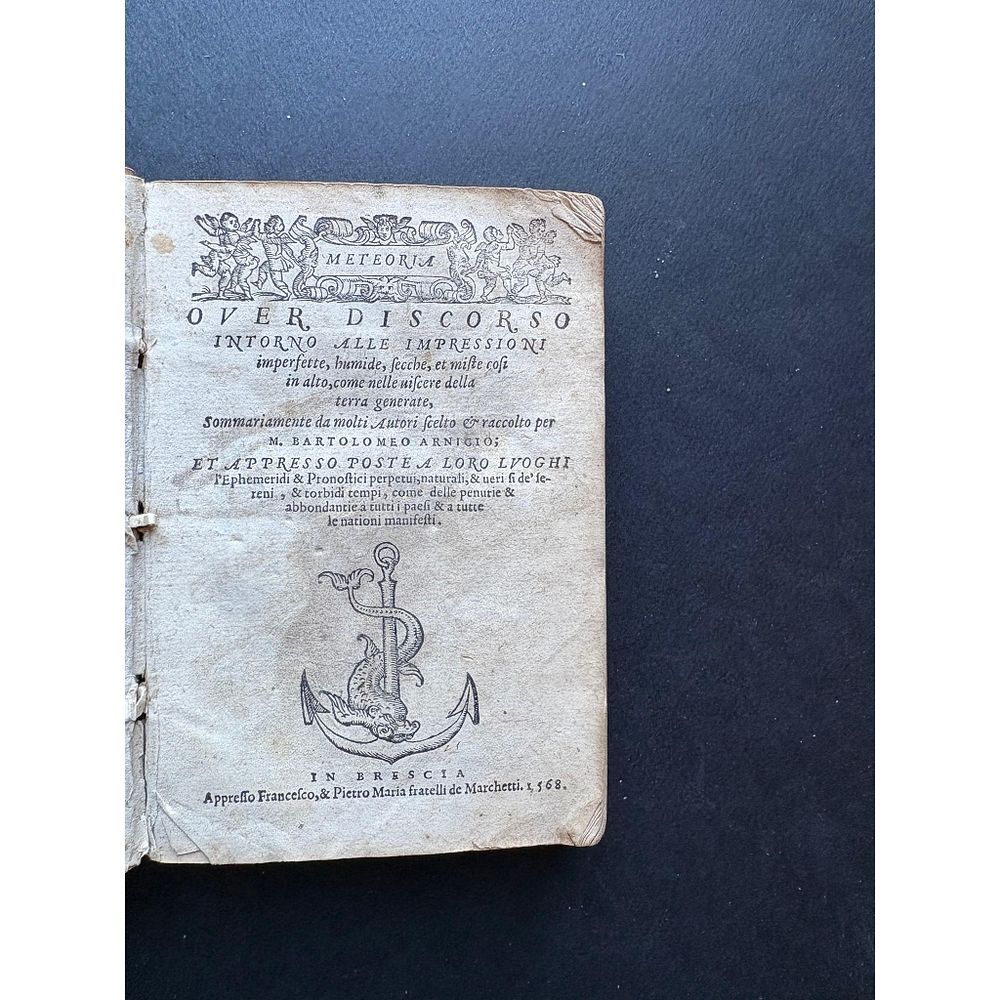
[ASTRONOMY, MATHEMATICS & PHYSICS] - ARNIGIO, Bartolomeo (1523–1577) - Meteoria over discorso intorno alle impressioni imperfette - ARNIGIO, Bartolomeo (1523–1577) Meteoria over discorso intorno alle impressioni imperfette, humide, secche, et miste così in alto, come nelle viscere della terra generate. Sommariamente da molti autori scelto & raccolto per M. Bartolomeo Arnigio; et appresso poste a loro luoghi l’ephemeridi & pronostici perpetui, naturali, & veri sì de’ sereni, & torbidi tempi, come delle penurie & abondantie à tutti i paesi & a tutte le nationi manifesti. Brescia: Francesco and Pietro Maria Marchetti, 1568 [colophon: Vincenzo di Sabbio, for Francesco and Pietro Maria Marchetti, 1568]. 8vo (150 × 100 mm). [8], 142, [6] leaves. Title with woodcut ornament, woodcut initials and illustrations in the text; final leaves containing the catalogue of authors and errata. Approximately ten leaves with marginal staining; at K8 a small loss affecting a portion of the woodcut; occasional marginal foxing and a few other minor defects. Contemporary limp vellum, manuscript title to spine and an additional early paper label bearing the title; some losses along the projecting edges. FIRST EDITION, AND APPARENTLY THE ONLY EARLY EDITION, OF A RARE AND REMARKABLE ITALIAN RENAISSANCE TREATISE ON METEOROLOGY, ATMOSPHERIC PHENOMENA AND THE PHYSICAL PROCESSES OCCURRING BOTH ABOVE THE EARTH AND WITHIN ITS DEPTHS. Published in Brescia in 1568, Arnigio’s Meteoria is one of the earliest substantial works in the Italian vernacular devoted specifically to meteorological phenomena and their causes. The word “meteorology” in the sixteenth century possessed a considerably broader meaning than it does today. Following the Aristotelian tradition, Arnigio investigates the so-called “imperfect mixtures” generated by the interaction of heat, cold, moisture and dryness, whether produced in the atmosphere or, as the title strikingly states, “nelle viscere della terra” — within the bowels of the earth. The work therefore belongs to the Renaissance tradition descending from Aristotle’s Meteorologica, in which atmospheric and terrestrial phenomena formed part of a single physical system. Vapours and exhalations rising from the earth were employed to explain changes occurring in the air as well as processes taking place below the surface. Arnigio describes the work himself as a synthesis “scelto & raccolto da molti autori”, drawing upon a broad body of ancient and later natural philosophy. The final Catalogo de gli autori makes explicit the learned foundations upon which his account was constructed. Particularly characteristic of the period is the close relationship between natural explanation and prediction. Arnigio supplements his physical discussion with ephemerides and “perpetual prognostications”, intended to provide indications of clear or disturbed weather and even of future scarcity or abundance. The book thus documents an important transitional stage in the history of meteorology. Traditional Aristotelian physics, astrological and prognostic practices and increasingly systematic observation of natural phenomena coexist within a single vernacular treatise intended for a readership extending beyond the universities. Arnigio was himself a physician trained at Padua as well as a poet and man of letters. His Meteoria occupies an unusual position within his varied literary production and is the work for which he is principally remembered in the early history of meteorological and medical thought. Later writers already regarded the treatise as remarkably early in its field, describing it as perhaps one of the earliest modern works devoted to such phenomena. Its publication in the vernacular is particularly significant, bringing subjects traditionally treated in scholastic Latin into the broader intellectual culture of Renaissance Italy. The present copy retains its contemporary limp-vellum binding with manuscript spine title and early title label, giving it a particularly genuine appearance. A RARE AND APPEALING COPY IN CONTEMPORARY VELLUM OF ONE OF THE EARLIEST ITALIAN VERNACULAR TREATISES DEVOTED SPECIFICALLY TO METEOROLOGY AND TERRESTRIAL PHENOMENA — AN UNUSUAL RENAISSANCE ATTEMPT TO EXPLAIN AND PREDICT THE PHYSICAL PROCESSES OF THE ATMOSPHERE AND THE EARTH.