Bidspirit auction | [ASTRONOMY, MATHEMATICS & PHYSICS] -
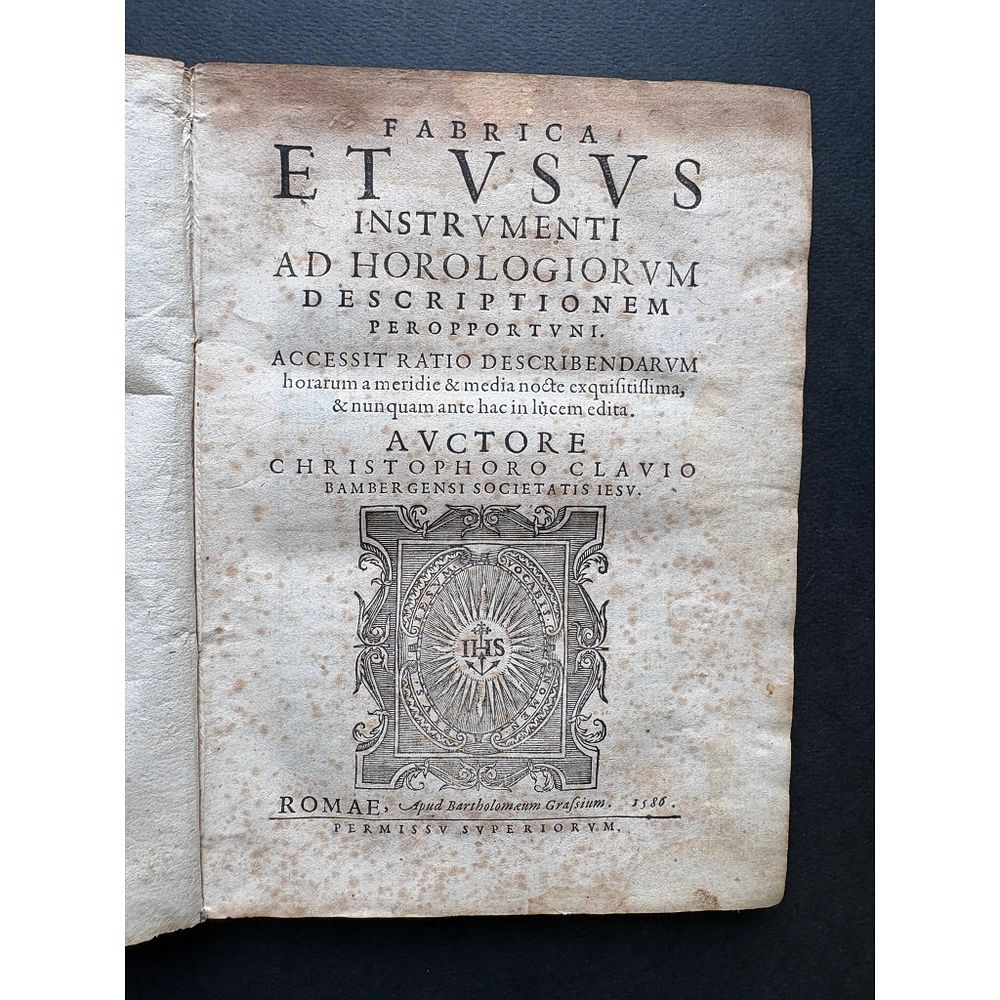
[ASTRONOMY, MATHEMATICS & PHYSICS] - CLAVIUS, CHRISTOPH (1538–1612) - Fabrica et usus instrumenti ad horologiorum descriptionem - CLAVIUS, CHRISTOPH (1538–1612). Fabrica& ; ; ;nbs p;et usus instrumenti ad horol ogiorum descriptionem peropportuni. ; ; ; ;Accessit ratio describendarum hora rum a meridie et media no cte exquisitissima, et nunquam ante hac in&a mp;a mp;a mp;n bsp;lucem edita.Rome: Bartolomeo Gr assi (printed by Giacomo Ruffi nelli), 1586. 4to. [4], 151 pages. Woodcut Jesuit emblem on the&a mp;a mp;a mp;n bsp;title-page, repeated in the colophon, four full-page woodcut illust rations of a mathematical inst rument, and numerous geometrical and& amp; amp; amp; nbsp;astronomical diagrams throughout&am p;am p;am p;nb sp;the text. Contemporary limp ; ; ; ;vellum, a fine and genuine copy, with some occasional browning but generally well preserved. RARE FIRST EDITION OF AN ; ; ; ;IMPORTANT RENAISSANCE TREATISE ON& amp; amp; amp; nbsp;MATHEMATICAL INSTRUMENTS AND T HE CONSTRUCTION OF SUNDIALS, BY THE CELEBRATED JESUIT ; ; ; ;ASTRONOMER CHRISTOPH CLAVIUS, ONE OF THE PRINCIPAL ARC HITECTS OF THE GREGORIAN CALEN DAR REFORM. Published in Rome in 1586,&am p;am p;am p;nb sp;the Fabrica et usus instrum enti ad horologiorum descriptionem& amp; amp; amp; nbsp;peropportuni is among the ; ; ; ;most interesting technical works&a mp;a mp;a mp;n bsp;of Christoph Clavius, the distinguished German math ematician and astronomer who t aught for many years at t he Collegio Romano and became& amp; amp; amp; nbsp;one of the leading scient ific authorities of the late&a mp;a mp;a mp;n bsp;Renaissance. The treatise describes the co nstruction and practical applicatio n of a mathematical instrument designed to facilitate the&am p;am p;am p;nb sp;drawing of sundials and the determination of time through geometrical and astronomical principles. Clavius explains how&am p;am p;am p;nb sp;the instrument may be emplo yed to establish hour lines, calculate the positions of&am p;am p;am p;nb sp;the sun and construct sundi als adapted to different geogr aphical latitudes. The work is particularly nota ble for its extensive mathemat ical illustrations, which provide a detailed ; ; ; ;visual account of the instrum ent and its applications. Comb ining theoretical geometry with& ; ; ;nbs p;practical astronomical observation, Clavius demonstrates how soph isticated mathematical knowledge co uld be translated into instrum ents of everyday utility. The publication appeared only ; ; ; ;four years after the introduc tion of the Gregorian calendar in 1582, a reform in& ; ; ;nbs p;which Clavius played a funda mental scientific role. His in vestigations into time measurement, celestial motion and mathemat ical astronomy form part of&am p;am p;am p;nb sp;the same intellectual programme& amp; amp; amp; nbsp;that contributed to the r eform of the calendar and ; ; ; ;the advancement of astronomical&am p;am p;am p;nb sp;computation. Regarded by his contemporaries& ; ; ;nbs p;as the ”Euclid of the&a mp;a mp;a mp;n bsp;sixteenth century”, Clavius exercised a profound& amp; amp; amp; nbsp;influence upon the development of mathematical education in& amp; amp; amp; nbsp;Europe. His writings were ; ; ; ;widely studied by mathematicians&a mp;a mp;a mp;n bsp;and astronomers, including Galileo Galilei, with whom he subsequently& ; ; ;nbs p;corresponded. An important and uncommon fir st edition, of considerable interest to&a mp;a mp;a mp;n bsp;collectors of early astronomy, mathematical instruments, horology and the history ; ; ; ;of Renaissance science.