Bidspirit auction | [ASTRONOMY, MATHEMATICS & PHYSICS] -
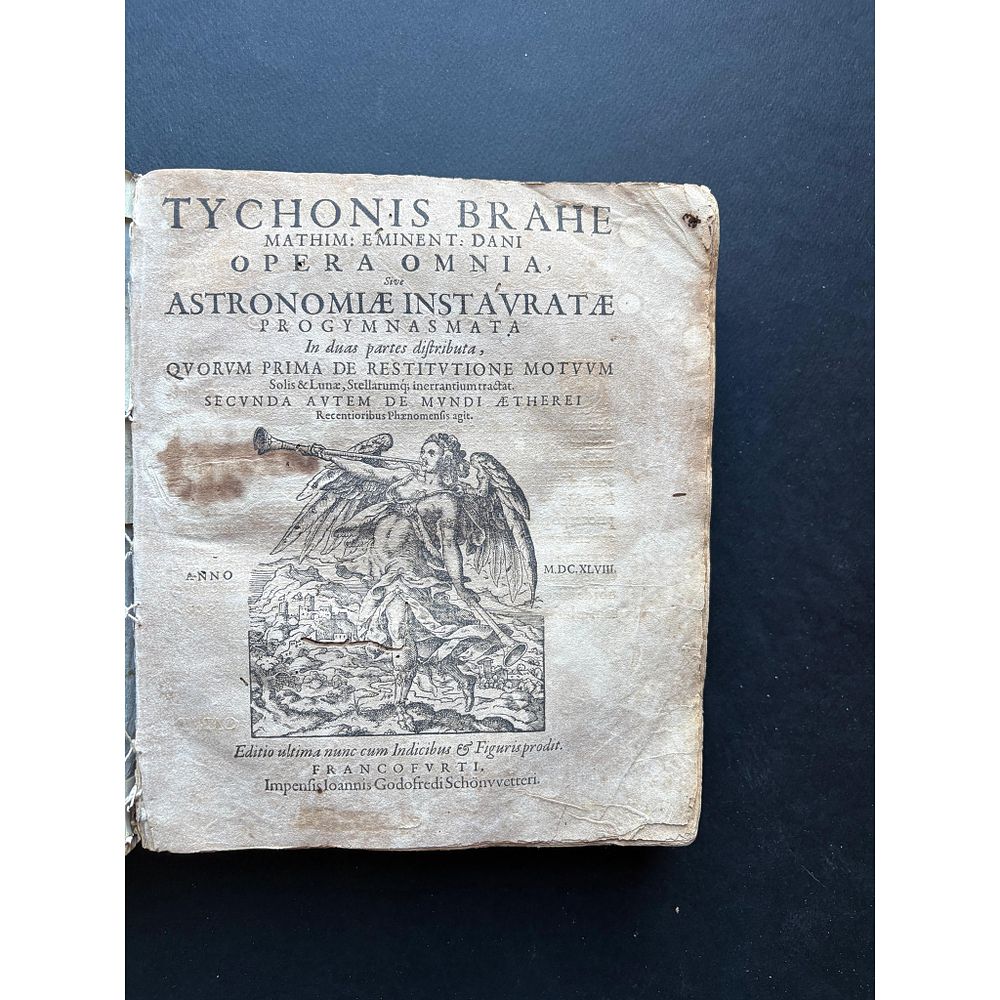
[ASTRONOMY, MATHEMATICS & PHYSICS] - Brahe, Tycho (1546–1601) - Tychonis Brahe ... Opera omnia - Brahe, Tycho (1546–1601) Tychonis Brahe ... Opera omnia, sive astronomiae instauratae progymnasmata in duas partes distributa, quorum prima De restitutione motuum solis & lunae, stellarumque inerrantium tractat. Secunda autem De mundi aetherei recentioribus phaenomenis agit. Editio ultima nunc cum indicibus & figuris prodit. Francofurti: impensis Ioannis Godofredi Schönwetteri, 1648. 4to. Two parts in one volume, each with separate title-page and pagination. Numerous woodcut geometrical and astronomical diagrams throughout the text, together with full-page woodcuts of the instruments developed at Uraniborg, including armillary spheres and the two telescopes used in Brahe's observations. Contemporary full vellum, manuscript title to spine. FIRST COLLECTED EDITION OF TYCHO BRAHE'S TWO MAJOR ASTRONOMICAL TREATISES, THE PROGYMNASMATA AND THE DE MUNDI AETHEREI, TOGETHER FORMING THE OBSERVATIONAL FOUNDATION ON WHICH KEPLER AND, LATER, NEWTON BUILT THEIR ASTRONOMICAL SYSTEMS. The Astronomiae instauratae progymnasmata, first published posthumously by Kepler at Prague in 1602–03, and the De mundi aetherei recentioribus phaenomenis, first printed at Uraniborg in 1588, represent the first two parts of a projected trilogy that Brahe did not live to complete. Together they preserve the observational record of his years at the Uraniborg observatory on the island of Hven: his celebrated sightings of the nova of 1572 in Cassiopeia — the first new star recorded in the West — his revised theories of solar and lunar motion, a catalogue of the positions of 777 fixed stars, and his observations of the comet of 1577, accompanied by detailed descriptions of the instruments he devised to achieve unprecedented precision. The present Frankfurt edition of 1648 gathers both texts for the first time in a single collected form, ”with indices and figures, ” making Brahe's foundational data more widely accessible to the astronomers of the following generation. Bound in contemporary full vellum with the title inscribed by hand to the spine, the sewing somewhat relaxed and the paper lightly oxidised, as usual for this edition. A small wormhole runs through the upper margin of a number of leaves in the later gatherings, touching the blank margin only and without loss to the text or diagrams. Pp. 281–282 have been repaired by the binder. The collation follows that recorded by ICCU; this copy differs from the ICCU exemplar in that the dedicatory epistle of the printer to Giovanni Filippo di Maganza — a bifolium of two leaves outside the regular gathering — is here bound between pp. 2 and 3 of the first volume, whereas in the ICCU copy it is bound into the second volume. A landmark collected edition of Tycho Brahe's principal astronomical writings, uniting the observational record of Uraniborg in the form that carried it forward into the age of Kepler.