Bidspirit auction | [ASTRONOMY, MATHEMATICS & PHYSICS] -
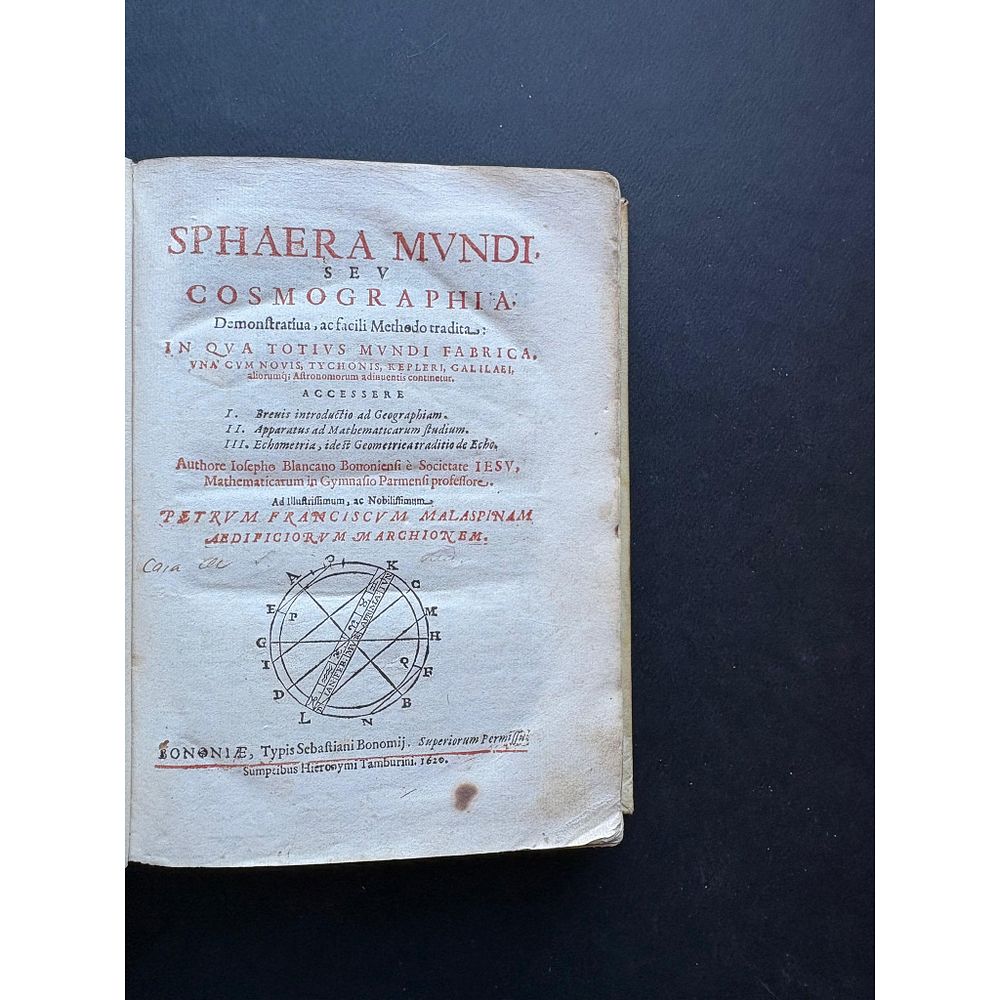
[ASTRONOMY, MATHEMATICS & PHYSICS] - BIANCANI, Giuseppe (1566–1624) - Sphaera mundi seu cosmographia demonstrativa - ***Note: This lot is located in Italy and requires an Italian export licence. We will manage the full application process for you. An additional fee of £50 applies.*** BIANCANI, Giuseppe (1566–1624). Sphaera mundi, seu Cosmographia demonstrativa, ac facili methodo tradita, in qua totius mundi fabrica, una cum novis Tychonis, Kepleri, Galilaei, aliorumque astronomorum adinventis continetur. Accessere I. Brevis introductio ad geographiam. II. Apparatus ad mathematicarum studium. III. Echometria, id est geometrica traditio de echo. Bologna: Sebastiano Bonomi, for Girolamo Tamburini, 1620. RARE FIRST EDITION OF ONE OF THE MOST IMPORTANT JESUIT ASTRONOMICAL COMPENDIA OF THE EARLY SEVENTEENTH CENTURY — A REMARKABLE SYNTHESIS OF THE NEW DISCOVERIES OF GALILEO, KEPLER AND TYCHO BRAHE, NOTABLE FOR ITS EARLY AND SYSTEMATIC USE OF THE WORD “TELESCOPE”, AND INCLUDING BIANCANI’S PIONEERING ECHOMETRIA, A FOUNDATIONAL TEXT IN THE DEVELOPMENT OF GEOMETRICAL ACOUSTICS. 4to (226 × 160 mm). [22] pp., 2 blank pp., 445 [i.e. 447], [1 blank] pp. Title-page printed in red and black. One folding plate and numerous woodcut astronomical and geometrical diagrams throughout, including the original movable volvelle preserved at fol. 2F2r. Remounted full stiff vellum, the covers decorated with concentric gilt fillets, gilt ornaments to spine. Front cover stained and a few small wormholes to spine. Some foxing and browning, more noticeable in occasional gatherings, but a complete, broad-margined and generally well-preserved copy, importantly retaining its volvelle. THE RARE FIRST EDITION OF A LANDMARK OF JESUIT ASTRONOMY Published in Bologna in 1620, Biancani’s Sphaera mundi is one of the most significant attempts by a Jesuit astronomer to absorb the extraordinary astronomical discoveries of the first two decades of the seventeenth century into a comprehensive description of the universe. Biancani had essentially completed the work by about 1615, in the immediate aftermath of the revolutionary telescopic observations announced by Galileo in the Sidereus Nuncius. Publication was nevertheless delayed until 1620, after the decree of 1616 concerning Copernicanism. The result is a fascinating document of the intellectual tensions within early seventeenth-century astronomy. Biancani remained committed to a stationary Earth and favoured a cosmological structure broadly compatible with Tycho Brahe, yet he treated with respect and considerable attention the discoveries and theories of Copernicus, Tycho, Kepler and Galileo. Indeed, their names are announced prominently on the title-page itself. The work consequently occupies an exceptional position between the traditional Sphaera literature inherited from the Middle Ages and the radically transformed universe revealed by the telescope. GALILEO AND THE NEW TELESCOPIC UNIVERSE Biancani was among the most capable Jesuit astronomers of his generation and took Galileo’s telescopic discoveries extremely seriously. The Sphaera mundi discusses the phenomena which had transformed astronomy since 1609: the satellites of Jupiter, sunspots, the appearance and structure of the Moon, the new stars, and other observations made possible by the telescope. Rather than simply reproducing the traditional Aristotelian-Ptolemaic cosmos, Biancani recognised that a new astronomical synthesis had become necessary. The discoveries of Galileo and his contemporaries could no longer be ignored, even by astronomers who were unwilling or unable to accept the motion of the Earth. This makes the Sphaera mundi an especially revealing document of the Catholic and Jesuit reception of Galilean astronomy. It subsequently became an influential teaching text and, in many Jesuit colleges, effectively succeeded the traditional astronomical works of Christopher Clavius as an introduction to the structure of the heavens. “TELESCOPIUM”: THE NEW INSTRUMENT ENTERS SCIENTIFIC LANGUAGE The book has a particular place in the history of the telescope itself. The instrument had been transformed by Galileo into an astronomical tool only a decade earlier, and even its name was remarkably new: the term telescopium had been coined in Rome in 1611. Biancani’s Sphaera mundi is especially important for what Joseph McColley identified as its repeated and systematic adoption of the word “telescopium” in astronomical discourse, helping to establish the new term within the scientific vocabulary of Europe. The significance is greater than a mere linguistic curiosity. By 1620 the telescope was no longer presented as an extraordinary novelty or optical amusement: in Biancani’s work it had become an accepted instrument of astronomical investigation, capable of supplying evidence about the physical constitution of the heavens.