Bidspirit auction | [ASTRONOMY, MATHEMATICS & PHYSICS] -
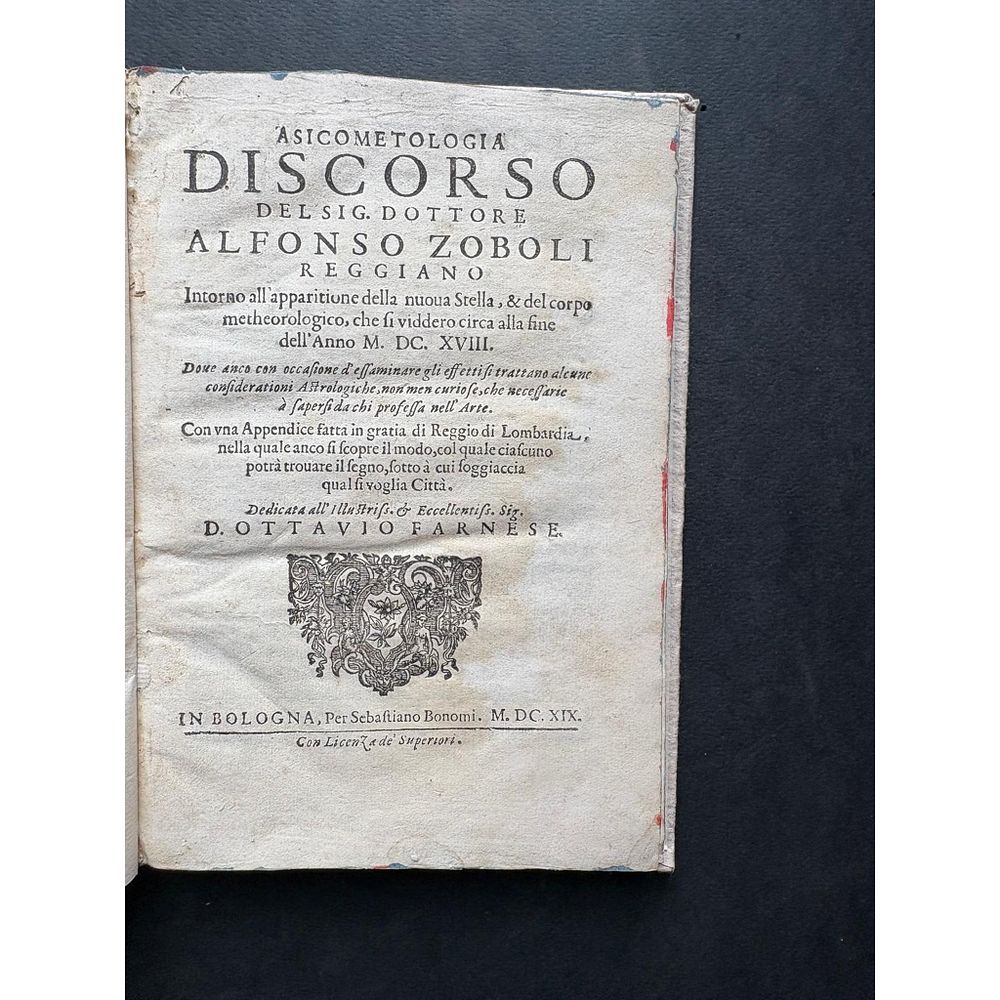
[ASTRONOMY, MATHEMATICS & PHYSICS] - ZOBOLI, Alfonso (d. 1640). Asicometologia - ZOBOLI, Alfonso (d. 1640). Asicometologia. Discorso del Sig. Dottore Alfonso Zoboli Reggiano intorno all'apparitione della nuova Stella, & del corpo Metheorologico, che si viddero circa alla fine dell'anno M.DC.XVIII. Dove anco con occasione d'essaminare gli effetti si trattano alcune considerationi astrologiche, non men curiose, che necessarie à sapersi da chi professa nell'arte. Con una appendice fatta in gratia di Reggio di Lombardia... Bologna: Sebastiano Bonomi, 1619. EXCEPTIONALLY RARE FIRST EDITION OF AN IMPORTANT AND LITTLE-KNOWN ITALIAN TREATISE ON THE GREAT COMETS OF 1618, PUBLISHED AT THE VERY BEGINNING OF THE CELEBRATED ASTRONOMICAL CONTROVERSY THAT WOULD CULMINATE IN GALILEO'S IL SAGGIATORE (1623). 4to. [8], 120 pp. limp board. A complete and well preserved copy An exceptionally uncommon and historically significant work devoted to the extraordinary celestial phenomena witnessed throughout Europe in the closing months of 1618, when the appearance of three comets provoked intense scientific, philosophical and astrological discussion. The great comets of 1618 represented a crucial episode in the transformation of European astronomy. Their appearance reopened fundamental questions concerning the nature and structure of the heavens, the distinction between celestial and atmospheric phenomena, and the validity of the traditional Aristotelian cosmology. Were comets temporary atmospheric exhalations, as Aristotelian doctrine maintained, or genuine celestial bodies moving beyond the Moon? The question touched the very foundations of the inherited understanding of the universe. Published in Bologna in 1619, Alfonso Zoboli's Asicometologia belongs to the remarkable group of contemporary works produced in response to these events. Its particular interest lies in the author's attempt to interpret the newly observed celestial phenomena through a combination of natural philosophy, astronomy and astrology, illustrating the continuing coexistence of traditional astrological explanations and the new astronomical investigations of the early seventeenth century. Zoboli, a physician and learned astrologer from Reggio Emilia, considers the appearance of the new star and the mysterious meteorological body observed in 1618, examining their possible physical nature and the terrestrial consequences traditionally attributed to such manifestations. The treatise offers a valuable testimony to the intellectual climate of the period, when astronomical discoveries were still frequently interpreted as portents of political upheaval, epidemics, wars and other extraordinary events. Of particular historical importance is the work's connection with the celebrated controversy surrounding Galileo Galilei.The extraordinary cometary apparitions of 1618 inspired Orazio Grassi's De tribus cometis anni M.DC.XVIII disputatio astronomica (1619) and Mario Guiducci's Discorso delle comete (1619), the latter closely associated with Galileo. The ensuing dispute developed into one of the defining intellectual confrontations of the Scientific Revolution and eventually produced Galileo's Il Saggiatore (1623). Although Zoboli was not a principal participant in the confrontation between Galileo and the Jesuit astronomers, his treatise appeared at precisely the same historical moment and forms part of the wider body of contemporary literature through which the great astronomical debate can be reconstructed. It is therefore of considerable interest not merely as a work of astrology, but as an independent witness to the scientific and philosophical concerns that accompanied the emergence of modern astronomy. A particularly curious feature is the appended discussion concerning the astrological relationship between cities and the zodiac. Written with special reference to Reggio Emilia, the appendix explains how the zodiacal sign supposedly governing a particular city might be determined, bringing together celestial calculation, geography and astrological interpretation. The text also preserves evidence of the continuing influence of Renaissance authorities such as Girolamo Cardano. Zoboli discusses, for example, the astrological significance of the plague affecting Milan in 1524 and its supposed relationship with a preceding eclipse, an instructive illustration of the techniques through which early modern astrologers sought to establish correspondences between celestial phenomena and historical events. The importance and contemporary reception of the treatise are further illustrated by the survival of a seventeenth-century Latin manuscript excerpt of Zoboli's Asicometologia, reproducing passages from the printed edition and part of its tabular material. This independent manuscript testimony is of particular interest as evidence that elements of the work were copied and transmitted beyond the original Italian printed text.