Bidspirit auction | [ASTRONOMY, MATHEMATICS & PHYSICS] -
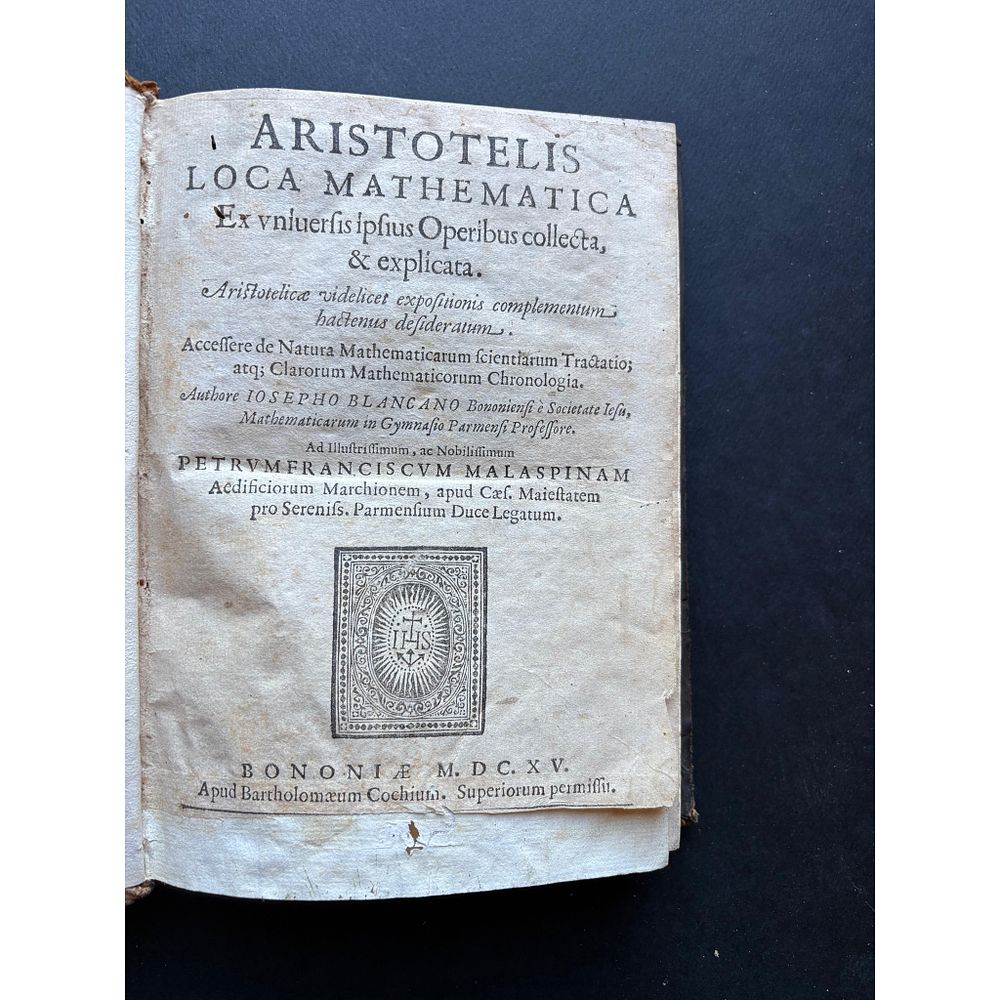
[ASTRONOMY, MATHEMATICS & PHYSICS] - BIANCANI, Giuseppe (1566–1624) - Aristotelis loca mathematica - BIANCANI, Giuseppe (1566–1624) Aristotelis loca mathematica ex vniuersis ipsius operibus collecta, & explicata. Aristotelicae videlicet expositionis complementum hactenus desideratum. Accessere de natura mathematicarum scientiarum tractatio; atque clarorum mathematicorum chronologia. Authore Iosepho Blancano Bononiensi è Societate Iesu... Bononiae: apud Bartholomaeum Cochium; sumptibus Hieronymi Tamburini, 1615. 4to. Two parts in one volume: 283, [1] pp.; 65, [7] pp., with diagrams in the text. Eighteenth-century stiff binding, spine tooled in gilt. THE RARE FIRST BOOK OF GIUSEPPE BIANCANI, IN WHICH THE YOUNG JESUIT MATHEMATICIAN FIRST ARGUED, AGAINST ENTRENCHED ARISTOTELIAN ORTHODOXY, FOR THE SCIENTIFIC STATUS OF MATHEMATICS. Published five years before his celebrated Sphaera mundi, the Aristotelis loca mathematica was Biancani's first printed work and already carried the seed of the position that would define his career: a systematic gathering and elucidation of every mathematical passage in the corpus of Aristotle, intended to complete an exposition of Aristotelian philosophy that had, in Biancani's view, long neglected its mathematical dimension. Appended to the main text are a treatise on the nature of the mathematical sciences and a chronology of celebrated mathematicians. Composed while Biancani was teaching at the Jesuit college of Parma, the work engages directly with the contemporary quaestio de certitudine mathematicarum — the debate, then dividing Jesuit scholars, over whether mathematics could properly be called a science in the strict Aristotelian sense. Biancani argued forcefully that it could, aligning himself with the mathematicians and astronomers within the Society of Jesus, including his friend Galileo, against the philosophers of stricter Aristotelian persuasion; the same conviction in the autonomy and rigour of mathematical and astronomical reasoning would later carry through into his Sphaera mundi. The volume is complete and agrees in pagination with the copies recorded by ICCU. The title-page shows a strip approximately 2 cm high cut away at the foot, removing the imprint line ”sumptibus Hieronymi Tamburini”; the excision was presumably made at the time of binding. A scarce survival of Biancani's earliest published work, marking the opening statement of the position on the scientific standing of mathematics that would occupy him for the rest of his career.