Bidspirit auction | [ASTRONOMY, MATHEMATICS & PHYSICS] -
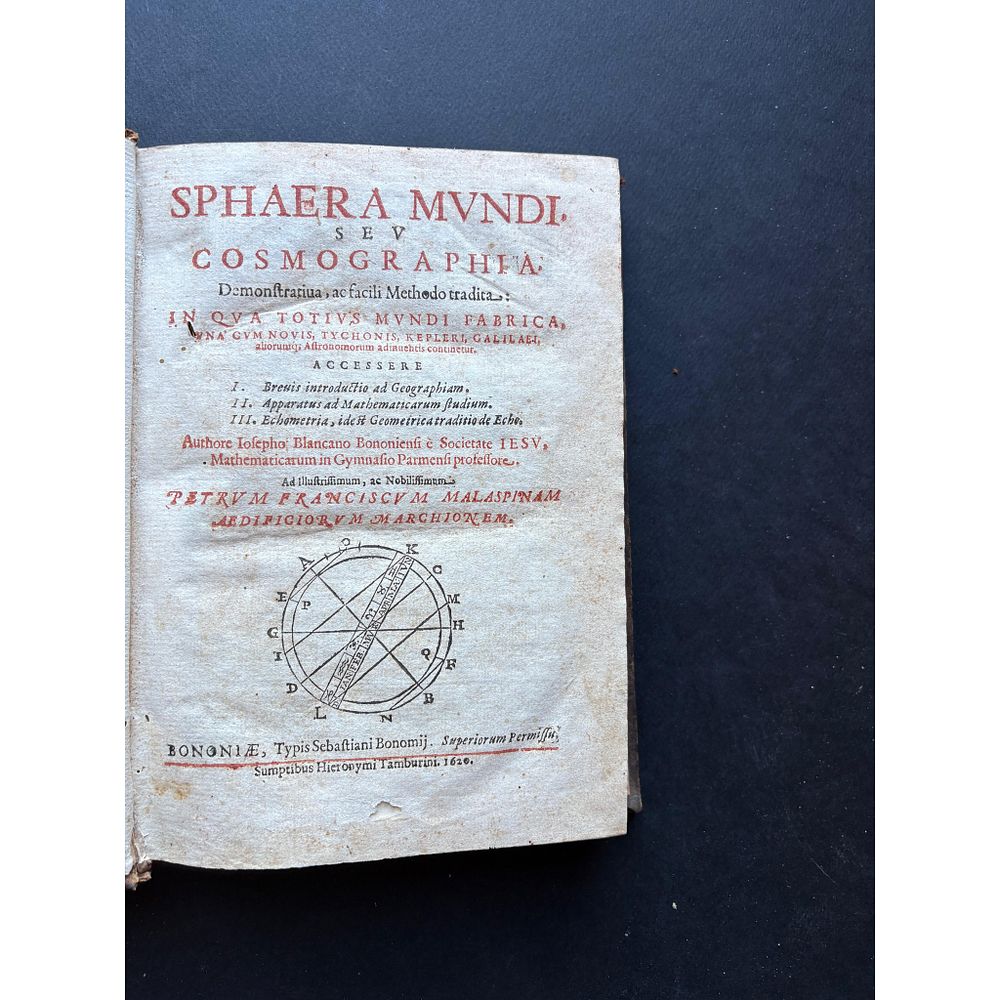
[ASTRONOMY, MATHEMATICS & PHYSICS] - BIANCANI, Giuseppe (1566–1624) - Sphaera mundi seu cosmographia demonstrativa - BIANCANI, Giuseppe (1566–1624) Sphaera mundi seu cosmographia, demonstratiua, ac facili methodo tradita: in qua totius mundi fabrica, vna cum nouis, Tychonis, Kepleri, Galilaei, aliorumque astronomorum adinuentis continetur. Accessere I. Breuis introductio ad geographiam. II. Apparatus ad mathematicarum studium. III. Echometria, idest geometrica traditio de echo. Authore Iosepho Blancano Bononiensi è Societate Iesu... Bononiae [Bologna]: typis Sebastiani Bonomij, sumptibus Hieronymi Tamburini, 1620. 4to, [24], 445, [1] pp. Title-page printed in red and black; numerous woodcut astronomical and geometrical diagrams in the text, lacks a volvelle at p. 227. Eighteenth-century stiff binding, spine tooled in gilt. FIRST EDITION OF BIANCANI'S SPHAERA MUNDI, THE WORK THAT BROUGHT THE TYCHONIC SYSTEM AND GALILEO'S TELESCOPIC DISCOVERIES INTO THE OFFICIAL ASTRONOMICAL TEACHING OF THE SOCIETY OF JESUS. Composed around 1615 but held back until 1620, in the wake of the 1616 Decree of the Congregation of the Index, Biancani's treatise was written at the request of his students during his long tenure as professor of mathematics at Parma, where he had studied under Christopher Clavius at the Roman College. Following the wave of debate that Galileo's observations of 1609–10 provoked among Jesuit mathematicians, Biancani's Sphaera mundi effectively codified the Society's adoption of Tycho Brahe's geo-heliocentric compromise, accepting the heliocentric arrangement of the planets while preserving a geocentric universe. The text draws repeatedly and respectfully on Brahe, Copernicus, Galileo and Kepler, discussing the newly discovered satellites of Jupiter and Saturn, sunspots, and the novae of 1572, 1600 and 1604 — phenomena unknown before the telescope. To the cosmographical core are appended a brief introduction to geography, a survey of mathematical studies, and an early treatise on the physics of echo (Echometria); Biancani would later add material on sundials in the enlarged 1635 Modena edition. The work is further notable for its author's selenographic interests, his hand-drawn lunar map being among the earliest to register the Moon's surface features from naked-eye observation. The volume is bound in an eighteenth-century stiff binding with gilt tooling to the spine. This copy lacks the folding plate. A foundational text of early seventeenth-century Jesuit astronomy, marking the moment at which the discoveries of the telescope were formally absorbed into the Society of Jesus's cosmological teaching.