Bidspirit auction | [ASTRONOMY, MATHEMATICS & PHYSICS] -
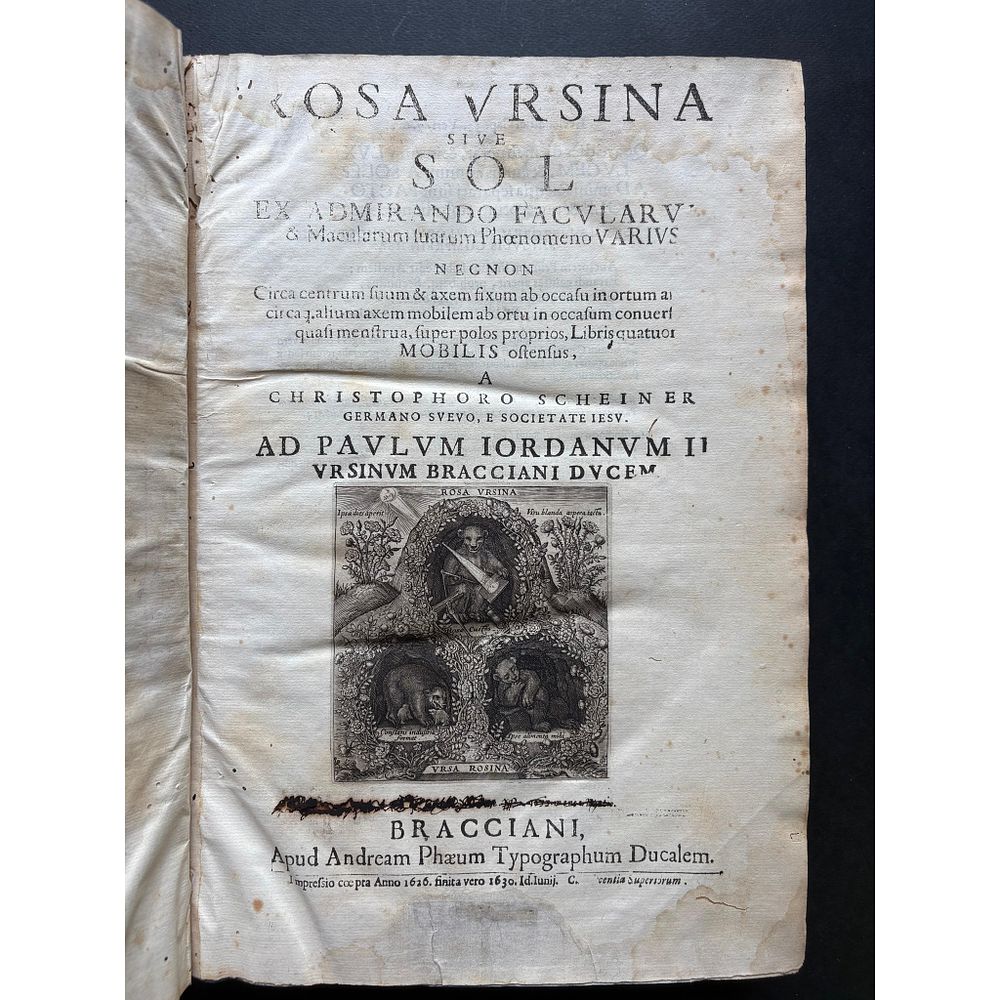
[ASTRONOMY, MATHEMATICS & PHYSICS] - SCHEINER, Christoph (1573–1650) - Rosa ursina sive Sol - SCHEINER, Christoph (1573–1650) Rosa Ursina, sive sol ex admirando facularum & macularum suarum phoenomeno varius. Bracciano: Andrea Fei (Andreas Phaeus), at the Ducal Press, 1626–1630. Folio (350 × 240 mm). Engraved title-page and letterpress title with large engraved vignette; numerous engraved illustrations, many full-page, including two large folding lunar plates, detailed records of solar observations, and representations of astronomical instruments. Woodcut initials and ornamental devices. Complete with all engraved plates. FIRST EDITION OF ONE OF THE MOST IMPORTANT WORKS IN THE HISTORY OF SOLAR ASTRONOMY, AND A LANDMARK IN THE SCIENTIFIC DEBATE BETWEEN CHRISTOPH SCHEINER AND GALILEO GALILEI. The German Jesuit mathematician and astronomer Christoph Scheiner devoted this monumental work to the systematic observation of the Sun, particularly its faculae and sunspots. Having observed sunspots in 1611, Scheiner published his initial findings anonymously in 1612, under the pseudonym Apelles latens post tabulam. His observations, made independently of Galileo’s, became central to one of the most celebrated scientific controversies of the seventeenth century. The Rosa Ursina represents the culmination of Scheiner’s research, combining extensive observational records with mathematical analysis, optical theory, and exceptionally detailed engravings. The work investigates the movement of sunspots across the solar disc, using their changing positions to study the Sun’s rotation and the inclination of its rotational axis. It also examines the nature of solar faculae and develops methods for the systematic recording and interpretation of telescopic observations. Scheiner’s conclusions brought him into direct intellectual opposition to Galileo, particularly over the interpretation of sunspots and the inclination of the Sun’s axis. The work is therefore an essential primary source for understanding the development of telescopic astronomy and the transition towards observation-based investigations of the heavens. Of particular importance are the engraved lunar maps associated with the Jesuit mathematician and astronomer Francesco Maria Grimaldi, together with the illustrations of instruments and observational procedures. These plates document the increasingly sophisticated techniques through which early seventeenth-century astronomers sought to measure and describe celestial phenomena. The book was printed at the private press established at the castle of Bracciano by Paolo Giordano II Orsini, Duke of Bracciano and patron of the sciences. The title Rosa Ursina is a learned allusion to the Orsini family, whose heraldic bear appears in the work’s decorative imagery. Binding: Seventeenth-century full rigid vellum, with broad margins; later rebacked or otherwise altered, as indicated by the trimming and comparison with other copies. Condition: Complete with all engraved plates. Frontispiece soiled, with ink offsetting; an old ownership inscription on the title-page has been cancelled, with associated ink corrosion and browning to the paper. Occasional wormholes, including in the preliminary leaves; generally in good condition, with some age-related staining and damp-marking. A further old manuscript inscription, apparently including the date “May 1633”, requires closer examination. Cinti 79; Sommervogel VII, 738, no. 8.