Bidspirit auction | [ASTRONOMY, MATHEMATICS & PHYSICS] -
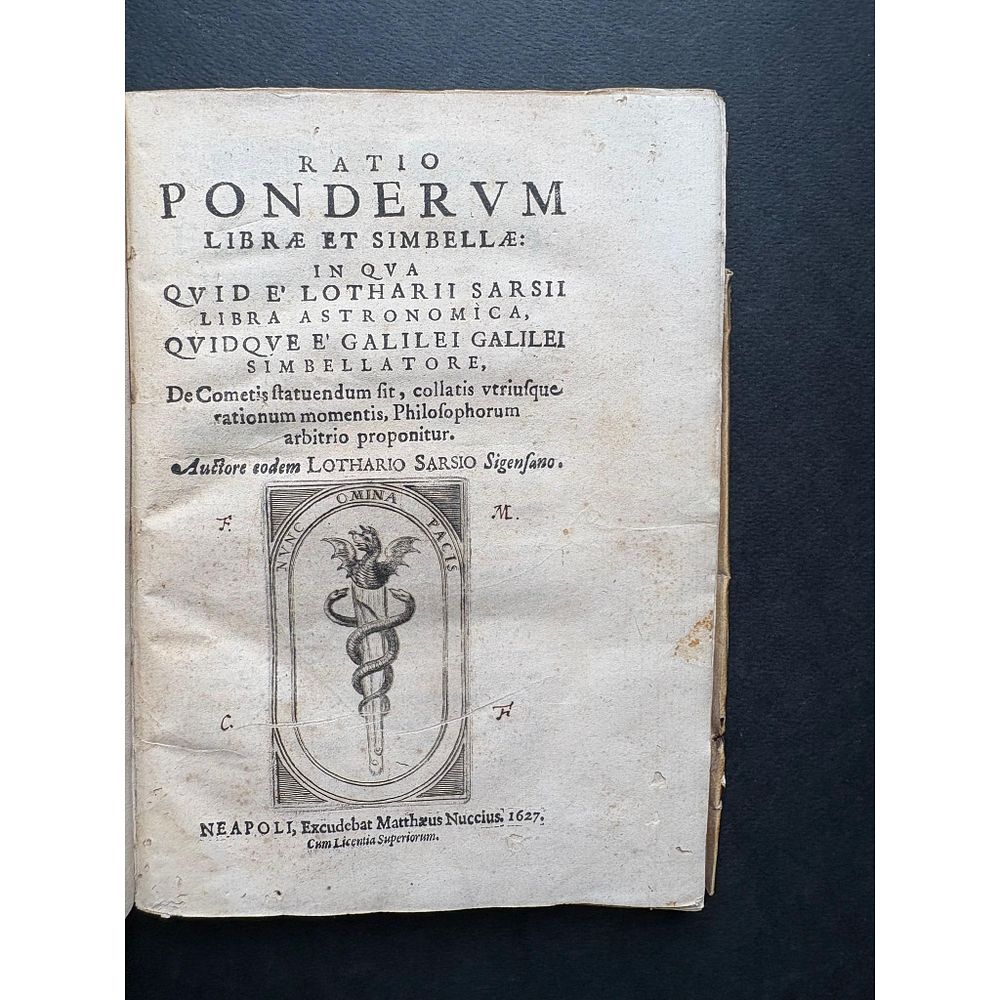
[ASTRONOMY, MATHEMATICS & PHYSICS] - GRASSI, Orazio (1583–1654) - Ratio ponderum librae - GRASSI, Orazio (1583–1654), writing under the pseudonym Lotario Sarsi Sigensano. Ratio ponderum librae et simbellae: in qua quid e Lotharii Sarsii Libra astronomica, quidque e Galilei Galilei Simbellatore, de cometis statuendum sit, collatis utriusque rationum momentis, philosophorum arbitrio proponitur. Naples: Matthaeus Nuccius, 1627. 4to (222 × 158 mm). [8], 149, [3] pp. With one engraved plate; engraved device on the title-page, woodcut initials and ornaments. Some light reddish discoloration and occasional spotting, a few small marginal wormholes affecting the first and final leaves, but overall a good copy. Contemporary limp vellum, manuscript title to spine. RARE FIRST ITALIAN EDITION, AND THE FINAL WORK IN THE CELEBRATED CONTROVERSY OVER THE COMETS BETWEEN GALILEO GALILEI AND THE JESUIT MATHEMATICIAN ORAZIO GRASSI — GRASSI’S DIRECT AND FINAL REPLY TO GALILEO’S IL SAGGIATORE. Published at Naples in 1627 under Grassi’s pseudonym Lotario Sarsi Sigensano, this is the revised Italian edition of the Ratio ponderum, following the first edition published in Paris in 1626. It represents the concluding act in one of the most famous intellectual disputes of the Scientific Revolution, a controversy which began with the appearance of the great comets of 1618 and gradually expanded from a disagreement in observational astronomy into a profound debate over cosmology, physics, scientific method, and the nature of matter itself. The sequence of publications that culminated in the present work constitutes one of the most remarkable printed dialogues in the history of early modern science. Grassi first entered the debate with his Disputatio astronomica de tribus cometis anni MDCXVIII, defending an interpretation broadly compatible with the cosmological system of Tycho Brahe. Galileo, who had been unable personally to observe the comets because of illness, responded through his friend and pupil Mario Guiducci, whose Discorso delle comete appeared at Florence in 1619 and substantially reflected Galileo’s arguments. Grassi replied later that year with his Libra astronomica ac philosophica, published under the name Lotario Sarsi. Galileo’s answer was the celebrated Il Saggiatore of 1623, one of the defining texts of seventeenth-century science and one of the great monuments of scientific prose. The present Ratio ponderum librae et simbellae is Grassi’s answer to that masterpiece — and the last printed exchange in the controversy. The titles themselves reveal the extraordinary literary character of the dispute. Grassi had entitled his earlier attack Libra, “the balance”, presenting himself as one who would weigh Galileo’s arguments. Galileo responded with Il Saggiatore, the “Assayer”, invoking the far more delicate balance used by goldsmiths to suggest the greater precision required in the examination of nature. Grassi now returned once again to the metaphor of weighing in the Ratio ponderum librae et simbellae, literally comparing the “weights” of the two balances and submitting the respective arguments of Sarsi and Galileo to the judgement of philosophers. Yet by 1626–27 the argument had moved far beyond the original question of the comets. Grassi subjected Galileo’s Saggiatore to a detailed, frequently personal and sometimes caustic examination. He challenged Galileo not only on astronomy and physics but also on matters of language, intellectual conduct and scientific priority, even questioning his connection with the invention of the telescope. The work therefore provides an exceptional contemporary witness to the increasingly bitter character of the dispute between Galileo and members of the Jesuit scientific establishment. More significantly, Grassi attacked the philosophical foundations of Galileo’s physics. In Il Saggiatore, Galileo had distinguished between the measurable properties inherent in bodies — such as size, shape, number and motion — and sensations such as colour, taste, smell and heat, which arise only through the interaction of bodies with the senses. Behind this distinction lay an essentially corpuscular conception of matter. Grassi recognised the potentially far-reaching implications of this argument. In the Ratio ponderum he contended that Galileo’s treatment of matter and sensible qualities raised problems extending beyond natural philosophy and into theology, particularly in relation to the Catholic doctrine of the Eucharist and transubstantiation. This passage has subsequently become one of the most discussed aspects of the Galileo affair. While modern scholarship does not accept the simple identification of Grassi with the anonymous denunciation of Il Saggiatore sometimes proposed in the twentieth century,