Bidspirit auction | [ASTRONOMY, MATHEMATICS & PHYSICS] -
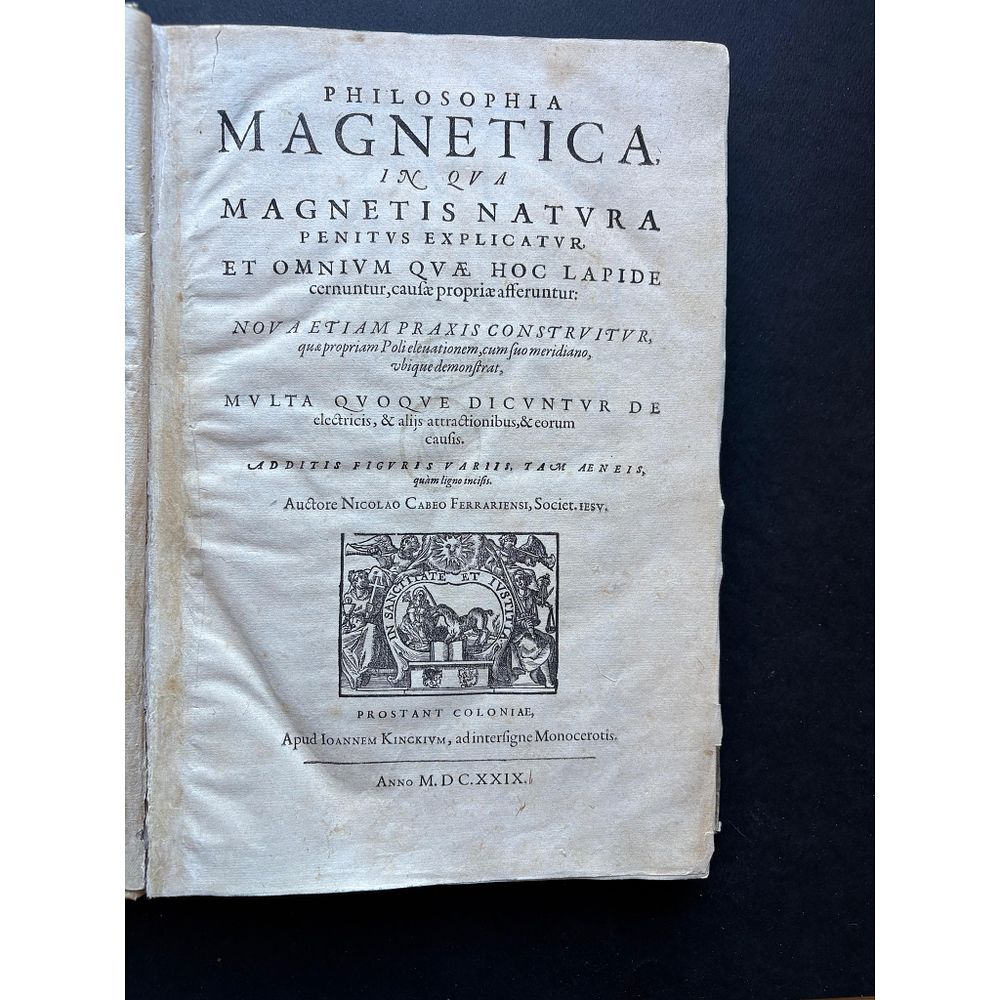
[ASTRONOMY, MATHEMATICS & PHYSICS] - CABEO, Niccolò (1586–1650) - Philosophia magnetica - CABEO, Niccolò (1586–1650). Philosophia magnetica, in qua magnetis natura penitus explicatur, et omnium quae hoc lapide cernuntur causae propriae afferuntur. Nova etiam praxis construitur, quae propriam poli elevationem, cum suo meridiano, ubique demonstrat. Multa quoque dicuntur de electricis, et aliis attractionibus, et eorum causis. Cologne: Johann Kinckius, 1629. Folio (323 × 225 mm). [18], 412, [12] pp. Elaborate engraved architectural title dated 1628, several engraved illustrations including a small world map, numerous historiated woodcut initials and approximately 240 woodcut diagrams and scientific illustrations throughout. Nineteenth-century paper-covered boards, vellum spine; binding worn, chipped and partly detached, with losses at head and foot, boards rubbed. Letterpress title detached. Internally complete. Provenance: Basel Public Library (Bibl. Publ. Basiliensis), old institutional stamps on verso of title and final leaf, subsequently deaccessioned. First edition, Cologne issue. One of the major seventeenth-century books on magnetism and electricity, and a landmark in the experimental investigation of magnetic and electrical phenomena after William Gilbert’s De magnete of 1600. Niccolò Cabeo, Jesuit mathematician, philosopher and experimental scientist, devoted many years to the study of the magnet. In the Philosophia magnetica he brought together an extensive knowledge of earlier authorities with a remarkable programme of experiments concerning magnetic attraction, polarity, compass behaviour, terrestrial magnetism and the newly developing study of electrical attraction. Cabeo engages repeatedly and critically with William Gilbert, whose experimental achievements he greatly admired while rejecting several of his theoretical conclusions, most notably the conception of the Earth itself as a great magnet. The work is therefore one of the most substantial early responses to Gilbert and an important document in the development of experimental natural philosophy. Its greatest historical importance lies in Cabeo’s observations concerning electricity. On p. 194 he describes how light particles attracted by rubbed amber could, after contact, recoil and move away from it. This passage has traditionally been regarded as the first published recognition of electrical repulsion, a phenomenon that would only later be investigated systematically by Otto von Guericke and others. Equally significant are Cabeo’s experiments with iron filings. By scattering filings around a lodestone he produced curved patterns corresponding to its magnetic action. The illustration on p. 316 has been identified as one of the earliest, and traditionally the first printed, visual representations of what would later be understood as the magnetic field — a striking anticipation of the “lines of force” made fundamental to electromagnetic theory by Faraday more than two centuries later. Cabeo also investigates the celebrated idea of the “sympathetic telegraph”, in which two magnetized needles were supposedly capable of communicating instantaneously over a distance. Although he rejects the possibility after experiment, the book preserves important early diagrams of this imaginary magnetic telegraph, one of the most curious anticipations of long-distance electrical communication. The extraordinary illustrative apparatus — nearly 240 woodcuts and diagrams — makes the Philosophia magnetica not only an important scientific text but one of the most visually compelling books devoted to experimental physics in the first half of the seventeenth century. The bibliographical history of the first edition is unusual. Copies were issued in 1629 with Ferrara and Cologne imprints; surviving examples may contain the engraved Ferrara title, a separate letterpress Cologne title, or both. The present copy belongs to the Cologne issue, published under the name of Johann Kinckius. A foundational work in the early history of magnetism and electricity, containing the first published recognition of electrical repulsion and an exceptionally early visualization of magnetic field patterns, richly illustrated throughout and with distinguished institutional provenance from the Basel Public Library.