Bidspirit auction | [ASTRONOMY, MATHEMATICS & PHYSICS] -
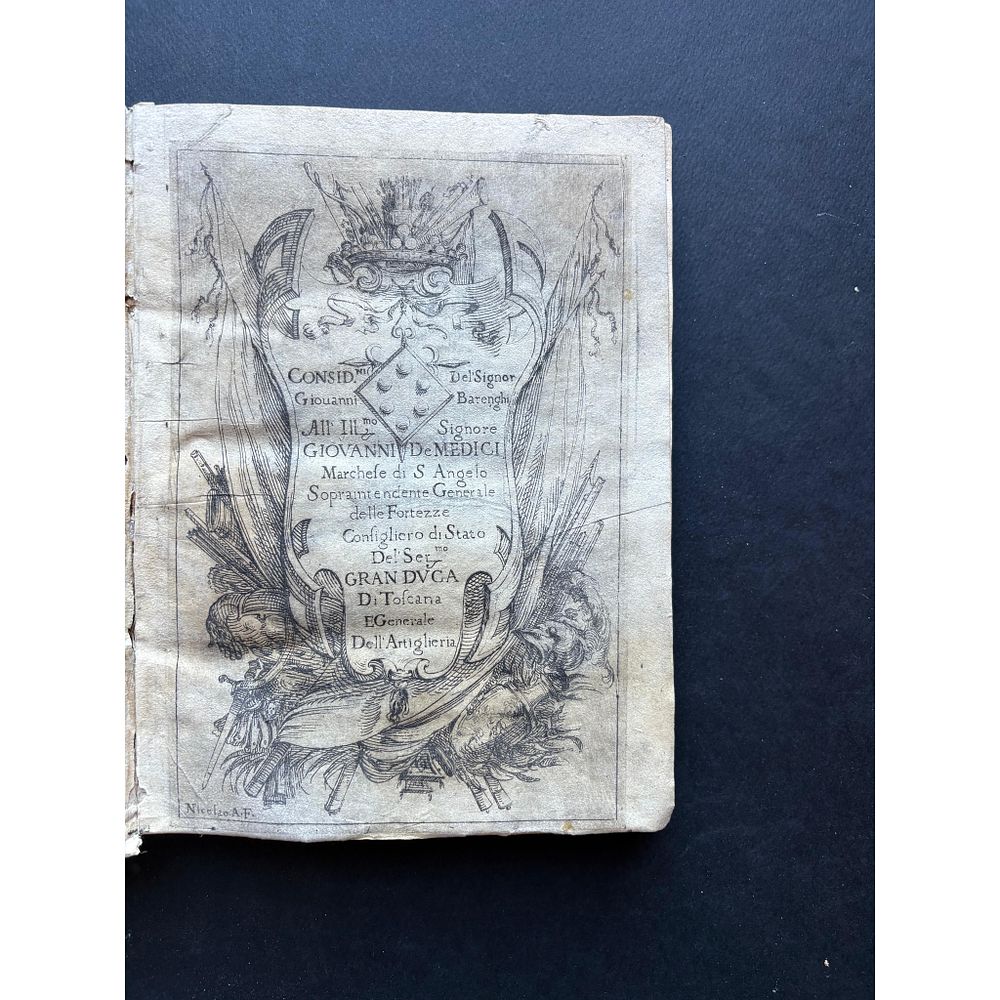
[ASTRONOMY, MATHEMATICS & PHYSICS] - BARENGHI, Giovanni. - Considerazioni sopra il Dialogo de dua massimi sistemi - ***Note: This lot is located in Italy and requires an Italian export licence. We will manage the full application process for you. An additional fee of £50 applies.*** BARENGHI, Giovanni. Considerazioni del signor Giovanni Barenghi sopra il Dialogo de dua massimi sistemi tolemaico, e copernicano, nelle quali si difende il metodo d’Aristotele ne’ libri del cielo, le sue dimostrazioni per lo moto retto de gl’elementi, e per la quiete della terra nel centro, e per lo moto de gl’orbi celesti, e loro dimensioni fra’ corpi sublunari, da quanto gl’ha scritto contro il signor Accademico Linceo. Libri tre. Pisa: appresso Francesco della Dote, 1638. EXCEEDINGLY RARE FIRST EDITION OF ONE OF THE MOST DIRECT AND REMARKABLE ANTI-GALILEAN RESPONSES TO THE DIALOGO SOPRA I DUE MASSIMI SISTEMI — PUBLISHED ONLY SIX YEARS AFTER GALILEO’S MASTERPIECE AND FIVE YEARS AFTER ITS CONDEMNATION. 4to (216 × 160 mm). Engraved allegorical frontispiece, [10], 216, [4] pp. Woodcut initials and ornaments throughout. The engraved frontispiece, signed “Nicolao A. F.”, incorporates the arms of Giovanni de’ Medici, Marquis of Sant’Angelo, to whom the work is dedicated. Contemporary rustic boards. Some light foxing; losses at head and foot of spine and along the joints. An appealing, genuine copy preserved in its unsophisticated contemporary binding. FIRST EDITION, AND EXTREMELY RARE IN COMMERCE, of Giovanni Barenghi’s posthumously published defence of Aristotelian cosmology against Galileo’s Dialogo sopra i due massimi sistemi del mondo. Published at Pisa in 1638, the work belongs to the immediate intellectual aftermath of one of the defining events in the history of science: the publication of Galileo’s Dialogo in 1632 and his subsequent condemnation by the Roman Inquisition in 1633. A DIRECT RESPONSE TO GALILEO Barenghi does not merely defend Aristotelian natural philosophy in general terms. His Considerazioni engages directly and repeatedly with Galileo’s text, seeking to answer the arguments advanced by the “Accademico Linceo” against the traditional Aristotelian and Ptolemaic structure of the universe. The relationship with Galileo’s prohibited book is particularly striking. Although the Dialogo had been condemned and placed on the Index in 1633, Barenghi evidently had access to the text: substantial passages from Galileo are reproduced verbatim or almost verbatim in the course of his refutation. The volume thus provides remarkable evidence for the continuing circulation, reading and intellectual impact of Galileo’s ideas even after his trial. THE DEFENCE OF THE ARISTOTELIAN UNIVERSE Barenghi attempts to preserve the traditional physical distinction between the terrestrial and celestial regions and to defend fundamental elements of Aristotelian cosmology attacked in the Dialogo. Among the principal subjects discussed are natural motion, the movement of the elements, the position and immobility of the Earth at the centre of the universe, the motions of the celestial spheres, and the distinction between the sublunary and celestial worlds. The work is therefore an exceptional document of the scientific controversy generated by Galileo. Rather than viewing the triumph of Copernican astronomy retrospectively as inevitable, the Considerazioni allows us to witness the debate from within the intellectual world of the seventeenth century, when Aristotelian physics still possessed powerful institutional and philosophical defenders. ONLY THE FIRST PART WAS EVER PRINTED Barenghi apparently conceived his response on a considerably larger scale. Although the title announces three books, only the first was published. According to the introductory material, the projected continuation was to include a second part devoted to the incorruptibility of the heavens, while a third was intended specifically to refute the arguments advanced by Galileo in favour of the motion of the Earth and the Copernican system. These further sections never appeared in print, making the present volume the sole surviving printed portion of Barenghi’s projected systematic attack upon Galileo. The work was published posthumously through the efforts of Domenico Beccari, Barenghi’s heir and editor. Contemporary bibliographical evidence confirms that only the first book was issued. A BOOK BORN IN THE IMMEDIATE AFTERMATH OF THE GALILEO AFFAIR The date, 1638, gives the book particular historical resonance. It appeared only five years after Galileo’s condemnation and in the same year in which his Discorsi e dimostrazioni matematiche intorno a due nuove scienze was published at Leiden. Barenghi’s volume consequently stands at precisely the moment when Galileo’s new physics was continuing to develop and circulate while defenders of the older Aristotelian cosmology attempted to contain its implications.