Bidspirit auction | [ASTRONOMY, MATHEMATICS & PHYSICS] -
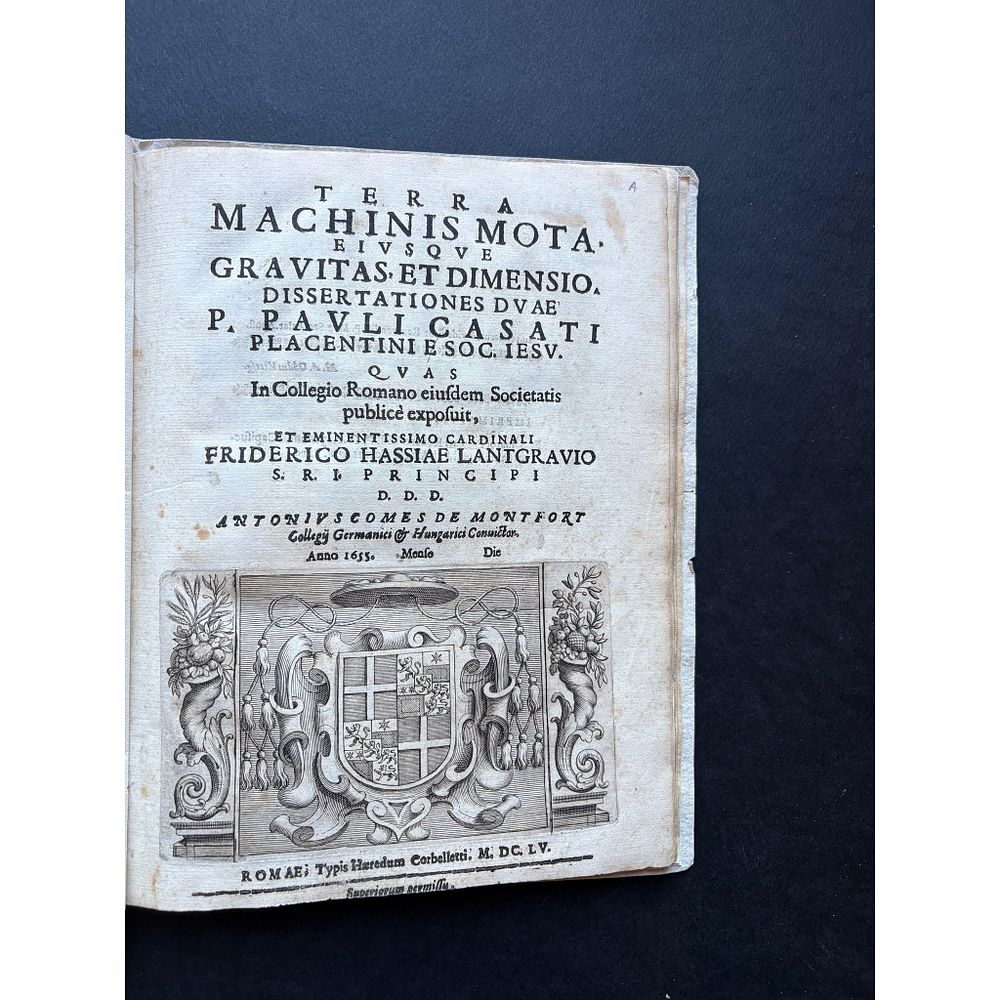
[ASTRONOMY, MATHEMATICS & PHYSICS] - CASATI, Paolo (1617–1707) - Terra machinis mota - CASATI, Paolo (1617–1707). Terra machinis mota, eiusque gravitas, et dimensio. Dissertationes duae P. Pauli Casati Placentini e Societate Iesu, quas in Collegio Romano eiusdem Societatis publicè exposuit. Rome: Typis Haeredum Corbelletti, 1655. EXCEEDINGLY RARE FIRST EDITION OF THIS REMARKABLE WORK OF JESUIT MECHANICS AND GEOPHYSICS, CAST AS AN IMAGINARY DIALOGUE BETWEEN GALILEO GALILEI, MARIN MERSENNE AND PAUL GULDIN — AN EXTRAORDINARY AND UNUSUALLY SYMPATHETIC REAPPEARANCE OF GALILEO WITHIN THE INTELLECTUAL WORLD OF THE ROMAN COLLEGE. Folio (267 × 198 mm). [6], 52 pp., lacking the final blank leaf. Engraved coat of arms of the dedicatee on the title-page and numerous woodcut diagrams and illustrations in the text depicting machines, mechanical arrangements and geometrical constructions. Lower margin of title-page trimmed; one leaf stained; a small restored hole with one letter supplied; one paper flaw resulting in a fold. Modern rustic boards. VERY RARE FIRST EDITION, representing the original, substantially shorter form of a work which Casati would extensively revise and enlarge in 1658. GALILEO RETURNS TO THE COLLEGIO ROMANO Perhaps the most remarkable feature of the Terra machinis mota is its literary form. Casati constructs an imaginary scientific conversation between three of the outstanding mathematical thinkers of the preceding generation: Galileo Galilei, Marin Mersenne and the Jesuit mathematician Paul Guldin. All three were dead by the time the book appeared. The choice of Galileo is particularly striking. Casati was himself a Jesuit and taught mathematics at the Collegio Romano, the intellectual centre of the Society of Jesus in Rome. Yet only a little more than twenty years after Galileo’s condemnation, Casati allows him to re-enter a Jesuit scientific discussion not merely as an adversary to be refuted, but as an authoritative and intellectually vigorous participant. The work is therefore a fascinating document of the reception of Galilean mechanics within seventeenth-century Jesuit science, demonstrating that Galileo’s influence extended well beyond the controversial cosmological questions that had led to his trial. “GIVE ME A PLACE TO STAND…” — MOVING THE EARTH The title itself evokes one of the most famous images in the history of mechanics: the Archimedean boast that, given a place to stand and a sufficiently powerful lever, one could move the Earth. Casati transforms this classical thought experiment into the organising principle of a serious mathematical investigation. The first dissertation compares the forces generated by different mechanical devices — including levers, pulleys, ropes, wheels and compound machines — asking how mechanical advantage may be calculated and how the powers of different machines may be compared. The second dissertation turns from the machine to the object that is hypothetically to be moved: the Earth itself. Casati investigates its size and gravity and asks, in mathematical terms, what kind of mechanical apparatus would theoretically be required to move such an enormous body. What begins as an apparently paradoxical Archimedean conceit thus becomes a sophisticated exercise in mechanics, geometry and the quantitative study of the terrestrial globe. THE MASS AND DIMENSIONS OF THE EARTH The second half of the work is particularly important for the history of mathematical physics. Casati explores methods for determining the dimensions and weight of the Earth, attempting to connect terrestrial measurement with the mechanical principles established in the first dissertation. The problem was a formidable one. The size of the Earth could be approached through geometrical and geographical measurement, but its weight or mass presented an entirely different theoretical challenge. Casati’s discussion belongs to the early modern attempt to treat the Earth not merely as the immobile centre of Aristotelian cosmology but as a physical body susceptible to mathematical analysis. In this respect the Terra machinis mota stands at an intriguing intersection between classical mechanics, Galilean science and the developing disciplines of geodesy and geophysics. A JESUIT RESPONSE TO GALILEAN MECHANICS The intellectual significance of the work lies also in its nuanced treatment of Galileo. The Galileo invoked by Casati is principally the mathematician and mechanician, rather than the condemned advocate of Copernican cosmology. His methods and mechanical reasoning could therefore be discussed, appropriated and incorporated into Jesuit mathematical teaching even while heliocentrism remained deeply problematic. This distinction is crucial for understanding the complex reception of Galileo in the decades following 1633.