Bidspirit auction | [ASTRONOMY, MATHEMATICS & PHYSICS] -
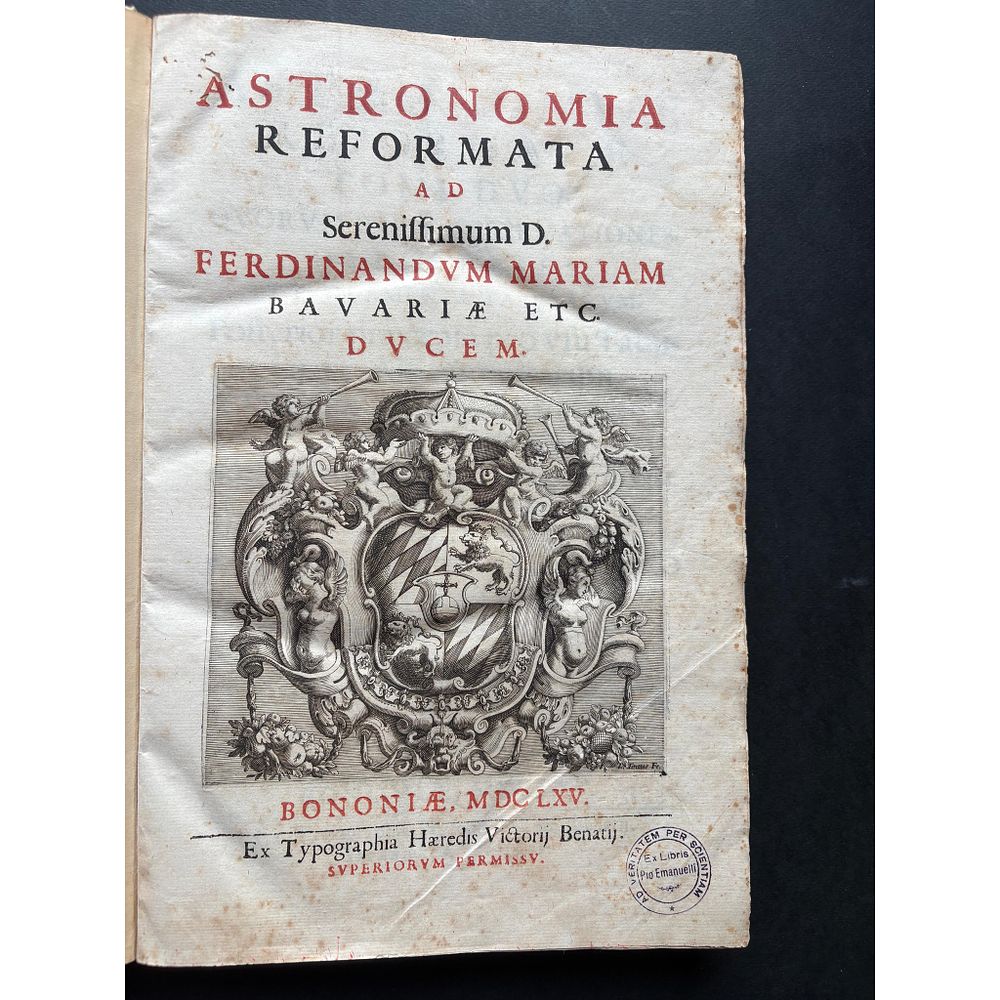
[ASTRONOMY, MATHEMATICS & PHYSICS] - RICCIOLI, Giovanni Battista (1598–1671) - Astronomiae reformatae tomi duo - RICCIOLI, Giovanni Battista (1598–1671) Astronomiae reformatae tomi duo, quorum prior observationes, hypotheses, et fundamenta tabularum, posterior praecepta pro usu tabularum astronomicarum, et ipsas tabulas astronomicas 102 continet. Bologna: heirs of Vittorio Benacci, 1665. Two parts in one volume, folio (355 × 230 mm). [14], XII, 374, [8], 35, [1], 128 pp. Two large folding engraved lunar maps, finely engraved within decorative frames, and numerous woodcut illustrations and astronomical diagrams in the text. Large engraved title-page vignette; additional title-page printed in red and black, bearing the engraved arms of Ferdinand Maria, Elector of Bavaria. Dedications and ornamental initials. RARE FIRST EDITION OF RICCIOLI’S MAJOR SUPPLEMENT TO THE ALMAGESTUM NOVUM, AN IMPORTANT CONTRIBUTION TO SEVENTEENTH-CENTURY OBSERVATIONAL ASTRONOMY AND THE HISTORY OF LUNAR CARTOGRAPHY. Giovanni Battista Riccioli, a Jesuit astronomer based in Bologna, was among the most influential astronomical authorities of the seventeenth century. His Almagestum novum of 1651 had offered an extensive critical survey of contemporary astronomical knowledge. The present work, published fourteen years later, was conceived as its third and supplementary part, bringing together further observations, hypotheses, mathematical foundations, and astronomical tables. The Astronomia reformata examines the principal bodies of the Solar System and the fixed stars, combining the inherited Ptolemaic tradition with the results of modern telescopic observation. Riccioli critically assessed competing astronomical systems, including Copernican and Tychonic models, while continuing to defend a geocentric cosmology. His approach nevertheless relied upon extensive observational work and a rigorous comparison of astronomical data, making the work an important document of the scientific debates preceding the eventual acceptance of heliocentrism. The two large folding lunar maps are of particular importance. Produced by Francesco Maria Grimaldi and engraved by Domenico Maria Fontana, they represent a major stage in the development of telescopic lunar cartography. The nomenclature devised by Riccioli and Grimaldi assigned names to lunar craters and other formations, many of which remain in use today. Their system established a durable framework for identifying and describing the Moon’s surface and became fundamental to subsequent selenographic studies. Riccioli also contributed significantly to the observation and description of the planets. His recorded observations of Jupiter’s equatorial bands and Saturn’s appearance illustrate both the progress and the limitations of seventeenth-century telescopic astronomy. Although he was familiar with Christiaan Huygens’s interpretation of Saturn’s rings, he did not accept the proposed explanation. The volume is thus an important witness to the complex relationship between traditional cosmology, mathematical astronomy, and the new observational sciences in the decades following Galileo. Provenance: Ownership stamps of Pio Emanuelli. Binding: Modern full vellum, with title-piece on the spine; red-sprinkled edges. Condition: Good copy, with light but persistent dampstaining, minor worming affecting the first two leaves, and superficial soiling to the verso of the final leaf. Riccardi I, 373; Houzeau & Lancaster 9230; De Backer–Sommervogel VI, 1801, 9.