Bidspirit auction | [ASTRONOMY, MATHEMATICS & PHYSICS] -
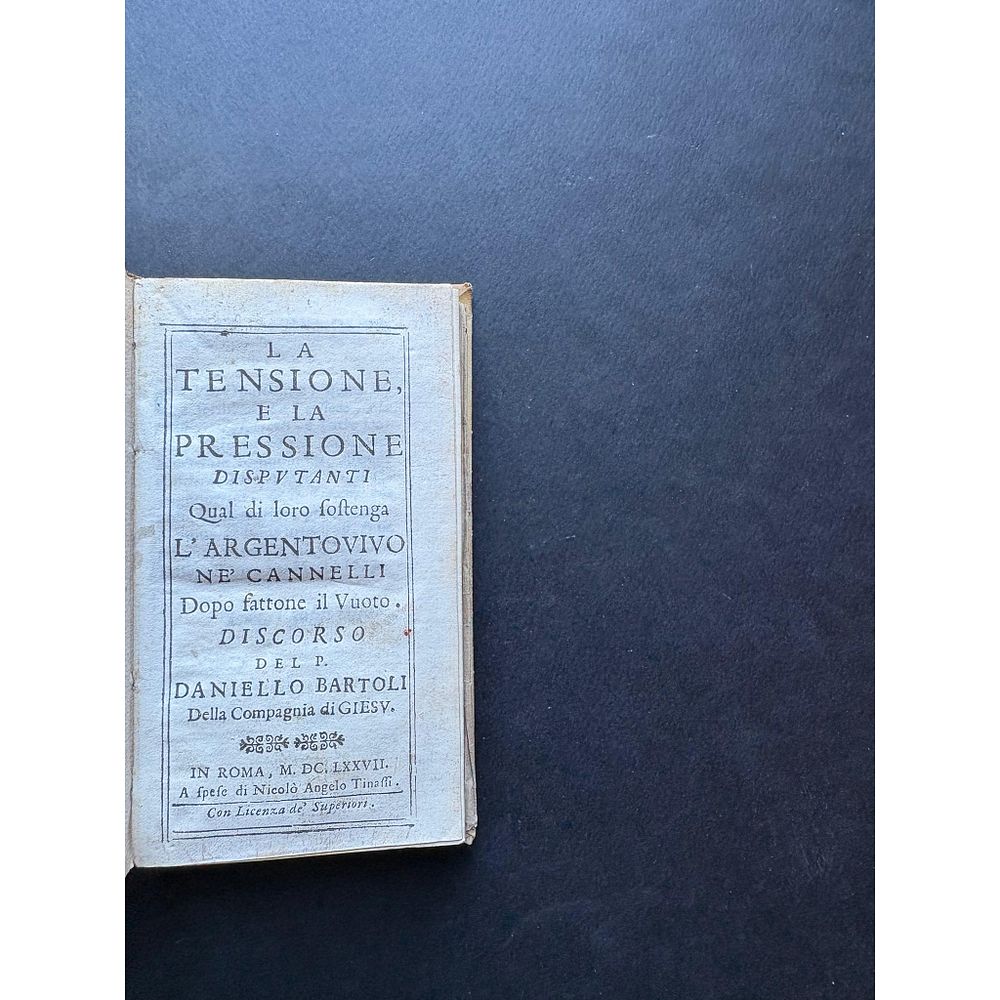
[ASTRONOMY, MATHEMATICS & PHYSICS] - BARTOLI, Daniello (1608–1685) - La tensione e la pressione - BARTOLI, Daniello (1608–1685). La tensione, e la pressione disputanti qual di loro sostenga l’argentovivo ne’ cannelli doppo fattone il vuoto. Discorso del P. Daniello Bartoli della Compagnia di Gesù. Bologna: Gioseffo Longhi, 1677. An important early work on the barometer and the nature of atmospheric pressure, published in the same year as the first edition. 12mo. 282 pp., with 2 folding plates illustrating barometric experiments. Contemporary full vellum, manuscript title to spine. A very attractive, fresh and well-preserved copy. Second edition, published in the same year as the first Roman edition (Rome, Nicolò Angelo Tinassi, 1677), of this significant contribution to the seventeenth-century debate concerning the vacuum and atmospheric pressure. Daniello Bartoli, Jesuit historian and scientist, here examines the celebrated Torricellian experiment and the problem of what causes mercury to remain suspended in a tube after the creation of a vacuum. The work is ingeniously structured as a dispute between two competing explanations, “tension” and “pressure”, and reviews the experimental evidence then available concerning the behaviour of air and mercury. Bartoli ultimately gives particular weight to atmospheric pressure, also considering experimental evidence associated with the development of the air pump. The book belongs to the intense period of experimental investigation that followed Torricelli’s discovery of the mercury barometer and the subsequent European debate on the existence and physical properties of the vacuum. Bartoli’s treatise is consequently of considerable interest for the history of experimental physics and barometry. A contemporary source already discussed the work shortly after its publication, while later bibliographical literature described it as a “rare early work on the barometer.” References: Honeyman 231; Sommervogel I, 980; Gamba 1774; Piantanida 1514.