Bidspirit auction | [ASTRONOMY, MATHEMATICS & PHYSICS] -
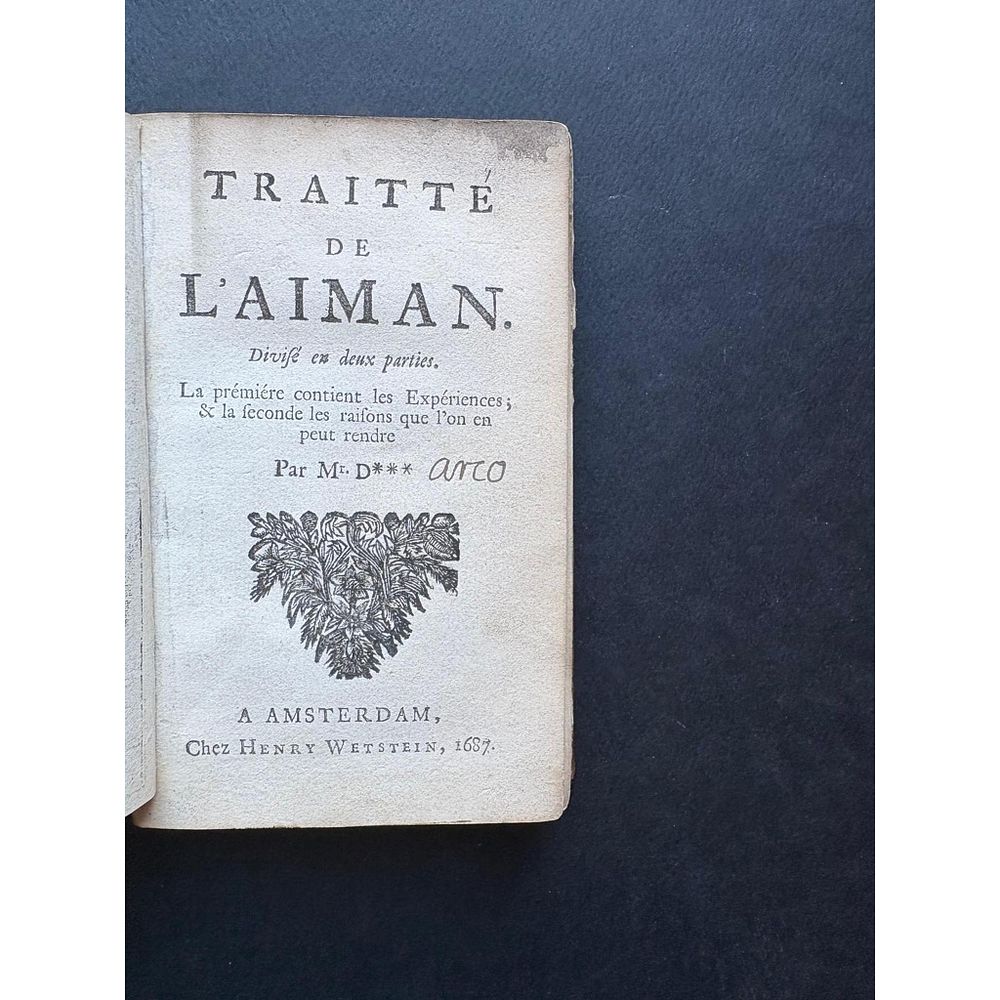
[ASTRONOMY, MATHEMATICS & PHYSICS] - DALENCÉ [D’ALENCÉ], Joachim (1640–1707) - Traitté de l'aiman - DALENCÉ [D’ALENCÉ], Joachim (1640–1707) Traitté de l’aiman. Divisé en deux parties. La premiére contient les expériences; & la seconde les raisons que l’on en peut rendre. Par M. D*.** Amsterdam: Henry Wetstein, 1687. 12mo (147 × 92 mm). Engraved frontispiece, [18], 140, [8] pp., and 33 full-page engraved plates, containing 41 figures and illustrating experiments, magnetic phenomena, compasses and devices employing magnets. Engraved frontispiece somewhat closely trimmed and possibly supplied from another copy; text slightly close-cut, with occasional minor marginal spotting. Full vellum, gilt-lettered spine label. Early manuscript inscription on title-page. FIRST EDITION OF THIS RARE AND FINELY ILLUSTRATED SEVENTEENTH-CENTURY TREATISE ON MAGNETISM, COMBINING EXPERIMENTAL OBSERVATION WITH A SYSTEMATIC ACCOUNT OF THE PHYSICAL PROPERTIES AND PRACTICAL APPLICATIONS OF THE LODESTONE. Joachim Dalencé’s Traitté de l’aiman is one of the most attractive illustrated works devoted exclusively to magnetism in the later seventeenth century. Divided deliberately into two complementary sections — the first presenting experiments, the second attempting to explain the physical reasons underlying them — it reflects the increasing emphasis placed upon experimental demonstration in European natural philosophy. Dalencé examines the principal properties of the magnet, the identification and preparation of lodestones, the attraction of iron, the polarity of magnets, methods of magnetising iron and the relative strength of different magnetic bodies. He also considers the behaviour of magnetic needles and the practical applications of magnetism in instruments and machines. A substantial portion of the work concerns the magnetic compass and terrestrial magnetism. Dalencé discusses the invention and operation of the mariner’s compass and offers explanations for the orientation of the magnetic needle, engaging with contemporary theories of terrestrial magnetism and proposing an interpretation distinct from that associated with Descartes. The book also preserves some of the more remarkable beliefs and controversies surrounding magnetism in the seventeenth century. Dalencé reports, for example, the story that the coasts of America contained enormous magnetic mountains capable of attracting the iron fittings of ships and drawing vessels towards destruction. He also discusses and rejects celebrated magnetic marvels and supposed occult effects, including the legendary suspension of Mahomet’s coffin by magnetic attraction and claims surrounding magnetic ointments. The final chapter, devoted to the “Description de quelques machines faites au moyen d’aimants, ” illustrates the transition from the magnet as an object of natural wonder to magnetism as a force capable of practical and mechanical application. Of particular importance is the exceptionally attractive suite of 33 engravings by Adriaan Schoonebeek (1658–1705), a pupil of Romeyn de Hooghe. The plates contain 41 individual figures: twenty-eight associated with the first part and thirteen with the second. Rather than presenting the experiments as purely abstract diagrams, Schoonebeek frequently places scientific apparatus within landscapes, interiors and lively scenes populated by human figures, creating a remarkable synthesis of scientific illustration and Dutch Baroque engraving. The illustrations depict magnetic experiments, compass needles, attraction and repulsion, methods of magnetisation and ingenious devices constructed around magnetic forces. The Wheeler Gift singled out the illustrations as particularly suggestive and recognised the work as a rare general treatise on the magnet and its uses. The Traitté de l’aiman thus occupies an appealing position between the older literature of magnetic wonders and the increasingly experimental physics of the late seventeenth century. Its combination of experiment, theoretical explanation and exceptionally accomplished illustration makes it an important document in the early history of magnetism, experimental physics and scientific instrumentation. A RARE AND HIGHLY ILLUSTRATED FIRST EDITION OF ONE OF THE MOST ATTRACTIVE SEVENTEENTH-CENTURY TREATISES DEVOTED TO MAGNETISM, COMPLETE WITH THE 33 ENGRAVED PLATES BY ADRIAAN SCHOONEBEEK. References: Wheeler Gift 200; Brunet V, col. 918; Hofer, Baroque Book Illustration, 142.