Bidspirit auction | [ASTRONOMY, MATHEMATICS & PHYSICS] -
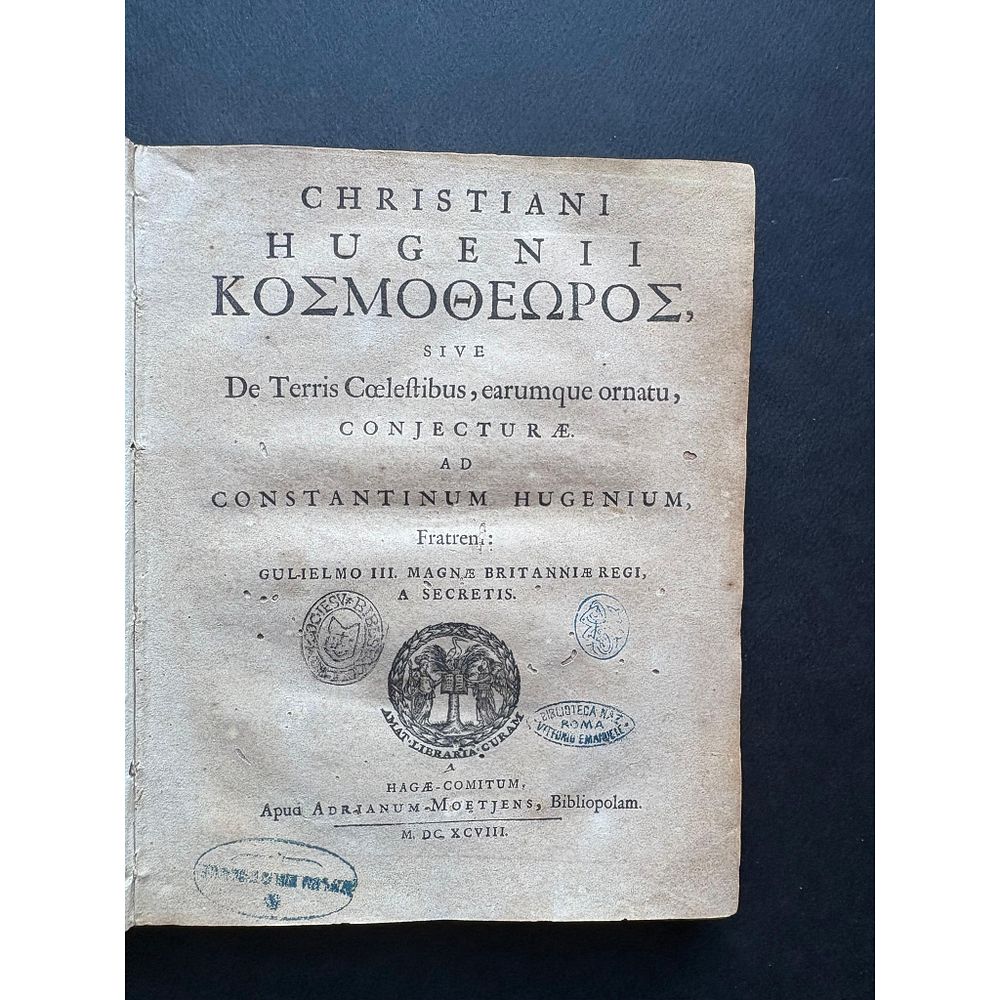
[ASTRONOMY, MATHEMATICS & PHYSICS] - HUYGENS, Christiaan (1629–1695) - ΚΟΣΜΟΘΕΩΡΟΣ [Kosmotheoros] - ***Note: This lot is located in Italy and requires an Italian export licence. We will manage the full application process for you. An additional fee of £50 applies.*** HUYGENS, Christiaan (1629–1695). ΚΟΣΜΟΘΕΩΡΟΣ [Kosmotheoros], sive de Terris Coelestibus, earumque ornatu conjecturae. The Hague: Adriaan Moetjens, 1698. FIRST EDITION OF HUYGENS’S CELEBRATED AND POSTHUMOUSLY PUBLISHED FINAL WORK — ONE OF THE EARLIEST SERIOUS SCIENTIFIC INVESTIGATIONS OF THE POSSIBILITY OF EXTRATERRESTRIAL LIFE AND THE HABITABILITY OF OTHER WORLDS. 4to (195 × 155 mm). [4], 144 pp. Woodcut vignette on title-page, ornamental head- and tailpieces and initials. Six engraved astronomical plates, most folding, numbered 1–5, with plate 4 represented in two versions, illustrating the planetary system, the comparative dimensions and relationships of celestial bodies and other astronomical phenomena. Contemporary full vellum, manuscript title to spine; some worming to the covers. Uniform browning of the paper, stamps on title-page, wormholes affecting the first and final leaves. Provenance: Biblioteca Nazionale Vittorio Emanuele, Rome, with its duplicate stamp. THE RARE FIRST EDITION, published three years after Huygens’s death, of one of the most remarkable works in the early history of speculation about inhabited planets. The Kosmotheoros represents the culmination of Huygens’s lifelong engagement with astronomy. Written during the final years of his life and addressed to his brother Constantijn, the manuscript was essentially completed by January 1695. Huygens died on 8 July of that year, having expressly requested that the work be published; after the subsequent death of his brother, its final publication was supervised by the Leiden mathematician and physicist Burchard de Volder. The Latin edition finally appeared at The Hague in 1698 and was almost immediately translated into English, followed by Dutch, French, German and other languages. IS THERE LIFE ON OTHER WORLDS? The extraordinary modernity of the Kosmotheoros lies in Huygens’s treatment of extraterrestrial life not as literary fantasy, but as a question susceptible to reasoned scientific conjecture. His starting point is Copernican astronomy. If the Earth is itself merely one planet orbiting the Sun, possessing no privileged physical position among the other planets, Huygens argues that there is no compelling reason to suppose that Earth alone should possess living creatures. From this principle he develops an extraordinarily ambitious investigation into the possible inhabitants, plants and environments of other planets. Huygens considers what physical conditions might exist on other worlds and whether they might support plant and animal life. He goes further still, speculating upon the intelligence of extraterrestrial inhabitants, their senses, social existence and even their possible cultivation of science, astronomy, mathematics, music and the arts. His reasoning is explicitly probabilistic. The work is presented as conjecturae — conjectures — but conjectures founded upon astronomical observation, analogy and rational inference rather than imaginative fiction. This distinction is crucial and is precisely what separates the Kosmotheoros from earlier fantastic voyages to the Moon and planets. Christie’s accordingly describes it as the first serious exploration of the idea of extraterrestrial life. A COPERNICAN UNIVERSE FILLED WITH LIFE The intellectual foundation of Huygens’s argument is the absence of any unique physical status for Earth within the Copernican system. If the planets share broadly comparable physical characteristics, and if the creation of living beings represents one of the highest manifestations of nature, Huygens considered it unreasonable that life should have been confined to a single world. He therefore imagines that other planets may possess their own vegetation, animals and intelligent beings. He attempts to deduce what such creatures might be like from the physical conditions known or suspected to prevail upon their respective worlds. This makes the Kosmotheoros an extraordinary early precursor to what would today be called astrobiology: the attempt to infer the possibility and nature of life elsewhere in the universe from astronomy and planetary conditions. Huygens even considers the possibility that the stars themselves are other suns surrounded by planetary systems of their own, extending the question of inhabited worlds far beyond the confines of our solar system. FROM ONE OF THE GREATEST ASTRONOMERS OF THE SEVENTEENTH CENTURY Such conjectures possessed particular authority coming from Huygens. He was not an armchair speculative philosopher but one of the greatest observational and mathematical scientists of the seventeenth century. In 1655 he discovered Titan, Saturn’s largest moon,