Bidspirit auction | [ASTRONOMY, MATHEMATICS & PHYSICS] -
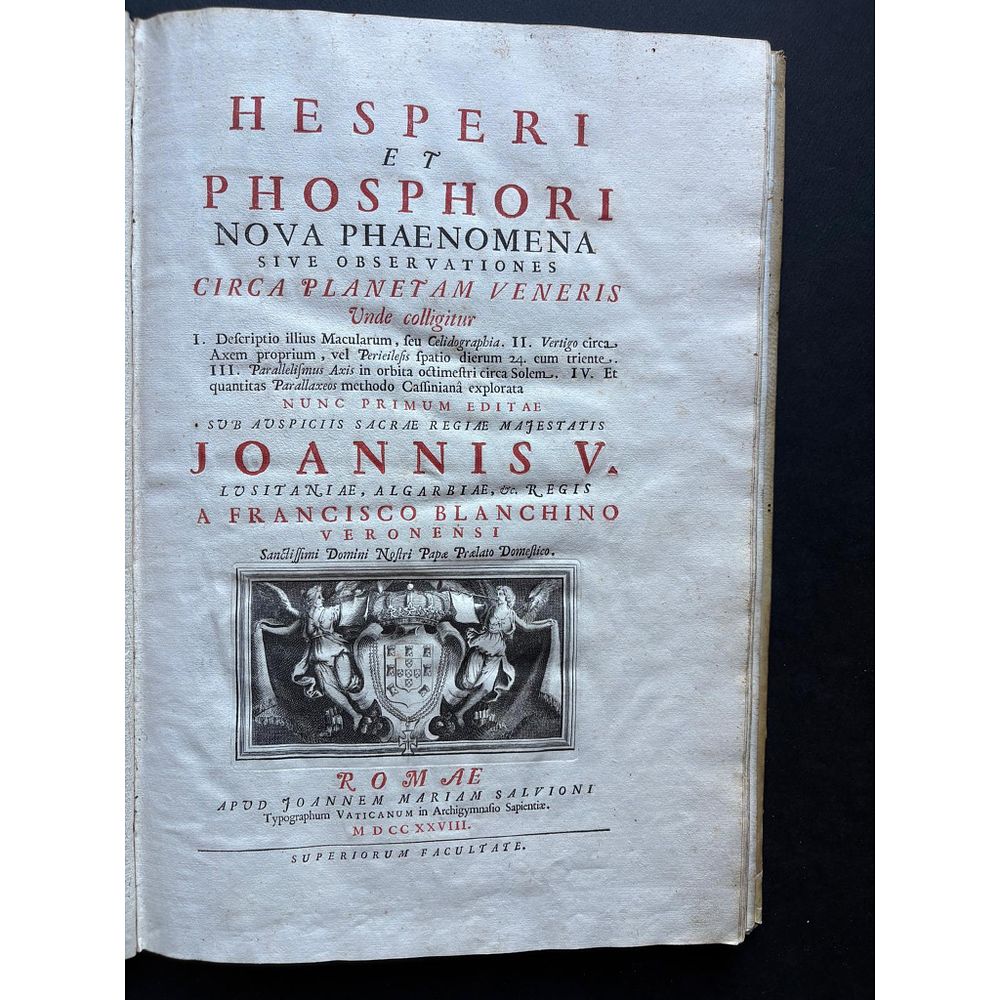
[ASTRONOMY, MATHEMATICS & PHYSICS] - BIANCHINI, Francesco (1662–1729) - Hesperi et Phosphori - ***Note: This lot is located in Italy and requires an Italian export licence. We will manage the full application process for you. An additional fee of £50 applies.*** BIANCHINI, Francesco (1662–1729). Hesperi et Phosphori nova phaenomena, sive observationes circa planetam Veneris. Rome: Giovanni Maria Salvioni, Vatican Printer at the Archiginnasio della Sapienza, 1728. Folio (420 × 274 mm). VIII, 92 pp. Title printed in red and black with engraved ornament; 10 engraved plates numbered I–X, several folding, illustrating observations, diagrams and instruments relating to the planet Venus. Contemporary full calf, spine richly gilt in compartments, gilt title on lettering-piece. Minimal wear to covers. Engraved frontispiece lacking; some light foxing to the final text leaf, otherwise an exceptionally fresh, wide-margined and finely printed copy, complete with all ten scientific plates. First edition. An important and beautifully produced work in the history of planetary astronomy, devoted entirely to telescopic observations of Venus and among the earliest substantial monographs dedicated to the physical study and mapping of the planet. Francesco Bianchini, astronomer, antiquarian and one of the leading scientific figures of early eighteenth-century Rome, observed Venus intensively during 1726 and 1727 from Rome and Albano. In the present work he attempted to identify permanent markings on the planet’s surface, determine its rotation, establish the orientation of its axis and calculate its parallax. The full title itself summarizes the ambitious programme: the description of the markings of Venus, its rotation about its own axis, the orientation of that axis during its orbit around the Sun, and the determination of parallax by a method associated with Cassini. Bianchini believed that his observations indicated a rotation period of approximately 24⅓ days. This value was later shown to be incorrect — the dense atmosphere of Venus makes reliable visual tracking of surface features extremely difficult — but his attempt represented an important stage in the systematic telescopic investigation of the planet. Treccani specifically records his observations of 1726–1727 and his conclusion concerning the 24-day rotation period. Of particular historical importance was his attempt to chart the visible markings of Venus and to reconstruct the planet graphically. The engraved plates constitute an early planetary atlas, translating repeated telescopic observations into maps, diagrams and geometrical projections. Modern catalogues of planetary cartography continue to record Bianchini’s 1728 work as an important early map of Venus. The work also reflects the increasingly sophisticated observational astronomy of the early eighteenth century, when improvements in telescopes, micrometers and geometrical methods made it possible to study planets not simply as moving points of light, but as physical worlds possessing rotation, surface features and measurable dimensions. Bianchini’s conclusions were not all correct, but the scientific importance of the book lies precisely in this transition toward the systematic physical investigation of another planet through repeated observation, measurement and graphic reconstruction. The ten large engraved plates are central to the value and beauty of the volume and include representations of the phases and apparent markings of Venus, geometrical constructions, observational schemes and astronomical instruments. The work has consequently been described in the antiquarian literature as one of the most important early illustrated books devoted specifically to Venus.A particularly attractive copy of the first edition, unusually fresh and wide-margined, retaining all ten engraved scientific plates in a handsome contemporary calf binding. References: Graesse I, 437; Riccardi I, p. 132.