Bidspirit auction | [ASTRONOMY, MATHEMATICS & PHYSICS] -
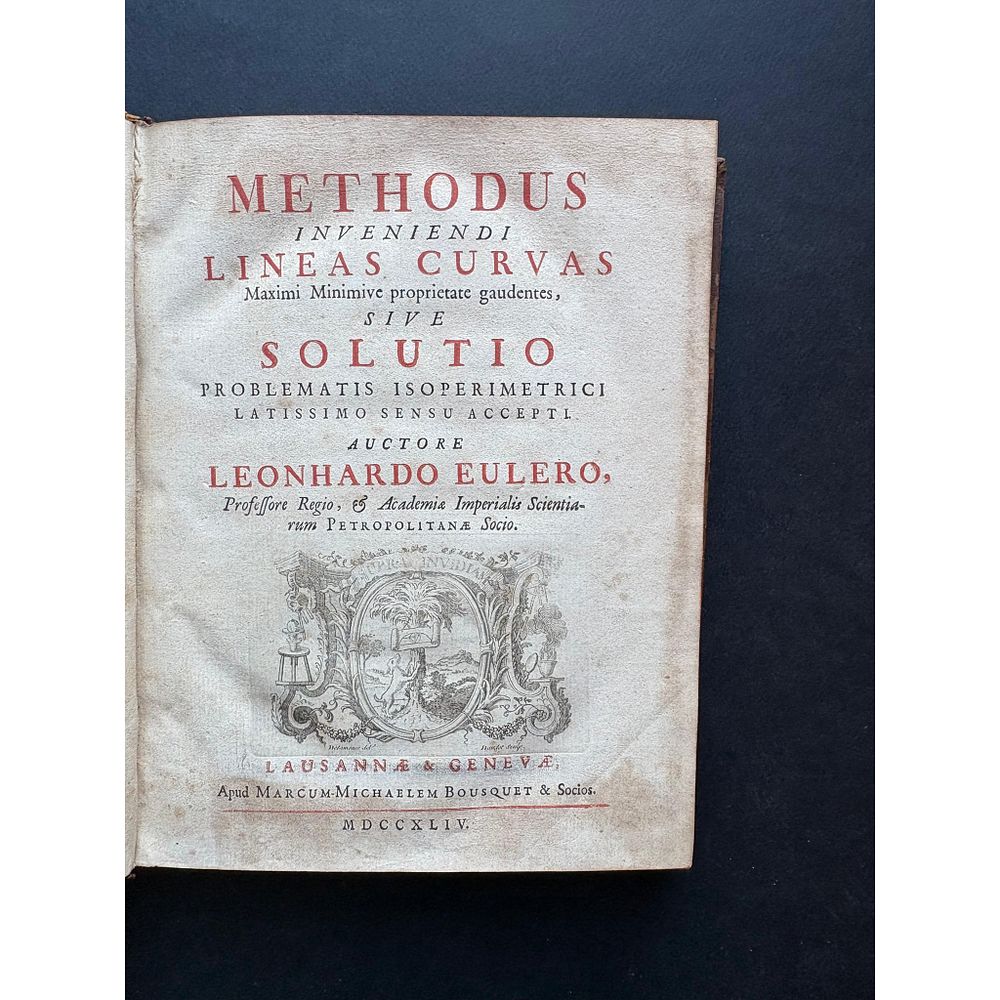
[ASTRONOMY, MATHEMATICS & PHYSICS] - EULER, Leonhard (1707–1783) - Methodus inveniendi lineas curvas - EULER, Leonhard (1707–1783). Methodus inveniendi lineas curvas maximi minimive proprietate gaudentes, sive solutio problematis isoperimetrici latissimo sensu accepti. Lausanne and Geneva: Marc-Michel Bousquet, 1744. RARE FIRST EDITION OF ONE OF THE GREAT LANDMARKS OF EIGHTEENTH-CENTURY MATHEMATICS — THE WORK WHICH ESTABLISHED THE CALCULUS OF VARIATIONS AS AN INDEPENDENT BRANCH OF MATHEMATICAL ANALYSIS. 4to (247 × 180 mm). [2], 322, [2] pp. Title-page printed in red and black with engraved vignette; 5 folding engraved plates. Light and mostly uniform browning, with occasional spotting. Contemporary brown calf, spine with five raised bands, gilt compartments and gilt title (rubbed and worn, joints used). FIRST EDITION of Euler’s celebrated treatise on maxima and minima, one of the most important mathematical books of the eighteenth century. The Methodus inveniendi gave systematic form to a class of problems that had occupied some of the greatest mathematicians of the preceding generation, particularly Johann and Jakob Bernoulli. Problems such as the brachistochrone had shown that mathematics could be used not merely to determine a numerical maximum or minimum, but to identify the particular curve possessing an extremal property. Euler recognised the generality of these investigations and transformed them into a coherent theory. THE BIRTH OF THE CALCULUS OF VARIATIONS The central achievement of the work was to establish general methods for determining curves which maximise or minimise a given integral quantity. In modern terms, Euler shifted the problem from the optimisation of numbers to the optimisation of functions and curves. This conceptual leap gave rise to what would later be called the calculus of variations. Norman accurately captures the importance of the publication: “With the publication of this work, the calculus of variations came into being as a new branch of mathematics. Euler was the first to formulate the principal problems of the calculus of variations and to create general methods for their solution.” The work contains the essential differential condition which, through the later development of Joseph-Louis Lagrange, became known as the Euler–Lagrange equation. This equation would prove fundamental not only to pure mathematics but also to analytical mechanics and theoretical physics, where variational principles came to provide some of the most powerful formulations of physical law. FROM THE BERNOULLIS TO LAGRANGE Euler’s work stands at the decisive transition between the ingenious individual problems of the Bernoulli school and the mature analytical theory later developed by Lagrange. Euler had studied with Johann Bernoulli in Basel and absorbed the extraordinary mathematical tradition created by the Bernoulli family. In the Methodus, however, he went far beyond his predecessors by identifying the common structure underlying a wide range of maximum and minimum problems. A decade later, the young Lagrange developed a more general analytical technique for treating such problems and communicated his ideas directly to Euler. The subsequent development of the subject would permanently associate their names in the Euler–Lagrange equation. The present work therefore occupies a foundational place in the history of modern analysis. MATHEMATICS APPLIED TO MECHANICS The importance of the Methodus inveniendi extends beyond pure mathematics. Euler devoted substantial attention to the application of variational methods to physical and mechanical problems, particularly the behaviour of elastic curves. The mathematical description of a bent elastic rod became one of the earliest major applications of the new theory. These investigations led directly into the developing mathematical theory of elasticity and stability and belong to the origins of what would later be known as Euler buckling, the analysis of the critical load at which a slender compressed column becomes unstable. The volume therefore represents a remarkable union of abstract mathematical innovation and practical mechanics. A NEW PRINCIPLE FOR MATHEMATICAL PHYSICS The deeper significance of Euler’s achievement lies in the idea that many natural phenomena can be described by an extremal principle. Instead of deriving the behaviour of a system solely from forces acting at each instant, one may search for a path or configuration that makes a certain mathematical quantity stationary, maximal or minimal. This principle would become central to the later work of Lagrange and Hamilton and, ultimately, to much of modern mathematical physics. In this sense, the Methodus inveniendi did more than establish a new branch of mathematics: it helped introduce one of the most fruitful ways of expressing the laws of nature. ONE OF EULER’S FUNDAMENTAL WORKS Euler’s scientific production was vast,