Bidspirit auction | [ASTRONOMY, MATHEMATICS & PHYSICS] -
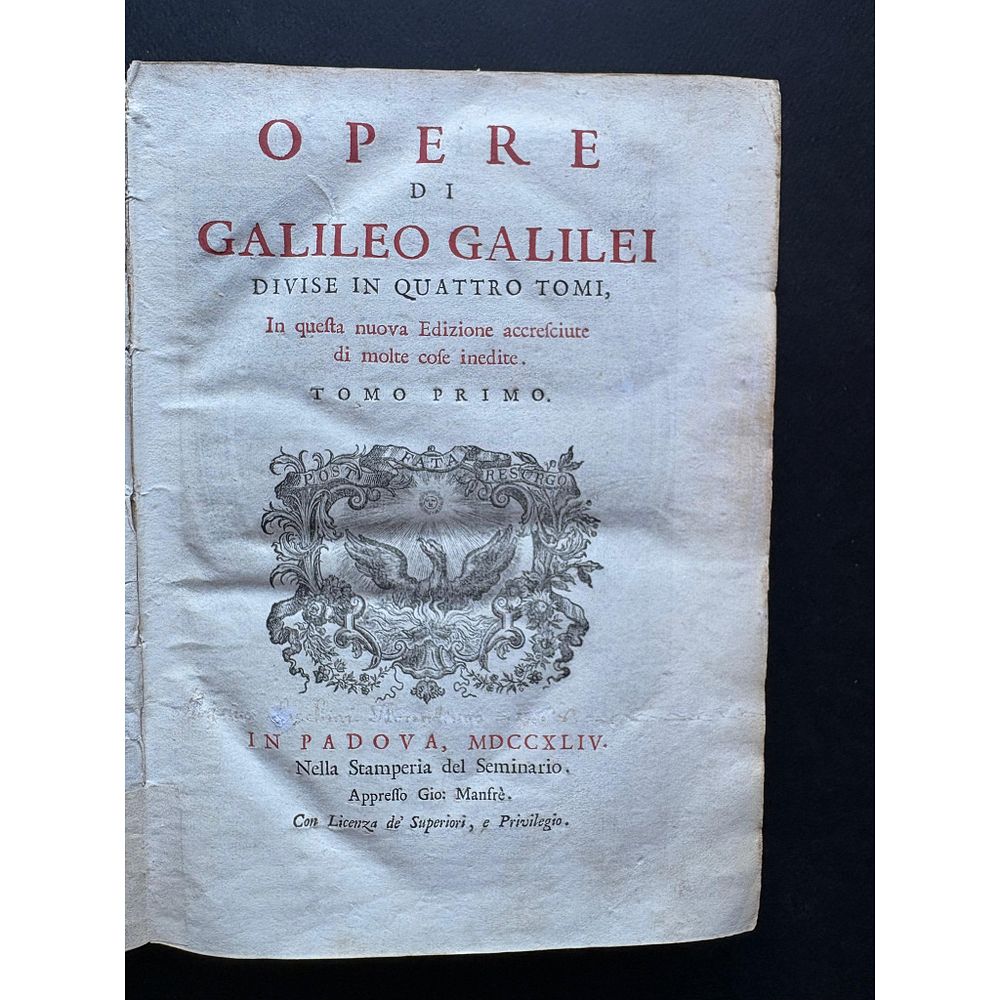
[ASTRONOMY, MATHEMATICS & PHYSICS] - GALILEI, Galileo (1564–1642) - Opere di Galileo Galilei - ***Note: This lot is located in Italy and requires an Italian export licence. We will manage the full application process for you. An additional fee of £50 applies.*** GALILEI, Galileo (1564–1642). Opere di Galileo Galilei divise in quattro tomi. Padua: nella Stamperia del Seminario, appresso Gio. Manfrè, 1744. IMPORTANT EIGHTEENTH-CENTURY COLLECTED EDITION OF GALILEO’S WORKS, CONTAINING HIS PRINCIPAL WRITINGS ON ASTRONOMY, MECHANICS, MATHEMATICS AND THE NEW SCIENCE, IN AN ATTRACTIVE CONTEMPORARY VELLUM SET. 4to (243 × 178 mm). 4 volumes bound in 3. Vol. I: [8], 601, [1] pp.; Vol. II: [4], 364 pp.; Vol. III: [4], 486 pp.; Vol. IV: [8], 442, [2] pp. Title-pages printed in red and black with the woodcut device of the Phoenix rising from the flames; engraved portrait of Galileo by Zucchi; one folding engraved plate depicting the proportional compass; numerous woodcut diagrams and illustrations in the text, several full-page. Contemporary full vellum, marbled edges. A few insignificant marginal repairs; otherwise a fresh, wide-margined and particularly pleasing copy. ONE OF THE MOST IMPORTANT EARLY COLLECTED EDITIONS OF GALILEO, published at Padua just over a century after his death and bringing together the writings through which he transformed astronomy, mechanics and the mathematical study of nature. The edition contains the works that established Galileo as one of the central figures of the Scientific Revolution: his investigations of motion and mechanics, his astronomical observations, his mathematical writings and his celebrated defence of a new conception of the physical universe. GALILEO AND THE BIRTH OF MODERN SCIENCE Few authors altered the course of European science as profoundly as Galileo. Through observation, experiment and mathematical analysis he challenged the inherited Aristotelian conception of nature and helped establish a new scientific method in which physical phenomena could be subjected to measurement and mathematical demonstration. His telescopic discoveries — including the satellites of Jupiter, the phases of Venus and observations of the lunar surface — provided some of the most compelling evidence against the traditional cosmological system. At the same time, his studies of falling bodies and accelerated motion laid essential foundations for modern mechanics. The collected Opere therefore document not merely the work of a great individual scientist, but one of the decisive transformations in the intellectual history of Europe. THE PADUA EDITION OF 1744 The present edition was printed by the celebrated Stamperia del Seminario at Padua, an important centre of scholarly and scientific publishing. Issued in four volumes, it represents one of the major eighteenth-century attempts to preserve and disseminate Galileo’s scientific legacy. By the middle of the eighteenth century Galileo had become an emblematic figure in the history of the new science, and editions such as the present one played an important role in transmitting his writings to a wider European readership. The portrait engraved by Zucchi, the folding plate of the proportional compass and the numerous scientific diagrams give the edition considerable visual appeal and reflect the strongly practical and mathematical character of Galileo’s work. THE PROPORTIONAL COMPASS The folding plate illustrating Galileo’s proportional compass is of particular interest. Developed in the closing years of the sixteenth century, Galileo’s geometrical and military compass was a sophisticated calculating instrument designed for use in geometry, surveying, gunnery and practical mathematics. It is one of the clearest examples of Galileo’s ability to unite abstract mathematical reasoning with practical mechanical invention. The inclusion of the instrument within the collected works underlines the breadth of Galileo’s achievement, extending from celestial observation to the construction of mathematical instruments and the foundations of mechanics. AN ATTRACTIVE CONTEMPORARY SET Complete sets of Galileo’s collected works are particularly desirable when preserved, as here, in contemporary bindings and with generous margins. The present copy, bound in contemporary full vellum with marbled edges, retains the sober appearance characteristic of eighteenth-century Italian scholarly libraries. Its freshness and wide margins further enhance the appeal of a substantial edition intended for sustained scientific study. AN IMPORTANT AND HANDSOME EIGHTEENTH-CENTURY EDITION OF THE WORKS OF ONE OF THE FOUNDERS OF MODERN SCIENCE, PRESERVED IN CONTEMPORARY VELLUM AND COMPLETE WITH THE ENGRAVED PORTRAIT, FOLDING PLATE OF GALILEO’S COMPASS AND NUMEROUS SCIENTIFIC ILLUSTRATIONS.