Bidspirit auction | [ASTRONOMY, MATHEMATICS & PHYSICS ]
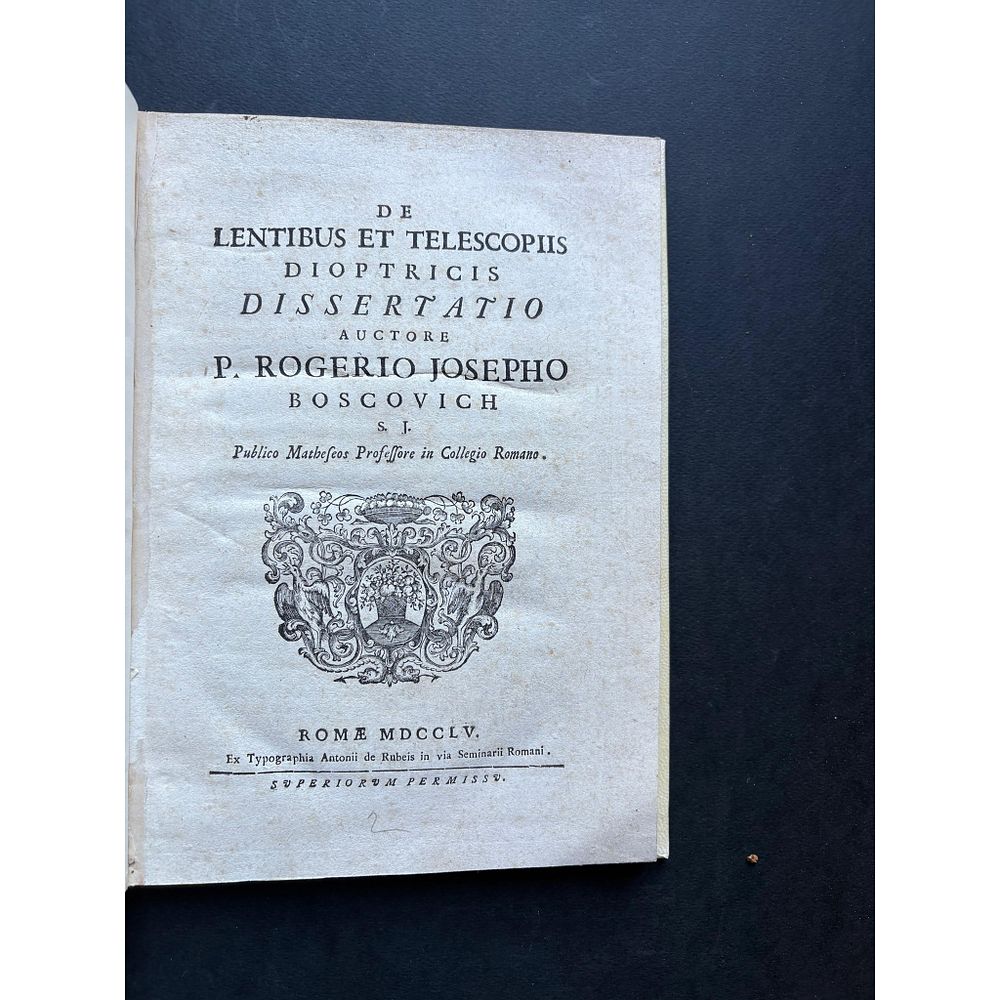
[ASTRONOMY, MATHEMATICS & PHYSICS ] - BOSCOVICH, Roger Joseph (1711–1787) - De lentibus et telescopiis - BOSCOVICH, Roger Joseph (1711–1787). De lentibus et telescopiis dioptricis dissertatio. Rome: Antonio de Rubeis, 1755. 4to (270 × 195 mm). 58 pp., [1] leaf of errata. With one large folding engraved plate illustrating optical and geometrical constructions. Twentieth-century vellum. A fine, exceptionally fresh and complete copy, with the large folding plate present. First edition, author-title issue. An important and uncommon work by Roger Joseph Boscovich devoted to the mathematical and practical theory of lenses and dioptric telescopes, and one of his principal contributions to eighteenth-century optics. In this dissertation Boscovich investigates the geometrical construction of lenses, refraction, the optical properties of glass and the design of telescopic systems. Particular attention is given to the problem of obtaining the most effective refraction for astronomical observation and to the mathematical relationships governing combinations of lenses. The work reflects Boscovich’s characteristic ability to move between abstract mathematical analysis and practical instrument design. He was deeply interested in the improvement of astronomical instruments and understood that advances in refracting telescopes depended upon a more precise knowledge of the optical behaviour of different glasses and of the geometrical conditions governing their combination. Newtonian optical theory is repeatedly engaged throughout the dissertation. Boscovich belonged to the first generation of major Continental scientists to assimilate and develop Newtonian mechanics and optics, while preserving an unusually independent approach to problems of matter, force and physical theory. The De lentibus forms part of the exceptionally fertile period preceding Boscovich’s great Theoria philosophiae naturalis of 1758, in which his conception of matter as point-like centres governed by attractive and repulsive forces received its mature formulation. His theoretical interest in optics was accompanied by direct involvement in observational astronomy and scientific instrumentation. A decade later, Boscovich designed the new observational tower of the Brera Observatory in Milan, completed in 1765 and subsequently praised by Lalande as a model for a modern astronomical observatory. The bibliographical history of the 1755 edition is particularly interesting. The dissertation circulated in more than one title-page state. Copies associated with its public presentation at the Seminario Romano name Boscovich’s pupil Luigi Leonori, while another state, as in the present copy, explicitly identifies Roger Joseph Boscovich as author. The internal sheets belong to the same original publication history, with certain alterations made during the course of issue.The present example, bearing Boscovich’s name and preserving the folding optical plate and errata leaf, is an especially attractive representative of this important dissertation.A fine and complete copy of a significant work in the history of eighteenth-century optics, demonstrating Boscovich’s remarkable combination of mathematics, experimental science and astronomical instrument design.