Bidspirit auction | [ASTRONOMY, MATHEMATICS & PHYSICS] -
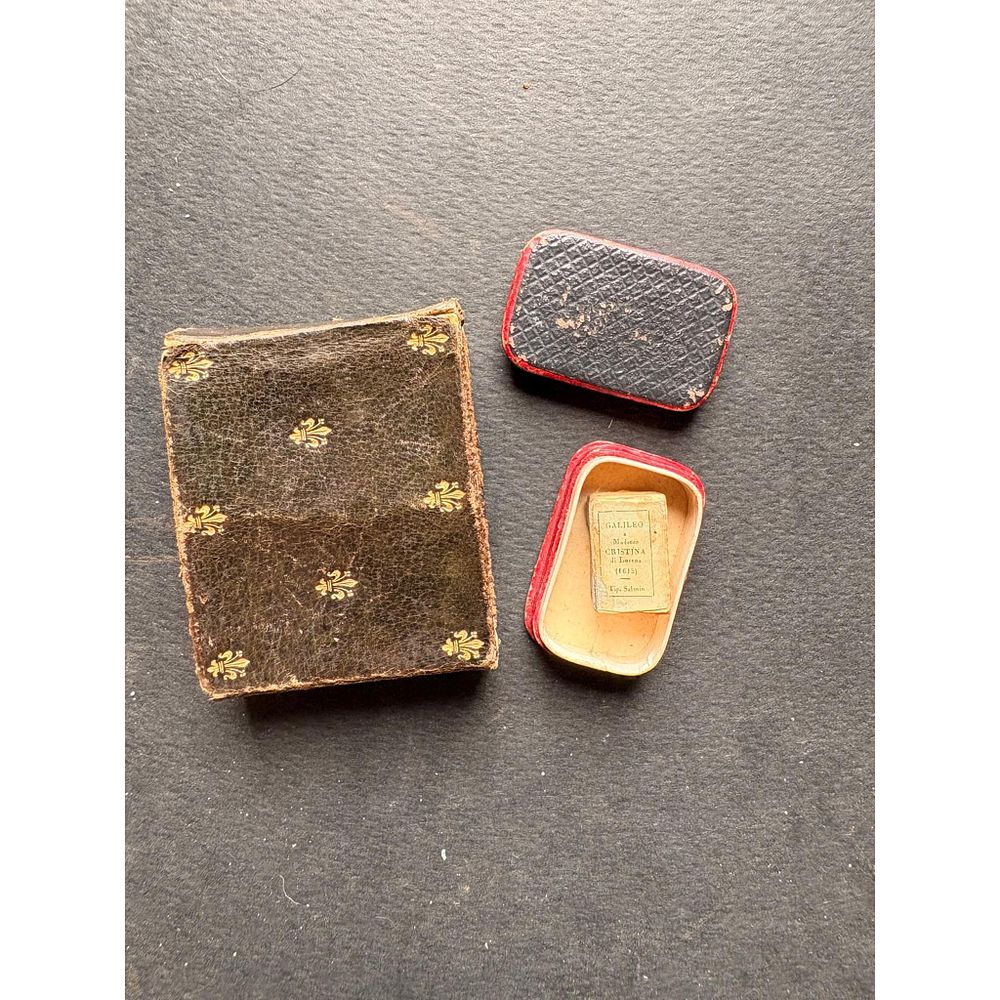
[ASTRONOMY, MATHEMATICS & PHYSICS] - GALILEI, Galileo (1564–1642) - Lettera a Madama Cristina di Lorena - GALILEI, Galileo (1564–1642) Galileo a Madama Cristina di Lorena (1615). Padua: Tipografia Fratelli Salmin, 1896 [i.e. May 1897]. 17 x 11 mm; 205, [4] pp. (each page comprising nine lines, no line exceeding three words). Engraved portrait of Galileo to the title-page. Original publisher's binding in plain card boards, lettered to the front cover and spine; housed in its small original card slipcase covered in red. This case is in turn preserved within a further, larger nineteenth-century case, its dark covering tooled in gilt with a repeating pattern of fleurs-de-lis. ONE OF THE SMALLEST BOOKS EVER PRINTED FROM MOVABLE TYPE, A TRUE MASTERPIECE OF NINETEENTH-CENTURY MICRO-TYPOGRAPHY, CONTAINING GALILEO'S CELEBRATED LETTER ON THE RELATIONSHIP BETWEEN SCIENCE AND FAITH. Published by the Salmin Brothers of Padua in 1896 (with a colophon dating its completion to May 1897), this miniature edition of the Letter to Madama Cristina di Lorena — the famous text of 1615 in which Galileo argues for the compatibility of scriptural and natural truth, insisting that the book of nature ought not to be read through the text of the Bible — is set entirely in the legendary ”fly's eye” type, engraved in 1834 by Antonio Farina of Piacenza and already used by the Salmin firm in 1878 for their celebrated miniature edition of the Divine Comedy (the ”Dantino”). The type, a mere 2 points in size, was reputedly so minute as to damage the eyesight of the compositors who set it. Long regarded as the smallest book in the world printed from movable type, the edition remains one of the most celebrated and sought-after items in the field of miniature books, cited by Spielmann (Catalogue of the Library of Miniature Books, no. 161) as one of the best-known and most popular miniature books in existence, and by Welsh (A Bibliography of Miniature Books, no. 2935). The book survives in excellent condition, its original card binding intact, preserved in its original red slipcase, which is itself housed within a larger nineteenth-century case, its covering tooled in gilt with a repeating fleur-de-lis pattern — evidently a period protective case made specifically for this celebrated miniature. A rarity of miniature printing, uniting one of Galileo's most significant texts on the dialogue between science and faith with the most extraordinary technical feat of nineteenth-century Italian micro-typography.