Bidspirit auction | [MEDICINE & PHARMACY ] -
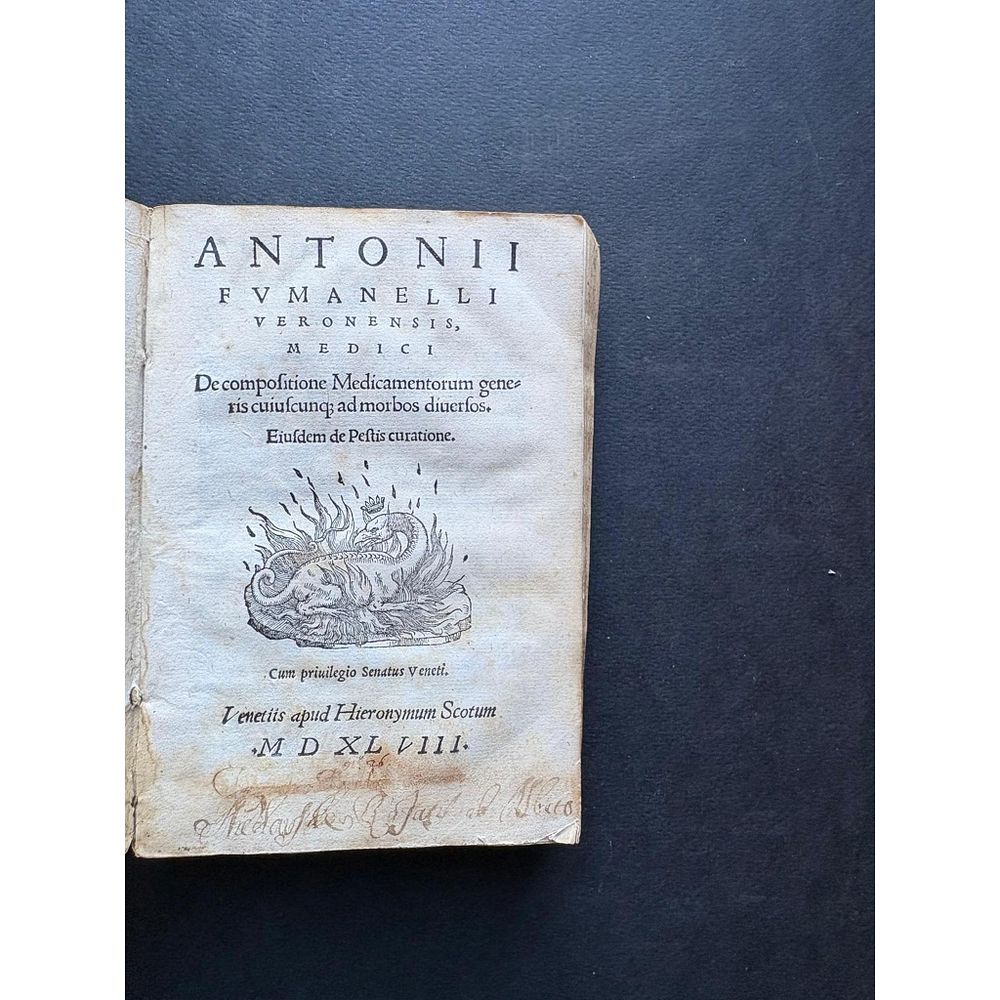
[MEDICINE & PHARMACY ] - FUMANELLI, Antonio (fl. first half of the 16th century) - De compositione medicamentorum - ***Note: This lot is located in Italy and requires an Italian export licence. We will manage the full application process for you. An additional fee of £50 applies.*** FUMANELLI, Antonio (fl. first half of the 16th century) De compositione medicamentorum generis cuiuscunque ad morbos diversos. Eiusdem de pestis curatione. Venice: Girolamo Scoto, 1548. 8vo. [16], 326 pp, [2] Woodcut printer’s device, ornamental initials and typographical ornaments. Slightly browned throughout, otherwise a fresh and attractive copy. Contemporary limp vellum, manuscript title to spine. Contemporary ownership inscription on title-page. AN IMPORTANT RENAISSANCE TREATISE ON THE PREPARATION OF MEDICINES, PHARMACEUTICAL PRACTICE AND THE TREATMENT OF PLAGUE, BY THE CELEBRATED VERONESE PHYSICIAN ANTONIO FUMANELLI. Published at Venice in 1548, Fumanelli’s De compositione medicamentorum is a remarkably practical medical and pharmaceutical compendium, devoted to the preparation and application of remedies for a wide range of diseases and bodily conditions. Fumanelli was a prominent physician of Verona, remembered by Vasari among the distinguished medical figures of the city. His writings circulated widely during the sixteenth century and were subsequently gathered into collected editions, including the substantial Opera medica published at Zurich in 1557. The present work is particularly valuable for the directness with which it records the pharmaceutical practice of the Renaissance. Rather than confining himself to theoretical medicine, Fumanelli gives detailed instructions for the preparation of waters, oils, balsams, powders, ointments, pills, decoctions and other compound medicines, frequently specifying ingredients, quantities and modes of preparation. The range of remedies is exceptionally broad. The text discusses preparations for disorders of the head, ears, skin and internal organs, together with treatments for wounds, ulcers and other ailments. Among the subjects encountered are remedies for hair and scalp conditions, vertigo and digestive complaints, as well as numerous pharmaceutical preparations based upon herbs, oils, resins, minerals and distilled substances. Of particular interest is Fumanelli’s attention to distillation, a technique of increasing importance in sixteenth-century pharmacy. One section explicitly discusses the ars destillandi, while numerous recipes employ distilled waters, aromatic substances and preparations produced through techniques associated with the apothecary’s workshop. Bound with the principal treatise is Fumanelli’s De pestis curatione, devoted specifically to the treatment of plague. Here the author considers medicinal preparations intended both to resist infection and to treat those already affected, including powders, electuaries and other compound remedies. The inclusion of this section gives the volume particular importance as a document of sixteenth-century responses to epidemic disease. The book therefore stands at the intersection of Renaissance medicine, pharmacy and practical materia medica, preserving the working knowledge of a physician deeply concerned with the preparation and administration of medicines rather than with medical theory alone. Fumanelli’s reputation was considerable in his own century. His medical writings were later collected and repeatedly reprinted, while contemporary and later sources remembered him as one of the notable physicians of Verona. The present copy is particularly attractive in its contemporary limp-vellum binding, retaining the manuscript title on the spine and a contemporary ownership inscription on the title-page. Despite some light overall browning, it remains a fresh and appealing example of an early Renaissance pharmaceutical manual. A HANDSOME COPY IN CONTEMPORARY VELLUM OF AN IMPORTANT SIXTEENTH-CENTURY WORK ON THE COMPOSITION OF MEDICINES, PRACTICAL PHARMACY AND THE TREATMENT OF PLAGUE.