Bidspirit auction | [MEDICINE & PHARMACY ] -
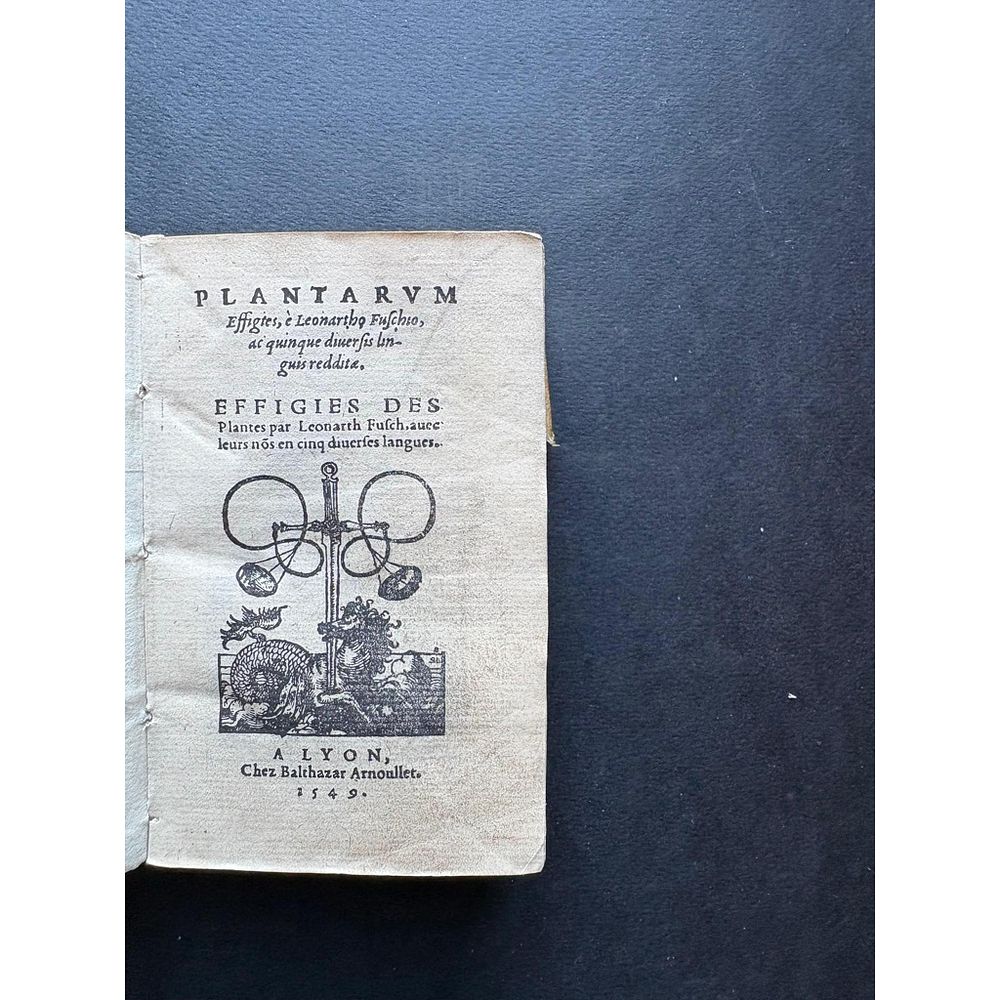
[MEDICINE & PHARMACY ] - FUCHS, Leonhart (1501–1566) - Plantarum effigies - FUCHS, Leonhart (1501–1566). Plantarum effigies, e Leonartho Fuschio, ac quinque diversis linguis redditae. Effigies des plantes par Leonarth Fusch, avec leurs noms en cinq diverses langues. Lyon, Balthazar Arnoullet, 1549. FIRST EDITION UNDER THIS TITLE — A REMARKABLE POCKET-SIZED SIXTEENTH-CENTURY BOTANICAL FIELD GUIDE, ILLUSTRATED WITH OVER FIVE HUNDRED WOODCUTS AND DESIGNED FOR THE PRACTICAL IDENTIFICATION OF PLANTS. 16mo (125 × 78 mm). [24], 516, [4] pp. Printer’s woodcut device on title-page; woodcut portrait of Leonhart Fuchs on the verso of the title and 516 nearly full-page botanical woodcuts by Clément Boussy, the names of the plants given in Greek, Latin, French, Italian and German. Lacking only the two blank leaves B4 and kk4. Contemporary overlapping vellum, traces of two original ties, traces of an early manuscript title to spine; small defects. Stamp on verso of final printed leaf. A remarkably fresh copy, the botanical woodcuts generally clean and strongly printed. FIRST EDITION UNDER THIS TITLE, and the second appearance of this celebrated series of small botanical woodcuts, first employed by Balthazar Arnoullet in his Lyon edition of Fuchs’s De historia stirpium of the same year. The Plantarum effigies represents a fascinating transformation of one of the great monuments of Renaissance botany. Leonhart Fuchs’s monumental De historia stirpium had established a new standard for the accurate visual representation of plants; in the present edition, its botanical imagery was reduced to a compact, portable format, dispensing with the lengthy descriptive text and concentrating instead upon the image and the multilingual identification of each species. The result was effectively an early botanical field guide. Each plant is represented by a clear woodcut, accompanied by its names in as many as five languages. This multilingual system gave the book an unusually practical character, allowing physicians, apothecaries, herbalists, students and travellers to connect the terminology used in classical botanical literature with contemporary vernacular plant names across Europe. The extraordinarily small format was fundamental to its purpose. Unlike the imposing folio herbals intended principally for consultation in libraries, studies and apothecaries’ shops, the Plantarum effigies could readily be carried into gardens and the countryside and consulted directly before the living specimen. Its almost text-free arrangement made visual comparison immediate. The woodcuts were executed by Clément Boussy for Arnoullet’s Lyon publications of Fuchs. Despite their drastic reduction in size from the monumental tradition of the great Renaissance herbals, they retain remarkable botanical clarity and constitute an impressive achievement of sixteenth-century scientific book illustration. The volume also preserves on the verso of the title-page the characteristic woodcut portrait of Leonhart Fuchs, one of the fathers of Renaissance botany and among the scholars most responsible for establishing direct observation and accurate illustration as essential elements in the study of plants. The two absent leaves, B4 and kk4, are blanks, and their absence therefore entails no loss whatsoever of text or botanical illustration. A VERY FRESH AND HIGHLY ATTRACTIVE COPY IN ITS CONTEMPORARY VELLUM BINDING OF THIS RARE AND INGENIOUS MINIATURE HERBAL — ONE OF THE EARLIEST PRACTICAL PORTABLE GUIDES TO PLANT IDENTIFICATION AND A CHARMING SIXTEENTH-CENTURY DISTILLATION OF FUCHS’S GREAT BOTANICAL WORK. Hunt 62; Meyer 98; Mortimer, Harvard French 16th Century Books, 241; Baudrier X, 122.