Bidspirit auction | [MEDICINE & PHARMACY ] -
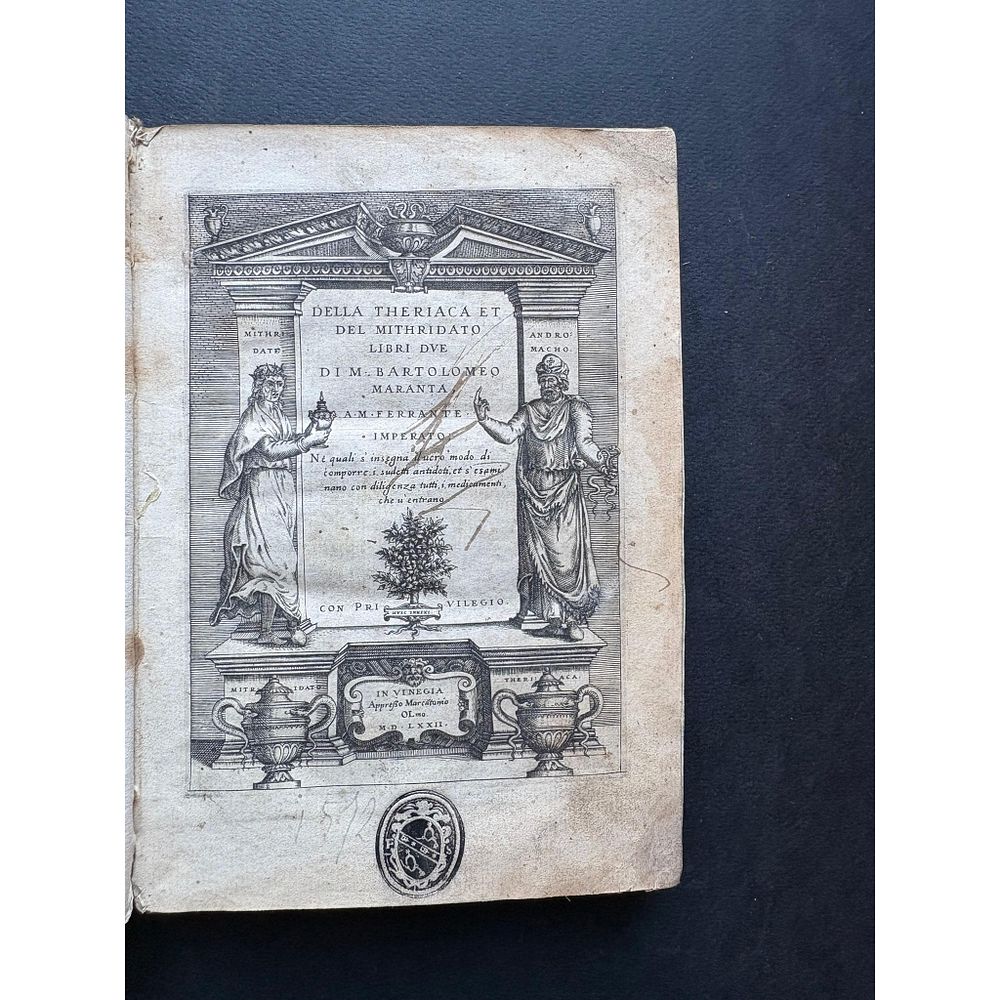
[MEDICINE & PHARMACY ] - MARANTA, Bartolomeo (1500–1571) - Della theriaca et del mithridato - ***Note: This lot is located in Italy and requires an Italian export licence. We will manage the full application process for you. An additional fee of £50 applies.*** MARANTA, Bartolomeo (1500–1571) Della theriaca et del mithridato libri due, ne’ quali s’insegna il vero modo di comporre i sudetti antidoti, et s’esaminano con diligenza tutti i medicamenti che v’entrano. Venice: Marc’Antonio Olmo, 1572. 4to (197 × 140 mm). [8] leaves, 280 pp., [14] leaves. Engraved architectural title-page, woodcut ornaments and initials. Seventeenth-century full vellum, blue edges. Private ownership stamp on title-page. Some general browning, but overall a particularly attractive, fresh and genuine copy. FIRST EDITION, PUBLISHED POSTHUMOUSLY, OF ONE OF THE MOST IMPORTANT RENAISSANCE ITALIAN TREATISES ON THERIAC, MITHRIDATE AND THE PRACTICAL COMPOUNDING OF COMPLEX ANTIDOTES. Bartolomeo Maranta’s final major work is devoted to the two most celebrated compound antidotes inherited from classical medicine: theriac and mithridate, remedies whose origins were traditionally associated with Mithridates VI of Pontus and the physician Andromachus and which, by the Renaissance, had acquired an almost legendary reputation as universal antidotes against poisons and a wide range of diseases. The work is divided into two books and examines in detail not merely the supposed therapeutic virtues of these preparations but, more importantly, the correct identification, selection, proportions and preparation of the numerous medicinal substances entering into their composition. Its importance lies precisely in this practical and experimental character. Maranta was one of the leading Italian naturalists and physicians of his generation and had studied botany within the circle of Luca Ghini, one of the founding figures of Renaissance scientific botany. His investigations into medicinal plants and materia medica brought him into close contact with physicians, botanists and apothecaries concerned with the accurate identification of the semplici described by the classical authorities. The Della theriaca et del mithridato, however, was the product of a particularly significant collaboration with the Neapolitan apothecary and naturalist Ferrante Imperato, later famous for his Dell’Historia Naturale and for the extraordinary natural-history collection or Wunderkammer that he assembled in Naples. Maranta dedicated the work to Imperato, and contemporary and modern scholarship recognise that the book grew from their joint theoretical and experimental investigations. In Imperato’s laboratory and natural-history collection the two men repeatedly examined ingredients, proportions and methods of preparation, attempting to determine in practical terms how the ancient recipes should be reconstructed. The work had been completed by October 1570 and appeared posthumously in Venice in 1572. This combination of philological scholarship and direct pharmaceutical experiment is particularly significant. Where ancient medical texts were obscure or incomplete, Maranta attempted to establish their meaning through critical comparison; where the problem concerned preparation, quantities or the behaviour of ingredients, practical experimentation became essential. Theriac was among the most elaborate medicines of early modern pharmacy, a complex polypharmaceutical involving numerous botanical and other ingredients. Its preparation was not merely medical but also a matter of civic and professional prestige, frequently supervised by physicians and guild authorities and sometimes performed publicly by apothecaries. Maranta examines the individual substances entering into the antidotes with considerable attention to their authenticity, quality and properties. The book therefore constitutes an important source not only for the history of medicine but also for the history of Renaissance pharmacy, pharmacognosy and materia medica. The relationship between physician and apothecary reflected in the book is particularly noteworthy. Imperato belonged to the Neapolitan body responsible for supervising apothecaries and the preparation of especially delicate compound medicines. The collaboration between the learned physician Maranta and the practical speziale Imperato consequently represents an important episode in the gradual convergence of theoretical natural history and experimental pharmaceutical practice. The book quickly achieved an international reputation. Only four years after the present Italian first edition, Joachim Camerarius translated it into Latin, publishing the Libri duo de Theriaca et Mithridato at Frankfurt in 1576 and thereby making Maranta’s investigations accessible to the wider European medical community. Its conclusions also provoked controversy, particularly concerning the identification of ingredients,