Bidspirit auction | [MEDICINE & PHARMACY ] -
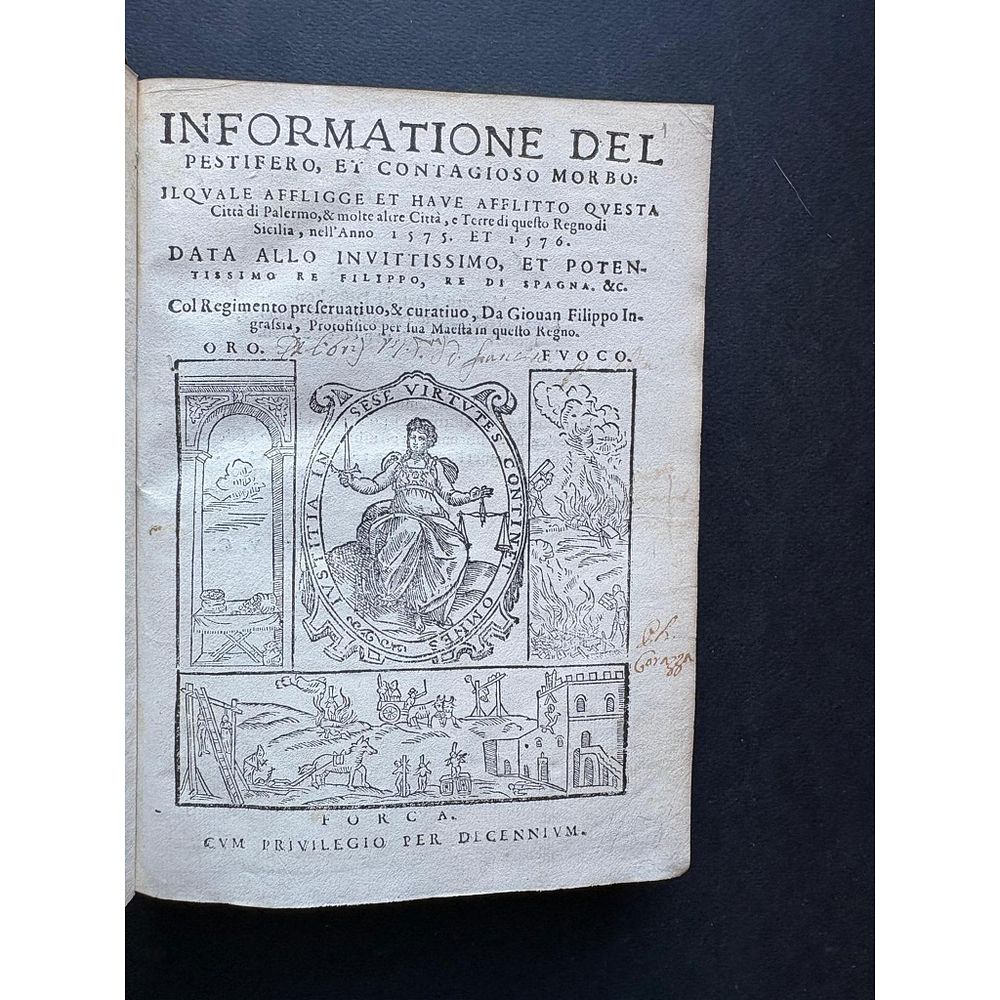
[MEDICINE & PHARMACY ] - INGRASSIA, Giovanni Filippo (1510–1580) - Informatione del pestifero - ***Note: This lot is located in Italy and requires an Italian export licence. We will manage the full application process for you. An additional fee of £50 applies.*** INGRASSIA, Giovanni Filippo (1510–1580). Informatione del pestifero, et contagioso morbo, il quale affligge et ha afflitto questa città di Palermo, & molte altre città e terre di questo Regno di Sicilia, nell’anno 1575 et 1576. Palermo: Giovanni Matteo Mayda, 1576. 4to (210 × 146 mm). [8], 312, [32], 205, [15] pp. Title-page with striking woodcut illustration relating to remedies against the plague, repeated at the beginning of the second part; engraved frontispiece showing Ingrassia presenting his work to Philip II of Spain; two engraved plates illustrating the plague hospital at Palermo and sanitary procedures connected with contaminated linen. Woodcut initials and ornaments. Modern hazelnut morocco, gilt title to spine. Repairs to title-page and final leaves, small wormholes to title, occasional browning and other minor defects; small loss at upper headcap. First edition. An important first edition of one of the major sixteenth-century works on plague and epidemic control, written by Giovanni Filippo Ingrassia, Protomedicus of Sicily, during and immediately after the devastating outbreak that struck Palermo in 1575–1576. Ingrassia was one of the leading physicians and anatomists of Renaissance Italy. Trained at Padua within the great anatomical tradition associated with Vesalius, he later taught medicine and anatomy at Naples before being appointed Protomedicus of Sicily. He combined anatomical research with an unusually strong concern for public health, hospital administration and the regulation of medical practice. The Informatione is exceptional because it is both a medical treatise and the first-hand record of a physician directly responsible for managing a major urban epidemic. Unlike many earlier plague books primarily concerned with individual remedies, Ingrassia devotes a substantial part of the work to the organization of the city itself. He discusses quarantine, the segregation of suspected cases, confirmed patients and convalescents, the establishment and administration of hospitals and lazarets, the purification of houses and possessions, the regulation of movement and trade, and the responsibilities of civic authorities. The work thus marks an important development in the history of epidemic medicine: disease is treated not merely as a problem affecting individual patients, but as a crisis requiring coordinated intervention by physicians, magistrates and public institutions. Ingrassia’s system was remarkably systematic. Suspected cases, the infected and recovering patients were to be separated into distinct institutions; contaminated houses were disinfected; clothing and other objects were subjected to cleansing and heat; and the movement of people and potentially infected goods was tightly controlled. Modern historians of medicine have consequently regarded his response to the Sicilian plague as an important early example of organized epidemic containment. The numerous practical details give the work exceptional documentary value. Ingrassia records the progress of the outbreak, mortality, administrative decisions and the organization of Palermo’s sanitary infrastructure, providing a vivid picture of how a major Mediterranean city confronted epidemic disease in the late sixteenth century. The illustrations are of particular importance. The two engraved views relating to Palermo’s plague hospitals and sanitary arrangements are rare visual records of early modern epidemic infrastructure, while the engraved presentation plate explicitly places the work under the patronage of Philip II of Spain, ruler of Sicily. The Informatione also reflects Ingrassia’s broader scientific formation. A distinguished anatomist, he was associated with the Paduan school of medicine and is remembered for important anatomical observations, including the early description of the stapes of the middle ear. His experience as Protomedicus enabled him to combine learned medicine with direct administrative action on an exceptional scale. The result is one of the most substantial Renaissance accounts of epidemic disease: at once a medical treatise, a public-health manual, an administrative chronicle and an eyewitness history of the plague of Palermo. A rare and important first edition of a landmark work in the history of plague, quarantine and organized public health, illustrated with remarkable contemporary representations of the sanitary response to the Sicilian epidemic of 1575–1576.