Bidspirit auction | [MEDICINE & PHARMACY ] -
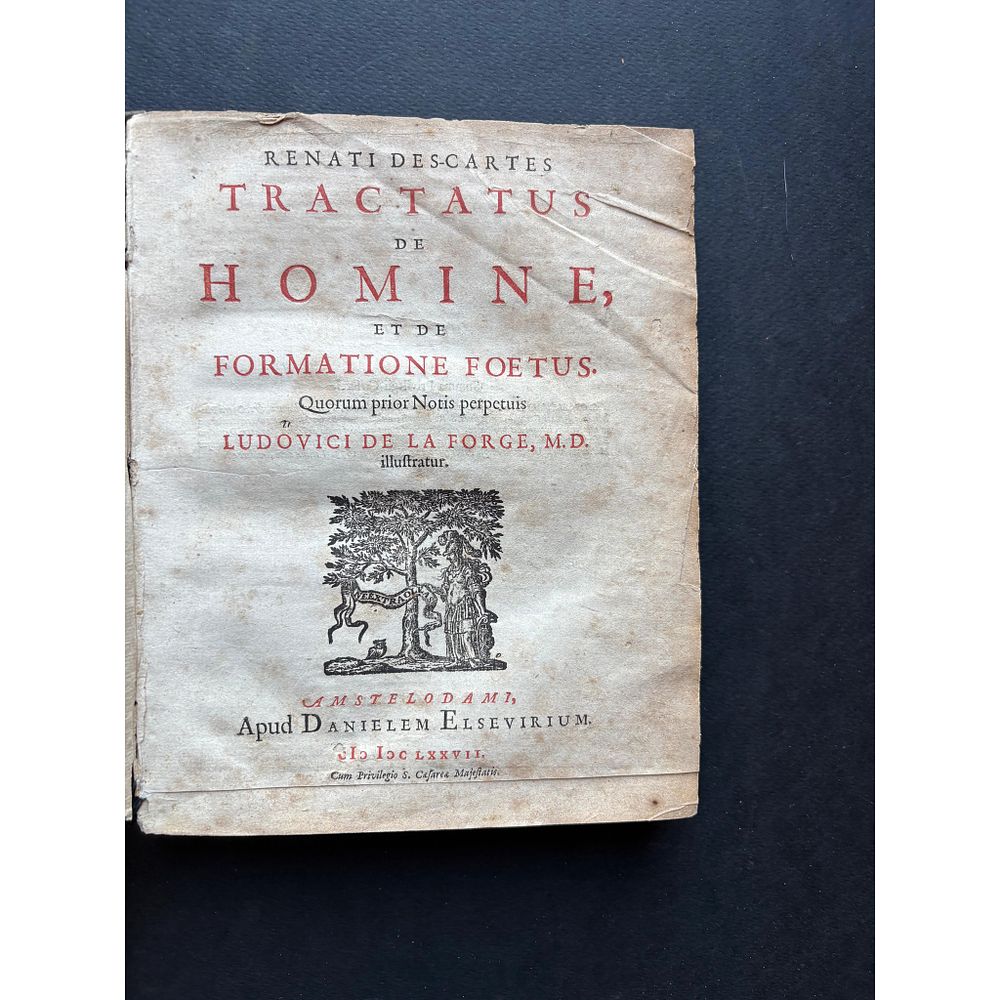
[MEDICINE & PHARMACY ] - DESCARTES, René (1596–1650) - Tractatus de homine et de formatione foetus - DESCARTES, René (1596–1650) Renati Des-Cartes Tractatus de homine, et de formatione foetus. Quorum prior notis perpetuis Ludovici de La Forge, M.D. illustratur. Amstelodami: apud Danielem Elsevirium, 1677. 4to (200 x 155 mm), [76], 239, [1] pp. Title-page printed in red and black with the Elzevir (Minerva) device. Over fifty woodcut and copper-engraved illustrations in the text, devoted to cerebral and ocular anatomy, the nervous system and the circulation of the blood. Contemporary full limp vellum, manuscript title to spine. AN IMPORTANT ELZEVIR EDITION OF DESCARTES' TRACTATUS DE HOMINE, WITH LOUIS DE LA FORGE'S EXTENSIVE COMMENTARY, PRESENTING WHAT IS WIDELY REGARDED AS THE FIRST EUROPEAN TREATISE OF PHYSIOLOGY IN ITS DEFINITIVE LATIN TEXT. Composed by Descartes in the 1630s but withheld from publication in his lifetime for fear of ecclesiastical censure, the Traité de l'homme extends his mechanistic philosophy to the human body itself, conceived as a complex hydraulic machine governed by physical law rather than occult principle. First printed only posthumously, the work reached a wider and more accurate Latin readership through this Elzevir printing, in which the physician Louis de La Forge's perpetual commentary clarifies and expands upon Descartes' most difficult passages, in particular those concerning the generation of the foetus and the function of the pineal gland — the organ through which Descartes located the interaction of soul and body. The rich cycle of woodcut and engraved illustrations, tracing the anatomy of the brain, eye, nerves and blood vessels, remains among the most celebrated iconographic apparatus of any seventeenth-century scientific text, and did much to carry Descartes' physiological model throughout Europe. The volume is fresh and well preserved, with the light, even oxidation spotting typical of north-European paper stocks of the later seventeenth century. The title-page, printed in the fine red-and-black Elzevir bichromy, shows an early, carefully executed excision to the blank lower margin (c. 1 cm), evidently carried out to remove a manuscript ownership inscription; ink offset surviving by capillary action on the rear flyleaf attests to the original extent of the inscription. The excision is clean and confined entirely to the blank margin, leaving both text and printer's device untouched. References: Willems, 1531; Krivatsy, 3121; Wellcome II, p. 453. A handsomely bound and well-preserved copy of one of the foundational texts of modern physiology, in the edition that fixed its standard Latin form for the learned world of the later seventeenth century.