Bidspirit auction | [MEDICINE & PHARMACY ] -
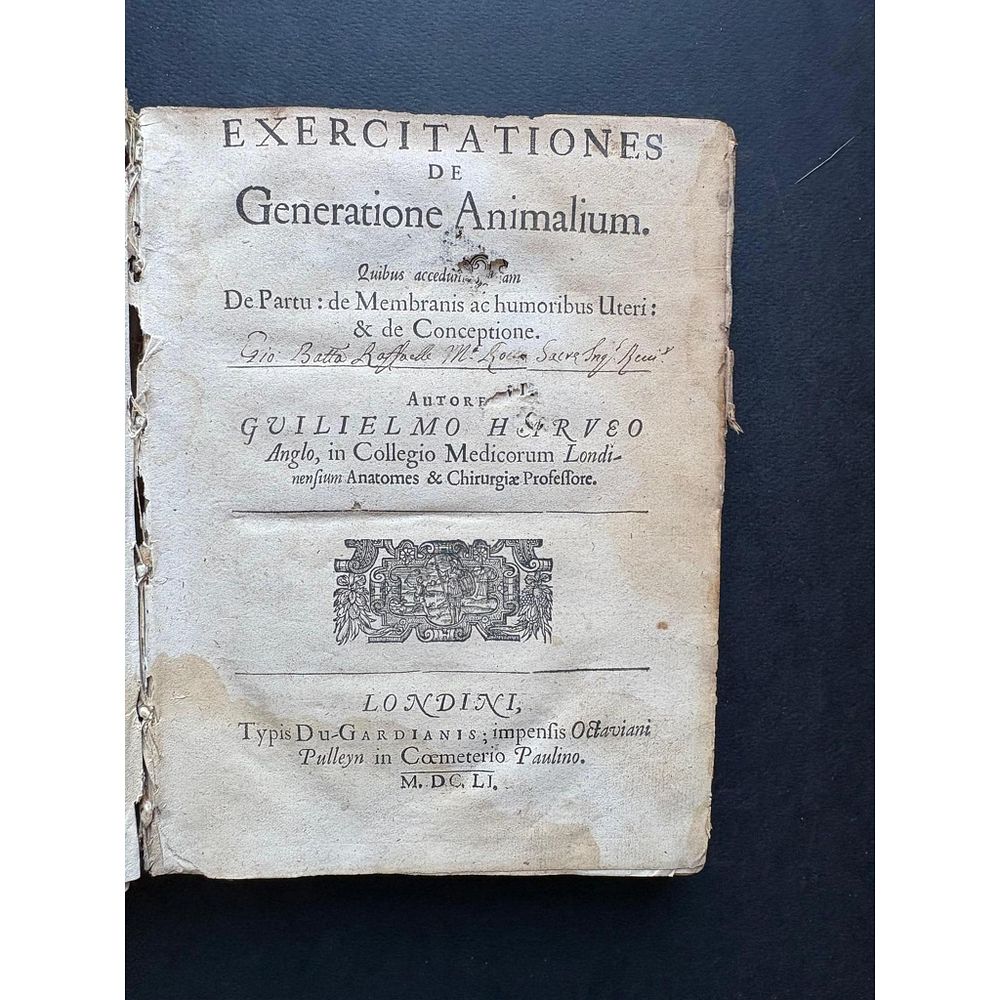
[MEDICINE & PHARMACY ] - HARVEY, William (1578–1657) - Exercitationes de generatione animalium - HARVEY, William (1578–1657). Exercitationes de generatione animalium. Quibus accedunt quaedam De partu: de membranis ac humoribus uteri: & de conceptione. London: printed by Du-Gardianis for Octavian Pulleyn, 1651. 4to (215 × 162 mm). [28], 301, [3] pp. Woodcut ornament on title, woodcut headpieces and initials. Contemporary vellum, manuscript title to spine, with minor losses and wear. Early ownership inscriptions. Lacking the first blank and the engraved frontispiece; printed title with some defects, browning and staining, small wormhole in the blank margin of a few final leaves. First edition. One of the great landmarks in the history of embryology and the second major scientific work of William Harvey, published more than twenty years after his revolutionary De motu cordis. Following his discovery of the circulation of the blood, Harvey devoted many years to the problem of animal generation. His investigations included the systematic observation of developing chick embryos and extensive anatomical studies of deer, particularly those kept in the royal parks. The Exercitationes de generatione animalium represents the mature result of these researches. Harvey rejected the idea that the embryo existed from the beginning as a fully formed miniature organism and instead defended an essentially epigenetic conception of development: the organs and structures of the animal emerge progressively during embryonic growth. Central to the work is Harvey’s celebrated conviction that generation begins from an egg. This principle was memorably expressed on the engraved frontispiece of the first edition by the motto “Ex ovo omnia” — “everything from the egg” — with Jupiter opening an egg from which living creatures emerge. The frontispiece is unfortunately lacking in the present copy. Although Harvey worked before the discovery of the mammalian ovum and without the benefit of modern microscopy, his observations marked a decisive advance in the study of reproduction. He treated embryological development as a dynamic process to be investigated through repeated observation and dissection rather than accepted solely on the authority of ancient authors. The work also contains important discussions of conception, pregnancy, the membranes and fluids of the uterus, and birth, extending Harvey’s enquiry from oviparous animals to mammals and human reproduction. The historical importance of the book has long been recognized. Norman observed that, even without Harvey’s discovery of the circulation of the blood, his work on generation would have secured him a place among the foremost biological investigators of his age. A major first edition in the history of biology and embryology, preserved in its contemporary vellum binding. Lacking the engraved “Ex ovo omnia” frontispiece and first blank, but otherwise complete in text; an important copy offered for its considerable scientific and bibliographical significance. References: Garrison-Morton 467; Norman 1011; Keynes 39; Wing H1091.